Astra (weapon)
In Hinduism, an astra (Sanskrit: अस्त्र; also romanized as asthra) was a supernatural weapon, presided over by a specific deity and imbued with spiritual and occult powers that caused its effect or impact. Later the word came to denote any weapon which was used by releasing it from one's hand (e.g. an arrow), as opposed to keeping it in one's hand (e.g. a sword). In the Ramayana and Mahabharata, Shri Rama had more astras than any other warrior. Various texts have stated that Parshuram possessed almost all astras except Trident.[1]
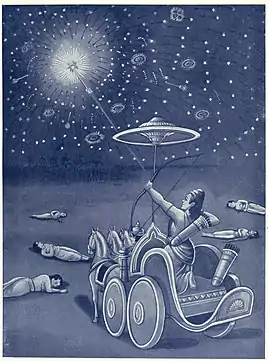
Summoning of Astra
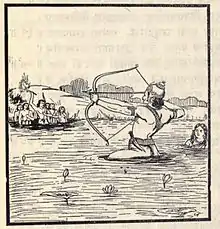
To summon or use an astra required use of a specific incantation or invocation. The deity invoked would then endow the weapon with supernatural powers, making it impossible to counter through regular means. Specific conditions existed involving the usage of astras, the violation of which could be fatal. Because of the power involved, the knowledge involving an astra was passed in the Guru-shishya tradition from a Guru (teacher) to a Shishya (pupil) by word of mouth alone, and only following the establishment of the student's character. Certain astras had to be handed down from the deity involved directly, knowledge of the incantation being insufficient.
Astras in Hindu Epics
Astras come into importance mainly in the Ramayana and Mahabharata, where they are used in the great battles described in each epic. They are depicted as used by archers such as Parashurama, Rama, Lakshman, Meghanada (Indrajit), Ravana, Bhishma, Drona, Karna, Ashwatthama, Arjuna and other warriors.
The divya ("divine")[3] astras were generally invoked into arrows, although they could potentially be used with anything. Ashwatthama invoked Brahmashirsha astra using a blade of grass as his weapon. Arjuna was capable of shooting all of his celestial weapons including Pashupatastra by the power of his mind alone.[4]
| Astra | Deity | Effect |
|---|---|---|
| Brahmastra | Brahma, the Creator | It would destroy entire armies at once and could also counter most other astras. In the epic Mahabharata, it is said that the weapon manifests with the head of Lord Brahma as its tip. In the Mahabharata era, Parasurama, Bhishma, Drona, Karna, Kripa, Ashwatthama, Arjuna, and in other eras several other Maharathis possessed the knowledge to invoke this weapon. It was the only weapon capable of piercing the Brahma Kavach; the invincible armor of Lord Brahma. Atikaya, one of Raavan's sons, possessed the invincible armor of Lord Brahma that could only be pierced by a Brahmastra and was killed by Lakshmana, brother of Lord Rama, using a Brahmastra. In ancient Sanskrit writings, the Brahmastra was a weapon created by Brahma, along with its more powerful versions: the Brahmashirsha Astra and the Brahmanda Astra. |
| Trishula | Shiva, the Destroyer | The Trident of Lord Shiva. The most powerful weapon in Hindu mythology, according to Shaiva traditions, infallible, cannot be stopped by anyone, except Lord Shiva himself and Goddess Shakti; the consort of Lord Shiva in Parvati form. However, it was once stopped by Atikaya, who caught hold of it in midair. |
| Sudarshana Chakra | Vishnu, the Preserver | The legendary discus of Lord Vishnu, was created for him by Vishvakarman.[5] The most powerful weapon in Hindu mythology, according to Vaishnav traditions, infallible, flies at the command of Lord Vishnu. It could be stopped only by Lord Vishnu's wish.[6][7] It has tremendous occult and spiritual power that could protect or destroy anything. It was used by Krishna, Vishnu's 8th avatar, to behead his cousin Shishupala.[8] |
| Barbarika's Teen Baan | Shiva, the Destroyer | Lord Shiva[9] gave Barbarika three infallible arrows (Teen Baan). A single arrow was enough to destroy all opponents in any war, and it would then return to Barbarika's quiver. The first arrow was used to mark all the things that Barbarika wants to destroy. On releasing the third arrow, it would destroy all the things that are marked and then would return to Barbarika's quiver. If Barbarika uses the second arrow, then the second arrow would mark all the things that Barbarika wants to save. On using the third arrow, it would destroy all the things that are not marked. In other words, with one arrow Barbarika could fix all his targets and with the other, he can destroy them. Barbarika came to be known by the appellation Teen Baandhaari, the "Bearer of the Three Arrows". Barbarika was the son of Ghatotkacha and the grandson of Bhima, second of the Pandava brothers, and Hidimbi. |
| Indrastra | Indra, God of Weather | It would bring about a 'shower' of arrows, like rain, from the sky. Arjuna displayed this astra first in Rangabhoomi.It was also possessed by some other warriors like Lakshman Meghanad Lord Rama etc. |
| Vasavi Shakti | Indra, God of Weather | The weapon gifted to Karna by Indra. It could be used only once and upon usage, it killed the opponent.Karna used it on Ghatotkacha and killed him. |
| Praswapastra | Vasus, Gods of Skies | This weapon would cause the afflicted to fall asleep on the battlefield. Bhishma was stopped by the Akashvani from using this weapon against his Guru, Lord Parashurama. In the Ramayana and Mahabharata, only Bhishma and Arjuna had this weapon. |
| Agneyastra | Agni, God of Fire | The weapon emitted flames inextinguishable through normal means. Arjuna used it against Angaraparna, the Gandharva. |
| Varunastra | Varuna, God of Water | The weapon released torrential volumes of water. This weapon is commonly mentioned as used to counter the Agneyastra. It was possessed by Rama, Indrajit, Ravana, Lakshman, Arjuna, Bhishma, Drona, likewise warriors. |
| Manavastra | Manu, Father of the Human Race | It could overcome supernatural protections and carry the target hundreds of miles away. It could inspire humane traits in an evil being. This weapon was used by Lord Rama on the rakshasa, Maricha. Arjuna also possessed this weapon. |
| Varunapasha | Varuna, God of Oceans | A powerful noose which not even other gods could escape from. Warriors including Rama, Indrajit, Arjuna possessed this weapon. |
| Bhaumastra | Bhūmi, Goddess of Earth | The weapon could create tunnels deep into the earth and summon jewels. Only Arjuna had this Astra. |
| Bhargavastra | Parashurama, an avatar of Lord Vishnu | Lord Parashurama was the creator of this Astra which he imparted to his disciple Karna. |
| Nagastra | The Nagas | The weapon would have an unerring aim and take on the form of a snake, proving deadly upon impact. It was used by many warriors. |
| Nagapasha | The Nagas | Upon impact, this weapon would bind the target in coils of living venomous snakes. In the Ramayana, it was used against Rama and Lakshmana by Indrajit. Arjuna obtained it from his wife Ulupi. |
| Garudastra | Garuda, the vehicle of Vishnu | A weapon that can defend against Nagastra when attacked by the opponents. It was possessed by Rama and Arjuna. It was used by Lord Rama in Ramayana.[10] |
| Anjalika Astra | Indra, God of Weather | Laxmana killed Indrajith using this weapon. It was possessed by Laxmana. In the Mahabharatha era it was the astra by which Arjuna killed Karna.[11] |
| Vayuvyastra | Vayu, God of Wind | Brings about a gale capable of lifting armies off the ground. On the 14th day of the Kurukshetra War, when the battle continued after the sunset Ashwatthama used this weapon to penetrate the illusions made by Anjanaparvan the son of Ghatotkacha. Arjuna, Indrajit, Rama also had this weapon. |
| Suryastra | Surya, God of the Sun | Creates a dazzling light that would dispel any darkness about and dry up water bodies. Arjuna used this astra against Shakuni on the twelfth day of the Kurukshetra War. |
| Maghavan | Indra | Swift and flaming weapon capable of baffling arms shower used especially in illusionary warfare. Arjuna obtained this weapon from Indra.[12] |
| Vajra | Indra, God of Weather | Target would be struck with bolts of lightning (vajra referring to Indra's thunderbolt). Apart from Indra, only Arjuna possessed Vajra. Indra gave this Astra to his son Arjuna.[13] |
| Mohini Astra | Mohini, an avatar of Vishnu | Dispel any form of maya or sorcery in the vicinity. Arjuna used this astra to dispel illusions created by the demonic Nivatakavachas. |
| Twashtar Astra | Twashtri, the Heavenly Builder | When used against a group of opponents (such as an army), would cause them to mistake each other for enemies and fight each other. Arjuna possessed this weapon[14] and used it in the Kurukshetra War. |
| Sammohana/Pramohana | Gandharvas | Would cause entire hosts/armies to collapse in a trance. Arjuna uses this weapon against the Kaurava army during the Virata war. On the sixth day of the Kurukshetra War, Dhrishtadyumna used it against the Kauravas, which caused them to be unconscious; but Drona used his Prajna astra to stop its effect. |
| Parvatastra | Would cause a mountain (parvata) to fall on the target from the skies. Arjuna possessed this astra. | |
| Brahmashirsha astra | Brahma, the Creator | Capable of killing devas. Was used by Ashwatthama on Parikshit. It is thought that the Brahmashirsha astra is the evolution of the Brahmastra and is a secret infallible weapon created by Lord Brahma 4 times stronger than Brahmastra. In the epic Mahabharata, it is said that the weapon manifest with the four heads of Lord Brahma as its tip. In Mahabharata era Sage Agnivesha, Drona, Arjuna and Ashwatthama (only Arjuna got the knowledge to release the astra and retract it) while all the others possessed the knowledge only to invoke this weapon. Rishi Lomasa states as thus That fierce weapon known by the name of Brahmasira arose after Amrita during Samudra mandhan.[15] |
| Brahmadanda | Brahma, the Creator | A defensive personal weapon, a divine rod (danda) possessed only by Bhramana. Capable of repelling other higher energy weapons. Used by Vashishta against Vishwamitra. |
| Narayanastra | Vishnu, the Preserver | Would create showers of arrows and discs. The astra's power would increase with the resistance offered to it. The only way to escape is total submission before the weapon, which prompts this weapon to spare the target as stated by Krishna. This weapon had to be obtained from the Narayana form Vishnu directly, and could be used only once. It is one of the most powerful weapons of Hindu mythology.[16] Any attempt to invoke it a second time would rebound back on the user. In the Mahabharata, Lord Vishnu (in the form of Narayana) blessed Drona with this weapon. Drona presented this astra to his son Ashwatthama. Although there is no direct mention of others who possessed this weapon, with Bhishma's words of weapons possessed by Arjuna "Agneyam varunam saumyam vayavyamatha vaishnavam The weapons appertaining to Agni, Varuna, Soma, Vayu, and Vishnu, as also those appertaining to Indra, Pasupati, and Paramesthi, and those of Prajapati, Dhatri, Tashtri, Savitri, and Vivaswat, all these are known to Dhananjaya alone in this world of men![17]" stating that he got all weapons of Vishnu, confirming Arjuna possessed it.
In Mahabharata war Ashwatthama used this weapon against Pandava army after the death of Drona.[18] It destroyed one Akshauhini of Pandava army. |
| Vaishnavastra | Vishnu, the Preserver | Would destroy the target completely, irrespective of target's nature. Infallible. Had to be obtained from Lord Vishnu directly. The only counter to this weapon was to invoke another Vaishnavastra to counter the attacking Vaishnavastra or for the presiding deity of the Vaishnavastra to stop the Vaishnavastra. In Mahabharata era Bhagadatta and Arjuna [19] had this weapon. Bhagadatta used this weapon on Arjuna but Krishna stood up before Arjuna to retrieve the weapon. Sri Rama used this weapon to destroy the energy of Bharghava Rama.[20] |
| Kaumodaki Gada | Vishnu, the Preserver | Divine mace of Vishnu. Would destroy whole armies. Infallible and without parallel. Lord Krishna slayed Demon Dantavakra with it. |
| Sharanga (bow) | Vishnu, the Preserver | The bow of Lord Vishnu, also called as Vaishnav Dhanush was used by Sri Rama then Sri Krishna. |
| Nandaka | Vishnu, the Preserver | The sacred sword of Vishnu. It had a blade which was indestructible. It was used by Lord Krishna to kill countless demons. |
| Vijaya (bow) | Shiva, the Destroyer | The bow was made by Shiva. Vijaya Dhanush was the personal bow of Lord Shiva (The city of Tripura was destroyed by Lord Shiva using the Vijaya), which was regarded as the foremost of bows. Lord Shiva left it in the care of Indra Dev who on instruction from Lord Shiva happily gave it to Sage Parashurama. Warrior Parashurama used this as his personal bow and gifted it to his favourite disciple Karna.[21][22] |
| Raudrastra | Shiva, the Destroyer | Also called the Pashupati Astra or Rudra Astra. Not to be confused with the other Pashupati Astra, the Maha Pashupatastra, which like Brahmasira, arose after Amrita in Samudra Manthan as stated by Lomasha Maharishi).[23] Raudra is an intense astra as represented by its name, literally translated from Sanskrit as "furious". Capable of repelling the Brahmāstra, according to the Kathāsaritsāgara, chapter 115. Used by Arjuna to kill Kalakeya demons. Form of a "male person having three heads, nine eyes, three faces, and six arms. And his hair was flaming like fire or the sun. And, O slayer of foes, for his dress, he had mighty serpents, putting out their tongues". |
| Maha Pashupatastra | Shiva, the Destroyer | Not to be confused with Raudrastra or Pasupati Astra (astras of Shiva or Pashupati in common). This higher Astra is not possessed by many. According to the Lord's own brief while giving it to Arjuna:[24] "O powerful one. I will give to thee that favourite weapon of mine called the Pasuputa. O son of Pandu, thou art capable of holding, hurling, and withdrawing it. Neither the chief himself of the gods, nor Yama, nor the king of the Yakshas, nor Varuna, nor Vayu, knoweth it. How could men know anything of it ?" Arjuna was given this astra by Lord Shiva after the former gratified Him by hard penance. This Astra with such destructive capabilities is not transferable by any preceptor other than the owner of the weapon. Manifestation of Lord Shiva's form of one thousand eyes, one thousand arms, one thousand faces, one thousand stomachs. Appeared to spout fire. Described as "superior to the Brahma, the Narayana, the Aindra, the Agneya, and the Varuna weapons. Verily, it is capable of neutralising every other weapon in the universe... that weapon, shot by Mahadeva's arms, can, without doubt consume in half the time taken up by a twinkling of the eyes the entire universe with all its mobile and immobile creatures. In the universe there is no being including even Brahma and Vishnu and the deities, that are incapable of being slain by that weapon." |
| Pinaka (bow) | Shiva, the Destroyer | Also called as Shiva Dhanush, was the bow of Lord Shiva, which he used to kill countless Asuras in battle. It was given to Parashurama By Lord Shiva, which was passed down to King Janaka, the father of Devi Sita, and was broken by Lord Rama in her swayamvara. |
| Maheshwarastra | Shiva, the Destroyer | Contains the power of Shiva's third eye. Shoots a really fast fiery beam which can turn even celestial beings to complete ashes. It has the power to turn the entire creation to ashes. |
| Parashu (axe) | Lord Shiva | The Parashu (axe) was an unconquerable and indestructible divine weapon given to Lord Parashurama by his Guru Lord Shiva along with other divine weapons due to the extreme devotion of Lord Parashurama. Lord Parashurama later gave this axe to Lord Ganesha. Parashurama means Rama who wields the axe as Rama was the name Lord Parashurama was known by till he acquired the axe from Lord Shiva. |
| Chandrahas | Shiva, the Destroyer | The divine sword Chandrahas (Chandra-Moon, Has-laugh, literally 'the laughter of the moon' but referring to the shape formed by a crescent moon which resembles a smile) was given to Raavan with a warning that if it was used for unjust causes, it would return to the three-eyed Lord Shiva and Ravana's days would be numbered. |
| Gandiva (bow) | Brahma, the creator | This invincible bow was created by Brahma, the Creator of universe. Brahma held it first for a thousand years, then Prajapati held it for five hundred and three years, Indra, for five hundred and eighty years, and Soma for five hundred years. After that Varuna held it for a hundred years before handing it to Arjuna along with a Kapi/Hanuman bannered chariot, and two inexhaustible quivers, as requested by Agni during the Khandava-daha Parva. The bow was decorated with hundreds of gold bosses, and had radiant ends. The bow was worshiped by Devas, Gandharvas and Danavas. No person other than Arjuna could wield the Gandiva and Arjuna was wielder of Gandiva then he came to be known as gandivdhari (carrier of gandiva bow). |
| Sabda-veda astra | This weapon prevents an opponent from turning invisible. Used by Arjuna against the Ghandarva king Chitrasena. In Mahabharat era, only Arjuna and Krishna knew this weapon. | |
| Antardhana Astra | Kubera | The Antardhana Astra would make things, people or entire places disappear. It was given to Arjuna by Kubera. |
| Prajnastra | This weapon was used to restore the senses and thoughts of someone. It was a good counter to the Sammohanastra. Warriors like Drona Arjuna had and Drona used this astra in war. | |
| Parjanyastra | This weapon was used by Arjuna to pierce the Earth to make a stream of pure cool water in order to quench Bhishma's thirst.[25] | |
| Tej Prabha Astra | Surya | The Sequestrator of the brilliance of enemies. Arjuna obtained this when he visited heaven. |
| Sailastra | The Sailastra was used to make heavy winds disappear, meaning it was the counter to Vayvayastra, the wind weapon. It was possessed by warriors Rama, Krishna, Indrajit, and Arjuna. | |
| Visoshana | Indra, god of weather | The Visoshana was the drying weapon. It could dry anything. It was an amazing counter to the Varunastra. Arjuna obtained this weapon from Indra at heaven.[26] |
| Jyotiksha Astra | Surya,God of light | The Jyotiksha Astra dispells darkness. Arjuna used this astra to dispel the darkness created by Nivatakavachas. |
| Sauparna | The Sauparna weapon would release crazy birds. Hence, it was a good counter to the Nagastra. It was used by Susharma in the Mahabharata war when Arjuna used the Nagastra on the Sampshapataka army. | |
| Govardhana (bow) | Vishnu, the Preserver | In the Mahabharata, this powerful bow was given to Vidura by Vishnu. |
References
- Narayan, R. K. (2006). The Ramayana : a shortened modern prose version of the Indian epic (suggested by the Tamil version of Kamban. New York: Penguin Books. p. 13. ISBN 9780143039679.
- "Astradhari (Astradhari) meaning in English - ASTRADHARI मीनिंग - Translation". dict.hinkhoj.com.
- Bhaktivedanta Database https://web.archive.org/web/20120318224435/http://vedabase.net/d/divya. Archived from the original on 2012-03-18. Retrieved 27 July 2018. Missing or empty
|title=(help) A concordance of occurrences of the word divya in the Bhagavad-gita and other sacred texts, with a translation for each occurrence. - "The Mahabharata, Book 3: Vana Parva: Kairata Parva: Section XL". www.sacred-texts.com. Retrieved 2018-01-28.
- "The unknown and untold story of Krishna's Sudarshan Chakra". www.speakingtree.in.
- Bodhasarananda Swami. (2016). Stories from the Bhagvatam. Advaita Ashrama. ISBN 978-81-7505-814-9.
There, Mahadeva told him: "I cannot help you either. Go to Vaikuntha. Nobody but Sri Hari can save you."
- Sri Swami Vishwananda (2016). The Essence of Shreemad Bhagavatam. Bhakti Marga Publications. p. 308. ISBN 978-3-940381-52-1., Quote: "Lord Shankar looked and said, "Aaah! I can't help you. Go to Maha Vishnu."
- "The Mahabharata, Book 8: Karna Parva: Section 89". www.sacred-texts.com. Retrieved 2018-01-11.
- Paramahamsa Sri Swami Vishwananda (2017). Shreemad Bhagavad Gita: The Song of Love. Publishdrive. ISBN 978-3940381705.
- "Valmiki Ramayana - Yuddha Kanda". www.valmikiramayan.net.
- "The Mahabharata in Sanskrit: Book 8: Chapter 67". www.sacred-texts.com. Retrieved 2018-01-11.
- "The Mahabharata, Book 3: Vana Parva: Tirtha-yatra Parva: Section CLXIX". www.sacred-texts.com. Retrieved 2020-05-01.
- "The Mahabharata, Book 3: Vana Parva: Tirtha-yatra Parva: Section CLXXI". www.sacred-texts.com. Retrieved 2018-01-11.
- "The Mahabharata, Book 7: Drona Parva: Dronabhisheka Parva: Section XIX". www.sacred-texts.com. Retrieved 2021-11-06.
- https://www.sacred-texts.com/hin/m03/m03091.htm
- Oppert, Gustav Salomon (1880). On the Weapons, Army Organisation, and Political Maxims of the Ancient Hindus: With Special Reference to Gunpowder and Firearms. Higginbotham. p. 30.
Narayanastra most powerful.
- "The Mahabharata, Book 6: Bhishma Parva: Bhagavat-Gita Parva: Section CXXIII". www.sacred-texts.com. Retrieved 2021-11-06.
- "The Mahabharata, Book 7: Drona Parva: Drona-vadha Parva: Section CC". www.sacred-texts.com. Retrieved 2020-05-01.
- "The Mahabharata, Book 6: Bhishma Parva: Bhagavat-Gita Parva: Section CXXIII". www.sacred-texts.com. Retrieved 2021-11-06.
- Rao, Desiraju Hanumanta. "Valmiki Ramayana - Baala Kanda - Sarga 76". www.valmikiramayan.net.
- Shah, Umakant Premanand (1995). Studies in Jaina Art and Iconography and Allied Subjects in Honour of Dr. U.P. Shah. Abhinav Publications. ISBN 9788170173168.
- Narasimhan, Chakravarthi V. (1999). The Mahābhārata: An English Version Based on Selected Verses. Motilal Banarsidass. ISBN 9788120816732.
- "The Mahabharata, Book 3: Vana Parva: Tirtha-yatra Parva: Section XCI". www.sacred-texts.com. Retrieved 2021-11-06.
- "The Mahabharata, Book 3: Vana Parva: Kairata Parva: Section XL". www.sacred-texts.com. Retrieved 2021-11-06.
- "The Mahabharata, Book 6: Bhishma Parva: Bhagavat-Gita Parva: Section CXXIII". www.sacred-texts.com. Retrieved 2021-11-06.
- "The Mahabharata, Book 3: Vana Parva: Tirtha-yatra Parva: Section CLXX".