Astras
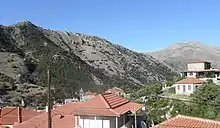
Astras (Greek: Αστράς) is a mountainous village of the Elis region[1] in West Greece. It has been part of the municipal unit of Lampeia since January 1, 2011. The municipal unit of Lampeia belongs to the municipality of Ancient Olympia. A local government plan, Kapodistrias, notes that the village belonged to the former municipality of Lampeia from 1997 to 2010. Lampeia was the capital of the former municipal unit of Astras. Towards the lower end of the village, there is a settlement named Kaluvia of Astras. There is also a mountain road that goes through a forest which connects Astras to the capital of the municipal unit of Lampeia, the village of Lampeia or Divri.
Population
As of the 2011 census, Astras had a population of 132 as compared to the 2001 census population of 143 inhabitants (0.80% decrease).[2]
The first recorded census was held in 1700 by Francisco Grimani from Venice. The village had 174 inhabitants (92 men and 82 women) and 34 families at that time.
History
The region of Astras has been inhabited since ancient times (now known as Nousa), a village a few kilometers away from Tripotama. There was the ancient city of Psophis which is mentioned in Iliad. In ancient times, Astras was a part of Psophis, which has been indicated by findings of man-made sculptures and other things of daily use in the modern settlement of Kaluvia of Astras. Proper Astras history begins in the Byzantine years. A significant town event was in the Proto-Byzantine years, when Alaric the Great destroyed Ancient Psophis in 398 AD. In fact, the historian Zosimus who wrote about the area 50 years after the destruction of the city of Psophis mentioned that only a few of the citizens returned to the destroyed cities as the damage was colossal. The most significant fact about the village itself is the “Asketerion of Nousa”. After the fall of the Byzantine Empire, the village became part of the Republic of Venice. Nousa (the name of the village at that time) belonged to the territory of Kalavryta and in 1700 Grimani's census took place. According to this census, there were 174 inhabitants of Nousa. During the Ottoman Occupation, the villagers suffered a lot from Ottoman rule and especially from the Bay of Lala, a close big city in the Ottoman times. Thus the Nousaites (demonym of villagers from Nousa/Astras) became klephts, who would spend their lives in the mountain seeking freedom. Many heroes of the Greek revolution were from Nousa. According to the National Library of Greece, some of Nousa’s freedom fighters were Nikolaos Koulis, Chrysanthos Koulis, Demetrius Karachioutis, Konstantinos Stathopoulos, Vasileios Makris, Aggellis Makris, and Panagiotes Makris (Makropanagos). The last was a relative of the famous Giannias who became the terror of the Turkalbanians of a big region containing villages of Patrai. After the liberation and the constitution of the first free Greek state, Nousa became part of the Municipality of Lampeia.
Present
Mountains slow people down from getting into Astras. Possibly due to that, the village retains the traditional character of the whole region. Every year there are festivities to honour Saint George, who is considered to be the protector of the village. The majority of the villagers of Astras are involved in the agriculture industry. In summertime, the natural environment of the village attracts tourists, who may visit the forest and the river that goes through the village. It is the river of Erymanthos where Hercules is said to have captured the Erymanthian boar.
The Asketerion
The Asketerion of Astras is a two-floor building that was built inside the mountain rock. To the left of the entrance, there is a ladder made of rock which leads to the upper floor where there is a small chapel with an image of Virgin Mary (Platytera). Near the Asketerion are the ruins of the old church of Saint John. The building of Asketerion was made by Osios Meletios in the 9th century, who had established many monasteries in the region of Astras and in other neighboring regions.
Astras Poem
In 1930 Theodoros Ksudis from Elia wrote a poem with the name Astras:
Greek:
Αστρά, περήφανε Αστρά,
βαθιά θεμελιωμένε,
που καμαρώνεις άσειστος,
ωραίε κι αγριεμένε,
Κρύβεις απέθαντες ψυχές
μέσ’ στα πυκνά σου ελάτια
και δείχνεσαι στον ουρανό
σαν ουρανός με μάτια...
Αστρά, περήφανε Αστρά,
νεανικέ Αστρά μου,
της νιότης είσαι η νιότη συ
και της χαράς χαρά μου.
Με ποια γαλήνια προσευχή
που δένεται η ψυχή μου
στην τρυφερή, ρεμβαστική
κι εκστατική στιγμή μου!
English:
Astras, proud Astras
Strongly established
You who stand steadily
Beautiful and wild
You hide immortal souls
In your deep forests
And you show yourself to the sky
Like a sky with eyes
Astras proud Astras
My young Astras
You are the youth of my youth
And the joy of my joy
With which relaxing prayer
My soul goes with
In my beautiful
Ecstatic moment of mine watching you
References
- DigiServices/Twinnet 2013-2015. "EG | Kalyvia Astra (Village) [ILIA, ARCHEA OLIBIA]". www.exploring-greece.gr. Retrieved 2021-09-20.
- "Astrás (Dímos Archaías Olympías, West Greece, Greece) - Population Statistics, Charts, Map, Location, Weather and Web Information".
External links
 Media related to Astras Ileias at Wikimedia Commons