Auburn Avenue Research Library on African American Culture and History
The Auburn Avenue Research Library on African American Culture and History is a special library within the Atlanta-Fulton Public Library System. It is in Atlanta's Sweet Auburn Historic District.[1] The Auburn Avenue Research Library opened in 1994 as the first library in the Southeast to offer specialized reference and archival collections for the study and research of African American culture and history and of other peoples of African descent.[2] Its collection was housed at other libraries and became knowm as the Samuel W. Williams Collection on Black America.
 | |
| Country | United States |
|---|---|
| Type | Special library |
| Established | 1994 |
| Location | Atlanta, Georgia |
| Website | www |
| Map | |

| |
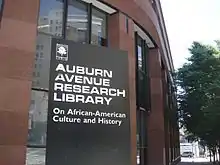
Covering 50,000 square feet, the Auburn Avenue Research Library's four-story red-brick and black-granite building houses a library research area containing general reference books and materials, study areas, and a reading room as well as a public section with exhibit cases, general reference materials, and main reading room, and its archive of library stacks in the center of the building on the second and third floors.[3]
The library is open to the public.[4] Appointments are encouraged for access to its archival collections.[4] In 2001, the Auburn Avenue Research Library on African American Culture and History received a Governor's Award in the Humanities.[2]
The library re-opened in 2016 after being closed for about two years during a $20 million renovation.[5][6]
History
Its core collection was established at the Auburn Branch of the Carnegie Library of Atlanta[1] that opened in 1921 and was Atlanta's first public library branch for African Americans.[1] "Due to Jim Crow laws, African Americans were denied public library services established in 1902.[1] The Auburn branch was opened with Carnegie Corporation funds despite Carnegie's offer to fund a branch for the city's large black population as early as 1908. [7]
From 1921 to 1959 the Auburn Avenue Research Library provided educational and community programming and amassed its core Negro History Collection.[1] "The holdings grew to include bound copies of magazines, newspapers, and scholarly journals by, for, and about African Americans, including the Atlanta Daily World, The Crisis, Journal of Negro Education, and Negro History Bulletin.[1] The library closed in 1959[1] and the Negro History Collection was moved to the West Hunter Branch,[1] "built in 1949 to accommodate the demands for expanded public library service from the increasing numbers of African Americans who had migrated to Atlanta's west side."[1]
The collection moved again in 1970, to "where Central Library now stands at One Margaret Mitchell Square."[1] One year later, the collection was named the Samuel W. Williams Collection on Black America in honor of the Atlanta-based educator, theologian, and philosopher Samuel Woodrow Williams.[1] "The collection remained at the main library until 1994, and was then moved to the newly built Auburn Avenue Research Library."[1]
The Auburn Avenue Research Library on African American History and culture opened in May 1994 in its current location.[1] After fifteen years, the Auburn Avenue Research Library on African American Culture and History outgrew its space[1] and on November 4, 2008, Fulton County voters approved a library bond referendum with funding to enhance and expand the library.[1]
Divisions
Reference & Research
"The Samuel W. Williams Collection forms the cornerstone of the reference and research division, which maintains a variety of textual and microform records, a noncirculating library of secondary sources, and a broad array of Web-accessible research databases for the study of African American culture and history and the African Diaspora."[1]
Archives
"The Archives division preserves and makes available unique historical records of enduring value related primarily to African American culture and history, with a concentration on local Atlanta history."[1] "These primary sources include not only textual and special media records (cartographic records, graphic arts, still photographs, sound recordings, and moving images) but also art and artifacts, microforms, rare book collections, and textiles."[1]
Program
"The Program division supports the library's mission and serves the public through book discussions and readings, exhibitions, film screenings, lectures, seminars, tours, and workshops."[1] "Through its cultural, educational, and scholarly programming—which is local, national, and transnational in scope—the program division helps interpret and highlight the institution's rich collections and provides outreach to the general public, as well as to Atlanta's academic community."[1]
Collections
The sections of the Auburn Avenue Research Library's collection that are contained in the Archives Division include "the Art and Artifacts Collection which contains art and artifacts by and about peoples of African heritage throughout the world."[8] "The collection contains contemporary works by African American artists, including works by Romare Bearden, Charles White, James Van Der Zee and Ed Dwight."[8] "The Archives Division also includes the Archives and Manuscripts Collection, which focuses on the history, literature, politics, and culture of peoples of African descent in Atlanta, the Southeast, the U.S. and the world."[8]
Other collections include "the Ephemeral Collection which contains resources in the following categories: calendars, dust jackets, family genealogical booklets, flags, maps, postcards, posters, sheet music, slave documents, yearbooks, vertical files, educational kits, black history month essays, funeral programs, coins, comic books, playbills, typescripts, buttons, recipes, autographs and stamps."[8]
The Moving Image and Recorded Sound Collection "provides audiovisual resources which document and interpret African American experiences in the city of Atlanta, the state of Georgia, the southeastern region of the U.S. and throughout the nation."[8]
The Oral History Collection "complements the Moving Image and Recorded Sound Collection."[8] "Preserved on videocassette tapes, audio cassette tapes and transcripts, and digital formats, this expanding collection seeks to enhance and make available collected oral histories of historical and significant cultural organizations, individuals, institutions and communities."[8]
The Pamphlet Collection "includes works published before 1865 in the United States; first editions by African American authors before 1930 and during the Harlem Renaissance and works published before 1901 in Europe, Africa, South America and the Caribbean, and publications of Black private presses."[8]
The Photographs and Prints Collection "contains both documentary and fine art photographs which document the history and culture of peoples of African descent as well as the work of photographers of African descent."[8]
The Rare Periodical and Newspaper Collection "contains mainly African American publications. A small percentage of the collection is composed of non-African American publications."[8] "The collection includes articles, photos, illustrations, newspapers and periodicals in bound volumes."[8]
Digital Collections
In 2010 the Auburn Avenue Research Library on African American Culture and History (AARL) and the Digital Library of Georgia (DLG) collaborated to digitize eleven archival collections. AARL and DLG received funds from the National Historical Publications and Records Commission (NHPRC) to make Web-accessible late nineteenth- and mid-twentieth-century manuscript collections "that document the historical development of education for African Americans, primarily in the South, from the early 1860s to the early 1950s." Eleven collections were digitized and are now available via the library website.[9]
The Reference and Research Division "contains the print, digital and microform collections which includes an impressive list of Africana resources that provide unlimited access to full-text articles from current and past issues of scholarly Africana journals, popular African American magazines and international African journals."[8]
The "strengths of the (Auburn Avenue Research Library's) collection are Southern Civil Rights Movement, Southern African American Literature and History, General African and African American History and Literature, Atlanta and Georgia Vertical File Collections, Current and Historic African American Journals, Current and Historic African American Newspapers, Africana Children's Literature Collection, The Coretta Scott King Award Winning Children's Titles 1969 to current, Africana Cinema and Documentary Film Collections, and Subject Bibliographies highlighting AARL resources."[8]
Notes
- "About Us". Atlanta-Fulton Public Library System. afpls.org. Retrieved August 9, 2019.
- Chenault, Wesley (February 13, 2009). "Auburn Avenue Research Library on African American Culture and History". New Georgia Encyclopedia. georgiaencyclopedia.org. Retrieved August 9, 2019.
- Chepesiuk, R. (1996). "Schomburg of the South: the Auburn Research Library". American Libraries. 27: 38–40.
- "Access to the Collections". Auburn Avenue Research Library on African American Culture and History.
- "Auburn Avenue Research Library Reopens After $20M Renovation". August 5, 2016.
- "Auburn Avenue Research Library to Close for Renovations and Expansion". January 9, 2014.
- Wheeler, Maurice; Johnson-Houston, Debbie (February 1, 2004). "A Brief History of Library Service to African Americans". American Library Association. 35, 2: 42–45 – via JStor.
- "Collections". Auburn Avenue Research Library on African American Culture and History.
- "AARL-Archival Appointment".
References
External links
 |
Wikimedia Commons has media related to Auburn Avenue Research Library on African American Culture and History. |
- Auburn Avenue Research Library on African American Culture and History website
- Auburn Avenue Research Library on African American Culture and History Archives Division Blog
- Atlanta–Fulton Public Library System website
- Auburn Avenue Research Library Historic African American Education Collections
Authority control  | |
|---|---|
| General | |
| National libraries | |