Autonomous administrative divisions of India
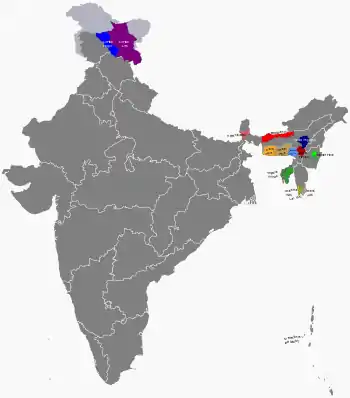
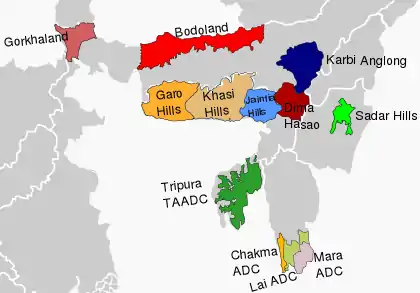
The Sixth Schedule of the Constitution of India allows for the formation of autonomous administrative divisions which have been given autonomy within their respective states.[1] Most of these autonomous district councils are located in North East India but two are in Ladakh, a region administered by India as a union territory. Presently, 10 Autonomous Councils in Assam, Meghalaya, Mizoram and Tripura are formed by virtue of the Sixth Schedule[2] with the rest being formed as a result of other legislation.
 |
|---|
 India portal India portal |

Powers and competencies
Executive and legislative powers
Under the provisions of the Sixth Schedule of the Constitution of India, autonomous district councils can make laws, rules and regulations in the following areas:[3]
- Land management
- Forest management
- Water resources
- Agriculture and cultivation
- Formation of village councils
- Public health
- Sanitation
- Village and town level policing
- Appointment of traditional chiefs and headmen
- Inheritance of property
- Marriage and divorce
- Social customs
- Money lending and trading
- Mining and minerals
Judicial powers
Autonomous district councils have powers to form courts to hear cases where both parties are members of Scheduled Tribes and the maximum sentence is less than 5 years in prison.[4]
Taxation and revenue
Autonomous district councils have powers to levy taxes, fees and tolls on: building and land, animals, vehicles, boats, entry of goods into the area, roads, ferries, bridges, employment and income and general taxes for the maintenance of schools and roads.[5]
List of autonomous administrative divisions
Autonomous district councils operating under the Sixth Schedule of the Constitution of India are shown in bold.
| State/Union Territory | Autonomous Council | Headquarters | Districts / Subdivisions | Formation | Last Election | Ruling Party | Chief Executive | Party Position |
|---|---|---|---|---|---|---|---|---|
| Assam | Bodoland Territorial Council | Kokrajhar | Baksa, Chirang, Kokrajhar, Udalguri | 2003 | 2020 | BJP & UPPL & GSP | Pramod Boro | Total-40 UPPL-15 BJP-12 GSP-1 BPF-12. |
| North Cachar Hills (Dima Hasao) Autonomous Council | Haflong | Dima Hasao | 1951 | 2019 | BJP | Debolal Gorlosa | Total-28 BJP-26 INC-2 | |
| Karbi Anglong Autonomous Council | Diphu | Karbi Anglong, West Karbi Anglong | 1952 | 2017 | BJP | Tuliram Ronghang | Total-26 BJP-24 KADF-2. | |
| Tiwa Autonomous Council | Morigaon | Kamrup (Metro), Morigaon, Nagaon and Hojai | 1995 | 2020 | BJP | Jiban Chandra Konwar | Total-36 BJP-33 AGP-2 INC-1. | |
| Mising Autonomous Council | Dhemaji | Dhemaji | 1995 | 2019 | BJP & SGS | Ranoj Pegu | Total-36 SGS+BJP-(29+5) IND-1. | |
| Rabha Hasong Autonomous Council | Dudhnoi | Kamrup Rural, Goalpara | 1995 | 2019 | BJP & RHJMC | Tankeswar Rabha | Total-36 BJP+RHJMC-34 INC-1 AGP-1. | |
| Sonowal Kachari Autonomous Council | Dibrugarh | 2005 | 2019 | BJP | Dipu ranjan Markari | Total-26 BJP-20 INC-5 IND-1. | ||
| Thengal Kachari Autonomous Council | Titabar | 2005 | 2016 | BJP | Kumud Ch Kachari | Total-22 BJP-13 INC-4 AGP-3 IND-2. | ||
| Deori Autonomous Council | Narayanpur | Lakhimpur | 2005 | 2016 | BJP | Madhav Deori | Total-17 BJP-7 INC-2 AGP-1 IND-7. | |
| Moran Autonomous Council | ** | Tinsukia district | 2020 | Not yet | ** | |||
| Matak Autonomous Council | ** | 2020 | Not yet | ** | ||||
| Bodo Kachari Welfare Autonomous Council | Simen Chapori | 2020 | Not yet | ** | Mihiniswar Basumatary | |||
| Kamatapur Autonomous Council | ** | 2020 | Not yet | ** | Hiteswar Barman | |||
| Ladakh | LAHDC Kargil | Kargil | Kargil | 2003 | 2018 | JKNC & BJP | Feroz Ahmad | |
| LAHDC Leh | Leh | Leh | 1995 | 2020 | BJP | Tashi Gyalson | ||
| Manipur | Chandel Autonomous District Council | Chandel | 2015 | |||||
| Churachandpur Autonomous District Council | Churachandpur | 2015 | ||||||
| Sadar Hills Autonomous District Council | Kangpokpi | Saikul, Saitu and Sadar Hills West subdivisions of Kangpokpi district | 2015 | |||||
| Manipur North (Senapati) Autonomous District Council | Senapati | 2015 | ||||||
| Tamenglong Autonomous District Council | Tamenglong | 2015 | ||||||
| Ukhrul Autonomous District Council | Ukhrul | 2015 | ||||||
| Meghalaya | Garo Hills Autonomous District Council | Tura | East Garo Hills, West Garo Hills, South Garo Hills, North Garo Hills and South West Garo Hills | 1973 | 2021 | NPP & GNC & IND. | Benedick R Marak | Total-29 NPP-11 INC-12 BJP-2 GNC-1 IND-3 |
| Jaintia Hills Autonomous District Council | Jowai | East Jaintia Hills, West Jaintia Hills | 1973 | 2019 | NPP & UDP | T Shiwat | Total-29 NPP-12 UDP-10 INC-4 IND-3 | |
| Khasi Hills Autonomous District Council | Shillong | West Khasi Hills, East Khasi Hills and Ri Bhoi | 1973 | 2019 | UDP & NPP & HSPDP & PDF & IND | Titosstarwell Chyne | Total-29 INC-10 NPP-7 UDP-6 HSPDP-2 PDF-1 IND-3 | |
| Mizoram | Chakma Autonomous District Council | Kamalanagar | Tuichawng subdivision | 1972 | 2018 | MNF | Durjya Dhan Chakma | Total-20 MNF-19 BJP-1 |
| Lai Autonomous District Council | Lawngtlai | Lawngtlai subdivision, Sangau subdivision | 1972 | 2020 | MNF | V. Zirsanga | Total-25 MNF-20 BJP-1 INC-1 IND-3 | |
| Mara Autonomous District Council | Siaha | Siaha subdivision, Tipa subdivision | 1972 | 2017 | BJP | N Zakhai | Total-25 BJP-19 INC-5 IND-1 | |
| Tripura | Tripura Tribal Areas Autonomous District Council | Khumulwng | West Tripura | 1982 | 2021 | TIPRA & INPT | Purna Chandra Jamatia | |
| West Bengal | Gorkhaland Territorial Administration | Darjeeling | Darjeeling, Kurseong and Mirik subdivisions of Darjeeling district, Kalimpong district | 2012 | 2012 | -- | Anit Thapa |
De facto self-governing areas
North Sentinel Island
North Sentinel Island is situated in the island chain of the Andaman and Nicobar Islands which is a union territory of India. It is home to the Sentinelese people, who are among some of the world's last uncontacted peoples. They reject any contact with other people and are among the last people to remain virtually untouched by modern civilization. There has never been any treaty with the people of the island nor any record of a physical occupation.
The local government (Andaman and Nicobar Islands) has stated[6] that they have no intention to interfere with the Sentinelese's lifestyle or habitat. Although the island is likely to have suffered seriously from the effects of the December 2004 tsunami, the survival of the Sentinelese was confirmed when, some days after the event, an Indian government helicopter observed several of them, who shot arrows at the hovering aircraft to repel it.
Although this has not been done with any formal treaty, the official policy of minimal interference has ensured that they have de facto autonomy and sovereignty over their island under the framework of the central and local governments.[7]
References
- "Sixth Schedule of The Constitution of India" (PDF).
- "Union Cabinet approves amendment in Sixth Schedule to strengthen 10 North East autonomous councils-India News , Firstpost". 24 January 2019.
- "Sixth Schedule of The Constitution of India" (PDF).
- "Sixth Schedule of The Constitution of India" (PDF).
- "Sixth Schedule of The Constitution of India" (PDF).
- The Sentineli Archived March 2, 2009, at the Wayback Machine.
- "Administration in India's Andaman and Nicobar Islands has finally decided upon a policy of minimal interference". Archived from the original on 2012-09-14. Retrieved 2008-08-21.
External links
| Proposed states |
|  |
|---|---|---|
| Proposed union territories |
| |
| 6th Schedule areas (Constitution of India) |
| ||||||||
|---|---|---|---|---|---|---|---|---|---|
| non 6th Schedule areas (State legislation) |
| ||||||||