Azim-ush-Shan
Prince Azim-us-Shan (15 December 1664 – 18 March 1712) was the second son of Mughal emperor Bahadur Shah I, by his second wife, Amrita Bai. He was the grandson of Emperor Aurangzeb, during whose reign, he was the subahdar (viceroy) of Bengal Subah, Bihar and Odisha from 1697 to his death in 1712, and the great grandson of Emperor Shah Jahan.
| Azim-us-Shan | |||||
|---|---|---|---|---|---|
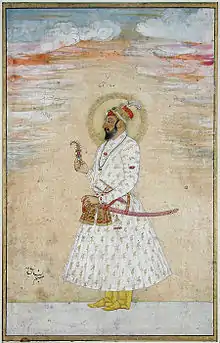 Azim us-Shan Bahadur | |||||
| Born | Muhammad Azimuddin 15 December 1664 Agra Fort | ||||
| Died | 18 March 1712 (aged 47) Near Agra | ||||
| Burial | Humayun Tomb | ||||
| Spouses | Bai Jas Kuar[1] Aisha Begum[1] Gitti Ara Begum[1] Sahiba Niswan[2] | ||||
| Issue | Muhammad Karim Mirza Humayun Bakht Mirza Ruh-ul-Daula Mirza Ahsanullah Mirza Farrukhsiyar | ||||
| |||||
| Father | Bahadur Shah I | ||||
| Mother | Amrita Bai | ||||
| Religion | Islam | ||||
Reign

In 1697 he was appointed the viceroy of Bengal Subah, Bihar and Odisha by Emperor Aurangzeb.[3] Shortly after, he took successful military initiative against Rahim Khan. Azim gave the East India Company permission to build Fort William in Calcutta (presently Kolkata) in 1696. Using Mughal permission, the Dutch also built Fort Gustavas in Chinsura and the French built Fort Orleans in Chandernagore (presently Chandannagar).[3]
Azim got into conflict with Murshid Quli Khan, the newly appointed Divan of Bengal, over imperial financial control. Considering the complaint of Murshid Quli Khan, Aurangzeb ordered Azim to move to Bihar.[3] In 1703 he transferred the capital to Rajmahal and then again to Pataliputra (present-day Patna). He renamed Pataliputra to Azimabad after his own name.[3]
In 1712, at the time of his father's death, he immediately proclaimed himself emperor but the other three Princes, Jahandar Shah, Jahan Shah and Rafi-ush-Shan, joined together and waged war against Azim. In the battle, a shot from heavy gun struck the trunk of the elephant that Azim was on, leading the elephant to run towards Ravi River and falling into quick sand, which consumed both the elephant and Azim, killing him.[4]
Personal life
Azim-us-shan's first wife was Bai Jas Kuar, the daughter of Kirat Singh, who was the son of Raja Jai Singh I, Kachwaha ruler of Amber. She married Azim-ud-din in 1678, and was the mother of Muhammad Karim Mirza born on 12 October 1679.[5] She died at Delhi on 19 February 1721, and was buried at the Qutb.[6]
His second wife was Aisha Begum, the daughter of Ruhullah Khan Yazdi, the Mir Bakhshi. She was the granddaughter of Khalilullah Khan. The marriage took place on 26 June 1692.[7] She was the mother of Prince Humayun Bakht Mirza, and Prince Ruh-ud-daula Mirza. Azim-ush-shan is said to have been very fond of her. On 24 May 1709, she gave birth to twins, a boy and a girl. She died at Daulatabad on 15 July 1709, and was buried there, near the tomb of Burhan ud-din.[6]
His third wife was Gitti Ara Begum, the daughter of Prince Muhammad Azam Shah. The marriage took place on 1 November 1709.[8] She died at Delhi on 12 June 1724 at age over forty years.[6]
His fourth wife was Sahiba Niswan, a Kashmiri lady, and the sister of Khwajah Inayatullah, entitled Shaista Khan. She was the mother of Emperor Farrukhsiyar. Upon Farrukhsiyar's accession on 11 January 1719, she occupied an eminent position in the imperial harem.[2] She died at Delhi in February 1729, having outlived her son for nearly ten years.[6]
Ancestry
| Ancestors of Azim-ush-Shan | ||||||||||||||||||||||||||||||||||||||||||||||||||||||||||||||||||||||||||||||||||||||||||||||||||||||||||||||||||||||||||||||||||||||||||||||||||||||||||||||||||||||||||||||||||||||||||||||||||||||||||||||||||||||||||||||||||||||
|---|---|---|---|---|---|---|---|---|---|---|---|---|---|---|---|---|---|---|---|---|---|---|---|---|---|---|---|---|---|---|---|---|---|---|---|---|---|---|---|---|---|---|---|---|---|---|---|---|---|---|---|---|---|---|---|---|---|---|---|---|---|---|---|---|---|---|---|---|---|---|---|---|---|---|---|---|---|---|---|---|---|---|---|---|---|---|---|---|---|---|---|---|---|---|---|---|---|---|---|---|---|---|---|---|---|---|---|---|---|---|---|---|---|---|---|---|---|---|---|---|---|---|---|---|---|---|---|---|---|---|---|---|---|---|---|---|---|---|---|---|---|---|---|---|---|---|---|---|---|---|---|---|---|---|---|---|---|---|---|---|---|---|---|---|---|---|---|---|---|---|---|---|---|---|---|---|---|---|---|---|---|---|---|---|---|---|---|---|---|---|---|---|---|---|---|---|---|---|---|---|---|---|---|---|---|---|---|---|---|---|---|---|---|---|---|---|---|---|---|---|---|---|---|---|---|---|---|---|---|---|
| ||||||||||||||||||||||||||||||||||||||||||||||||||||||||||||||||||||||||||||||||||||||||||||||||||||||||||||||||||||||||||||||||||||||||||||||||||||||||||||||||||||||||||||||||||||||||||||||||||||||||||||||||||||||||||||||||||||||
References
- Irvine, William (1971). Later Mughal. Atlantic Publishers & Distri. p. 144.
- Cheema, G. S (2002). The Forgotten Mughals: A History of the Later Emperors of the House of Babar, 1707-1857. Manohar Publishers and Distributors. p. 179. ISBN 9788173046018.
- Chatterjee, Anjali (2012). "Azim-us-Shan". In Islam, Sirajul; Jamal, Ahmed A. (eds.). Banglapedia: National Encyclopedia of Bangladesh (Second ed.). Asiatic Society of Bangladesh.
- Irvine, William (1971). Later Mughal. Atlantic Publishers & Distri. p. 177.
- Irvine, p. 145.
- Irvine, p. 144.
- Sarkar, Jadunath (1947). Maasir-i-Alamgiri: A History of Emperor Aurangzib-Alamgir (reign 1658-1707 AD) of Saqi Mustad Khan. Royal Asiatic Society of Bengal, Calcutta. p. 209.
- Irvine, p. 35.
- Charles Francis Massy, Chiefs and Families of Note in the Delhi, Jalandhar, Peshawar and Derajat Divisions of the Panjab (1890), p. 396
- Vijay Kumar Mathur, Marvels of Kishangarh paintings: from the collection of the National Museum, New Delhi (2000), p. 8
- Irvine, p. 128.
Bibliography
Irvine, William. The Later Mughals. Low Price Publications. ISBN 8175364068.