Azmari
An Azmari (Amharic: አዝማሪ meaning: to sing or singer) is an entertainer who sings while playing traditionel string instruments of the Ethiopian Highlands. It's comparable to the medieval European minstrels or bard, or the West African griot. [1]
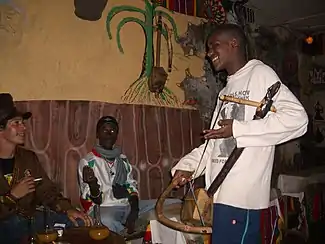
Azmari, who may be either male or female, are skilled at singing extemporized verses, accompanying themselves on either a masenqo (one-stringed fiddle) or krar (lyre).
Etymology
Azmari is derived from Amharic and means to sing or singer. Amharas tend to call all musicians Azmari simply because there's no other word in the language denoting a person who plays a musical instrument.[2]
History
The earliest documented mention of the Azmaris goes back to the mid 15th century, and presumably goes back much further.[3]
Role in society
In the past Azmaris played an important role as social critics, improvising sophisticated texts of praise or criticism.[4] Azmaris would mock people in high places, even Emperors were not spared, if they were found to be unpopular with the public. The Azmaris were the first to convey scandals in high places.[5]
Female Azmaris flourished in feudal Ethiopia. They are just like their male counterparts poet-musicians. Such female musicians are usually wives or lovers of male Azmaris who have gradually learned the repertory of their male counterparts.[6]
Between 1841-1843 English traveller and Major William Cornwallis Harris captured the prevailing political atmoshere and attitudes of Sahle Selassie court towards his enemies, in a song of praise played by one of his female chorist (azmari).
In stature like the lance he bears,
His godlike mien the prince declares;
And famed for virtue through the land,
All bow to Saloo's just command.
The sabre feels the royal grasp,
And Pagans writhe in death's cold clasp;
The Galla taste the captive fare,
And dread the vengeance which they dare.— A memorable observation by Major William Cornwallis Harris, of an female Azmari praise of king Sahle Selassie court, in " Misgana (translated from Amharic) praise song", [7]
Modern day avenue's
Azmaris continue to perform in various settings ranging from wedding ceremonies, to hotels, and in drinking establishments called tejbeit, which specialize in the serving of tej (mead). The Azmari introduced the popular Tizita ballad form.[8][9]
Notable Azmari
- Asnaketch Worku
- Bahru Kegne
- Eténèsh Wassié
- Weres Egeziaber
References
- "The "Azmari", Poet-Musician of Ethiopia". The Musical Quarterly. 61 (1). January 1975. doi:10.1093/mq/lxi.1.47.
- May, Elizabeth (1983). Musics of many cultures : an introduction. Berkeley: University of California Press. p. 234.
- Shelemay, Kay Kaufman (2021). SING AND SING ON : sentinel musicians and the making of the ethiopian american diaspora. Chicago: University of Chicago Press. p. 316.
- Uhlig, Siegbert (2017). Ethiopia : history, culture and challenges. Munster, East Lansing: Michigan State University Press. p. 207.
- Milkias, Paulos (2011). Ethiopia. Santa Barbara, California: ABC-CLIO. p. 344-345.
- Milkias, Paulos (2011). Ethiopia. Santa Barbara, California: ABC-CLIO. p. 344-345.
- The Highlands of Ethiopia (London, 1844) vol.3 page 288
- Dag Woubshet (2008). "Tizita: A New World Interpretation" (PDF). English at Cornell: A newsletter from the Department of English. Cornell University. Retrieved 2010-02-05.
- Uhlig, Siegbert (2017). Ethiopia : history, culture and challenges. Munster, East Lansing: Michigan State University Press. p. 207.