Baby bottle
A baby bottle, nursing bottle, or feeding bottle is a bottle with an attached teat (also called a nipple in the US) on the top opening, on which can be suckled, and from thereby drank directly. It is typically used by infants and young children, or if someone cannot (without difficulty) drink from a cup, for feeding oneself or being fed. It can also be used to feed non-human mammals.
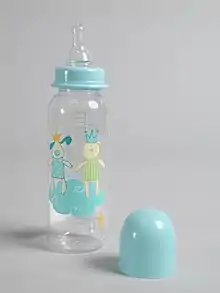
Hard plastic is the most common material used, being transparent, light-weight, and resistant to breakage. Glass bottles are sometimes recommended as being easier to clean, less likely to retain formula residues,[1] and relatively chemically inert.[2] Combinations bottles have also been developed.[3] Other materials used for baby bottles include food-grade stainless steel and silicone.[4][5]
Baby bottles can be used to feed expressed breast milk, infant formula,[6] or pediatric electrolyte solution.[7] A 2020 review reports that healthy term infants, when breastfeeding or bottle‐feeding, "use similar tongue and jaw movements, can create suction and sequentially use teat compression to obtain milk, with minimal differences in oxygen saturation and SSB patterns" (suck–swallow–breath patterns).[8] Sick or pre-term babies may not be able to breastfeed or take a bottle effectively and may need specialized care.[9][6]
The design characteristics of the bottle and teat have been found to affect infant feeding and milk intake. Interactions between the infant and the caregiver feeding them affect the infant's milk intake during feeding. Who controls the feeding, the caregiver or the infant, appears to affect the infant's ability to learn to self‐regulate their milk intake.[8]
Dimensions and design
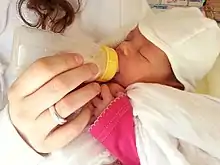
A typical baby bottle typically has four components: the first is the main container or body of the bottle. A teat, or nipple, is the flexible part of the bottle that the baby will suck from, and contains a hole through which the milk will flow. The collar goes over the nipple and typically screws onto the neck of the bottle, forming a seal. Most, but not all baby bottles will also have a cap or travel cover that goes over the teat to keep it clean and to prevent small spills.[10] Some bottles may optionally have a disposable liner.
A large-sized bottle typically holds 280 ml; the small size 150 ml.[11] The height-to-width ratio of bottles is high (relative to adult cups) because it is needed to ensure the contents flood the teat when used at normal angles; otherwise the baby will drink air. However, if the bottle is too tall, it easily tips. There are asymmetric bottles that ensure the contents flood the teat if the bottle is held at a certain direction.
Material
In 2020 researchers reported that infant feeding bottles made out of polypropylene were found to cause microplastics exposure to infants ranging from 14,600 to 4,550,000 particles per capita per day in 48 regions with contemporary preparation procedures. Microplastics release is higher with warmer liquids and similar with other polypropylene products such as lunchboxes.[12][13][14] Medical experts have suggested reducing exposure to microplastics by not shaking plastic bottles or exposing them to high temperatures, or by using alternative materials such as glass, silicone, or stainless steel.[15]
Teats (or nipples)
The teat itself is generally designed to be slimmer than the mother's nipple. Specialized teats are marketed that report attempting to mimic the shape of the breast to help babies to switch back and forth between bottle feeding and breastfeeding for cases where "nipple confusion" occurs.[16]
Teats come in a selection of flow rates, marketed to be based on the age of the infant. Different flow rate teats either have more holes or larger holes. Variable flow rate teats are available for older infants. The hole is asymmetric so that by turning the bottle/teat, different flows can occur. Specialized teats are available for infants with cleft palate.
Vented bottles
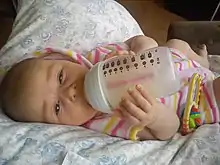
"Vented" bottles allow air to enter the bottle while the baby is drinking without the need to break the baby's suction during feeding. Alternatively a bottle liner can be used to enclose the formula instead of directly in the bottle. The liner collapses as the formula is drained.
Vented bottles work by allowing air to enter while preventing the liquid inside from escaping. It works by an "anti-vacuum skirt" in the base of the teat, where it forms a seal with the bottle. The skirt acts as a one way valve, allowing air to enter the bottle but not liquids to leave. If the sealing ring is tightened too much, the skirt is compressed too tightly to allow it to open and the bottle will not vent. If the sealing ring is too loose, liquid leaks from the bottle.
There are multiple patents for technologies in this area. Initial designs called for a complex spring and valve system that was impossible to clean and sterilize. Current research is in specialized materials with microscopic pores that allow the entry of air without the escape of liquids. This avoids the caregiver having to get the sealing ring tension just right. It remains to be seen whether these materials can withstand the rigours of daily cleaning and sterilization. Another competitor, Dr. Brown's, offers a system whereby the vented air is conducted through a tube to the bottom of the bottle where the airspace is when the bottle is in use.
A 2012 study comparing two types of vented bottles with anti-vacuum features found no differences in infant growth between randomized groups. "Bottle A", a partial anti-vacuum design, was rated by parents as easier to assemble and clean. Infants fed using "Bottle A" were reported to engage in less "fussing", but no difference were found in "crying" or "colic" or in rates of ear infection.[17]
Health recommendations for the storage and handling of human milk typically focus on preventing the growth of dangerous bacteria, but some research is also being done on nutrition. Experimental studies have shown a degradation of retinol (Vitamin A) and α-Tocopherol (Vitamin E) content dependent upon the formation of bubbles in expressed breast milk and in formula. Seven models of bottles were studied, from six companies. Less degradation occurred when using a bottle feeding system designed to minimize the mixing of air with the bottle's contents.[18]
Variations and accessories
Bottles may be designed to attach directly to a breast pump for a complete "feeding system" that maximizes the reuse of the components. Such systems include a variety of drinking spouts for when the child is older. This converts the bottle into a sippy cup, a cup with lid and spout for toddlers, which is intermediate between a baby bottle and an open top cup. Bottles that are part of a feeding system may include handles that can be attached. The ring and teat may be replaced by a storage lid.
Accessories for bottles include cleaning brushes, or bottle brushes, sterilizers, and drying racks. Brushes may be specially designed for a specific manufacturer's bottles and teats. Bottle sterilizers use different techniques for sterilization, including ultraviolet light, boiling water, and hot steam.
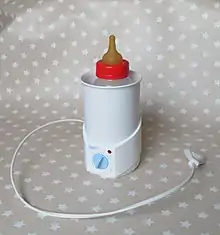
Bottle warmers warm previously made and refrigerated formula. Coolers designed to fit a specific manufacturer's bottles are available to keep refrigerated formula cold. Special formula powder containers are available to store pre-measured amounts of formula so that caregivers can pre-fill bottles with sterile water and mix in the powder easily. The containers are typically designed to stack together so that multiple pre-measured amounts of formula powder may be transported as a unit.
Institutions can purchase ready-to-feed formula in containers that can be used as baby bottles.[19] The lid screws off and is replaced by a disposable teat when the formula is ready to be used. This avoids storing the formula with the teat and possibly clogging the teat holes when formula is splashed within the bottle and dries.
Some bottles have been specifically designed to reduce colic in babies but there is little evidence that these actually do any good. The bottles are designed to minimize the intake of air during feeding.[20]
Use
Cleaning and sterilization
In the UK, the current advice given by NHS Choices remains to sterilize baby bottles,[21] which is deemed as especially important for newborn and high-risk infants (i.e., those susceptible to infection). Sterilization is also recommended in Australia, such as by Milton sterilizing fluid.[22] A current recommendation in the US is that bottle sterilization can be replaced by cleaning with hot soapy water.[23]
By age
Nipples (teats) are typically subdivided by flow rate, with the slowest flow rate recommended for premature infants and infants with feeding difficulties. However, flow rates are not standardised and vary considerably between brands.[24][25]
The NHS recommends a sippy cup or beaker be introduced by 6 months and the use of bottles discontinued by 1 year.[26] The AAP recommends that the cup be introduced by one year of age and that the use of the bottle by discontinued by 18 months.[27] The use of bottles is discouraged beyond two years of age by most health organisations as prolonged use can cause tooth decay.[28]
Regulation
While infant formula is highly regulated in many countries, baby bottles are not. Only the materials of the teat and bottle itself are specifically regulated in some countries (e.g. British Standards BS 7368:1990 "Specification for babies' elastomeric feeding bottle teats"[29]). In the USA, the Food and Drug Administration (FDA) regulates teats and the bottle materials.[30][31][32][33] In 1985 the FDA restricted allowable levels of nitrosamines (many of which are carcinogens) released from bottle teats.[34]
Another chemical that has been regulated is Bisphenol A (BPA), described as an endocrine disruptor in 1991.[35] Ongoing research into the possible effects of BPA at levels of exposure far below the U.S. government's BPA safety standards have led to concerns about the safety of plastics, including baby bottles. A 1999 Consumer Reports study showed that some polycarbonate baby bottles released unsafe amounts of BPA.[36][37][38] Concerns about BPA have been supported by further work.[39][40][41] Research into the effects of BPA has frequently been hotly contested and controversial[42] and issues have been raised over research biases due to industry funding and conflicts of interest due to close ties between government consultants and BPA manufacturers.[39][36][40] One result has been proposals to change the testing paradigm for assessment of endocrine-disrupting chemicals.[39]
Research and public pressure have led to bans on the use of Bisphenol A in bottles and cups to be used by children.[30][43][36] In 2008 Walmart announced that it would stop selling baby bottles and food containers containing BPA.[35] As of 2017, these were applied in at least 40 countries.[44] Canada classified BPA as "toxic" in 2008 under the Canadian Environmental Protection Act.[39] In 2011 use of bisphenol A in baby bottles was forbidden in all EU countries,[45][46] in China,[36] in Malaysia, and South Africa.[47] In July 2012, the FDA stated that BPA would no longer used in baby bottles and sippy cups, in response to a petition from the American Chemistry Council stating that this was now in line with industry practice.[48][49] Other countries such as Argentina[50] and Brazil followed suit by prohibiting bisphenol A in baby bottles.[47] Korea has extended its BPA ban to include all children's utensils, containers and packaging as of January 2020.[51] There are calls for increased regulation of BPA in India.[44][52]
History
Throughout most of human history, infant nutrition has primarily depended on the availability of the child's mother or a wet nurse to breastfeed the infant.[53] Beliefs and behaviors relating to infant feeding also vary widely across countries, cultures and times. Mothers and caregivers have also sought additional ways to feed children, sometimes referred to as "hand feeding".[54][55] As early as 1500 BCE, Egyptian pottery shows images of women breastfeeding their babies and also using animal horns to feed them.[56]
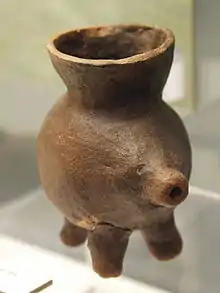
Containers with hard spouts date to early in recorded time, as evidence by archeological finds (see image). The first vessels known to be used for feeding infants had an opening at one end for filling the bottle, and a second at the other to be put into the baby's mouth.[57][58][59] Examination of the organic residues on ancient ceramic baby bottles shows that they were used as early as 1200 BCE to feed babies with animal milk.[58][59]
Around 250 BCE to 300 BCE the Egyptians developed the ability to blow glass and the Romans blew clear feeding bottles of glass, but these did not retain obtain long-term popularity. Leather and wood were also used.[57][60][61] By the 1700s infant-feeding vessels such as the feeding-cups, bubby-pots, and sucking-pots were also being made[56][61] from materials that included pewter, tin, and silver.[53]
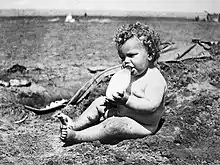
In the 19th century, artificial feeding begin to replace wet nursing, and by 1900, wet nursing no longer existed as an organized profession.[53] Changes to the feeding of infants were both socially and technologically driven. With industrialization, more mothers worked outside the home and could less easily breastfeed their children. Technological changes including the design of artificial feeding methods and the preparation of animal milks and other milk substitutes supported a transition to artificial feeding. but with mixed success. Understanding of both nutrition and sanitation lagged behind the introduction of artificial feeding methods, contributing to extremely high infant mortality rates in the Victorian era.[56][62][63][64][55][65][66]
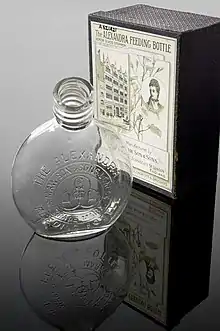
In the United States, the first glass nursing bottle was patented by C.M. Windship in 1841. It was intentionally shaped like the mother's breast. In 1845 the Alexandra Feeder was marketed in England.[57][67] In Paris, the "Biberon" was introduced by M. Darbo: it was reported to be quite popular in a review from 1851.[57][68] As the group American Collectors of Infant Feeders notes, by "the late 1800s a large variety of glass nursing bottles were produced in the United States", and the U.S. Patent Office had issued more than 200 patents for various designs of nursing bottles by the 1940s—designed to lie flat or stand up straight, with openings on their sides or ends, with detachable or permanently attached nipples, etc.[69]
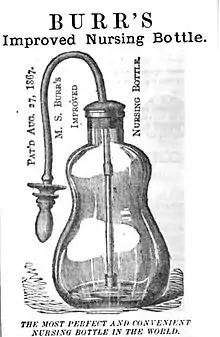
The design of baby bottles and particularly the ease of cleaning them had potentially serious consequences for the health of the children using them. Estimates of infant mortality suggest that 20-30% of infants died in the first year of life during the late Victorian era.[70][66][63] During the 1890s, at a time when England's childhood mortality rates (ages 1-5) were declining, infant mortality rates actually rose.[71][72] A bottle with a long Indian rubber tube ending in a teat remained popular until the 1920s because even very young babies could feed independently. The feeding tubes could be bought separately and were sometimes used with empty whiskey or medicine bottles. Almost impossible to keep clean, this type has been nicknamed the "murder bottle".[62][56]
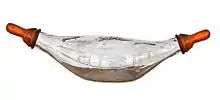
Allen and Hanbury introduced a new bottle design with a removable valve and teat on the two ends in 1894, and an improved model, the Allenbury, in 1900. This "banana" bottle was easier to clean. Sometimes referred to as the "hygienic bottle", it helped to improve survival rates. Similar bottles were introduced by other manufacturers and remained popular from the 1900s to the 1950s.[73] Eventually increased understanding of the causes and transmission of disease and improvements in medicine and public health began to reduce infant mortality.[74][75]
Heat-resistant Pyrex bottles were introduced to the American and British markets at different times. Pyrex bottles were first introduced in the United States by Corning Inc. in 1922. They were offered in three shapes (narrow neck, wide mouth, and flat) and multiple sizes, for a total of ten varieties. By 1925, the product line had been limited to a small subset of the original shapes and sizes.[76] In the 1950s a upright Pyrex bottle with a narrow neck was introduced. In the 1960s a wide-neck version was finally introduced to the UK market.[73] The design of upright bottles with a wider mouth meant that they could be more easily cleaned, and sterilized in batches.[77]
Soft nipples of various materials were introduced early in the history of feeding (e.g., leather, cork, sponge, dried cow's teat filled with cloth). Many were very difficult to clean and when unsanitary could pose a serious threat to infant health.[53][57][60][61] Although Elijah Pratt of New York patented the first rubber nipple in 1845,[57] it took until the 20th century before materials and technology improved sufficiently to allow manufacture of a soft nipple that was practical for use. The invention of rubber (1840s) provided a material that was soft. Early black Indian rubber "had a very strong pungent smell", and did not survive repeated exposures to hot water. However, by the early 1900s more pleasing rubber nipples could be manufactured in volume and could withstand the heat of sterilization.[73][61]
During the 1940s nurse Adda M. Allen filed for multiple patents relating to the design of baby bottles,[78] including the first disposable collapsible liner for a baby bottle.[79] Her patent was one of many attempts to design a bottle to limit swallowing of air during feeding, and reduce gastric upset and spitting up. A plastic bottle with a disposable liner was eventually tested at George Washington University Hospital and marketed by Playtex.[80]
Innovations such as the introduction of a working check valve in the nipple (to provide unidirectional flow of the liquid food) appeared as early as 1948 in a patent to J.W. Less.[81] This technology was picked up by others including Owens-Illinois Glass,[82] eventually making its way into Gerber and all modern pressure-balancing bottle designs.[83] It is also used for adult drinking cups and various other products requiring fluid flow under vacuum.[84]
The modern business of producing bottles in the developed world is substantial. For 2018, the global baby bottle market was valued at 2.6 billion USD.[85] [86] In 1999 it was reported that the UK "feeding and sterilising equipment sector ... stands at £49m… [where] [s]ales of feeding bottles account for 39%" or £19.1m of that market.[87]
Controversy
The 2014 summary policy statement of the American Academy of Pediatrics (AAP) makes no specific mention of bottle feeding, but makes clear that "[b]reastfeeding and human milk are the normative standards for infant feeding and nutrition", and refers to decisions regarding the supply of infant nutrition as "a public health issue and not only a lifestyle choice… [g]iven the documented short- and long-term medical and neurodevelopmental advantages of breastfeeding".[88][89] The AAP policy recommends breastfeeding exclusively for six months, continuing it with introduction of complementary foods, with an overall duration of "1 year or longer as mutually desired by mother and infant".[89] The body of the policy statement notes and cites literature indicating that, in addition to the importance of mother's milk, the manner of the food delivery has implications: that "breastfed infants self-regulate intake volume", whereas bottle-fed infants receiving expressed breast milk or formula have "increased bottle emptying, poorer self-regulation, and excessive weight gain in late infancy", and that such early practice of self-regulation correlate with adult patterns of weight gain (ibid.).
The AAP policy notes that "[m]edical contraindications to breastfeeding are rare".[89] The transmission of some viral diseases through breastfeeding is reportedly preventable, e.g., by expressing breast milk and subjecting it to Holder pasteurization.[90]
In response to public pressure felt from policies de-emphasizing bottle- and formula-feeding, efforts have arisen to support mothers experiencing physiologic or other difficulties in breastfeeding, and sites include individual views that attempt to weaken the scientific case of the AAP policy;[91] a book of the personal experiences and views of one mother committed to bottle/formula feeding, Bottled Up, by Suzanne Barston, has appeared.[92]
See also
References
- Chen, YL; Kuan, WH (December 2014). "Is a Plastic or Glass Feeding Bottle Easier to Be Cleaned?". Iranian journal of public health. 43 (12): 1716–7. PMID 26171367. Retrieved 6 December 2021.
- Everts, Sarah (August 31, 2009). "Chemicals Leach From Packaging Food and drugs just can't leave their wrappings behind". Chemical & Engineering News. 87 (35). Retrieved 6 December 2021.
- "Glass vs. Plastic Baby Bottles". WebMD. Retrieved 6 December 2021.
- Risk Assessment Studies Report No. 47 Safety Issues of Baby Bottles and Children’s Tableware (PDF). Centre for Food Safety, The Government of the Hong Kong Special Administrative Region. January 2012. pp. 43–51. Retrieved 6 December 2021.
- "Non-toxic Baby Bottles:: Plastic, Glass, Stainless Steel, or Silicone?". Gimme the Good Stuff. 8 February 2018. Retrieved 6 December 2021.
- More, Judy (2021). "Chapter 11: Preterm Infants". Infant, child and adolescent nutrition : a practical handbook (Second ed.). Boca Raton: CRC Press. pp. 147–161. ISBN 9781000369748. Retrieved 6 December 2021.
- "Pedialyte for Babies: Benefits, Dosage, and Safety". Healthline. 26 May 2020. Retrieved 6 December 2021.
- Kotowski, Judith; Fowler, Cathrine; Hourigan, Christina; Orr, Fiona (April 2020). "Bottle‐feeding an infant feeding modality: An integrative literature review". Maternal & Child Nutrition. 16 (2). doi:10.1111/mcn.12939. Retrieved 6 December 2021.
- "Nutrition and Fluids for Your Baby in the NICU". The Children's Hospital of Philadelphia. 23 August 2014. Retrieved 6 December 2021.
- "How to Clean, Sanitize, and Store Infant Feeding Items". CDC.gov. 2018-10-31. Retrieved 2020-05-22.
- "EasyFeeder™ - Dispensing Spoon". Bunny & Lu.
- Carrington, Damian (19 October 2020). "Bottle-fed babies swallow millions of microplastics a day, study finds". The Guardian. Retrieved 9 November 2020.
- Trinity College Dublin (October 19, 2020). "High levels of microplastics released from infant feeding bottles during formula prep". phys.org. Retrieved 9 November 2020.
- Li, Dunzhu; Shi, Yunhong; Yang, Luming; Xiao, Liwen; Kehoe, Daniel K.; Gun’ko, Yurii K.; Boland, John J.; Wang, Jing Jing (November 2020). "Microplastic release from the degradation of polypropylene feeding bottles during infant formula preparation". Nature Food. 1 (11): 746–754. doi:10.1038/s43016-020-00171-y. hdl:2262/94127. ISSN 2662-1355. S2CID 228978799. Retrieved 9 November 2020.
- "Are Plastic Baby Bottles Safe?". Cleveland Clinic. Retrieved 2 December 2021.
- "Nipple Confusion - Ask Dr Sears® - The Trusted Resource for Parents". 16 December 2020.
- Fewtrell, MS; Kennedy, K.; Nicholl, R.; Khakoo, A.; Lucas, A. (16 March 2012). "Infant feeding bottle design, growth and behaviour: results from a randomised trial". BMC Research Notes. 5 (1): 150. doi:10.1186/1756-0500-5-150. ISSN 1756-0500. Retrieved 6 December 2021.
- Francis, Jimi; Rogers, Kristy; Dickton, Darby; Twedt, Roxanna; Pardini, Ron (April 2012). "Decreasing retinol and α-tocopherol concentrations in human milk and infant formula using varied bottle systems: Decreasing retinol and α-tocopherol in milk using varied bottle systems". Maternal & Child Nutrition. 8 (2): 215–224. doi:10.1111/j.1740-8709.2010.00279.x. Retrieved 30 November 2021.
- "Homepage". www.smanutrition.co.uk.
- "Colic". Dr Tal Ditye @ Mommyhood101.
- "Bottle feeding advice". www.nhs.uk. 7 December 2020.
- "Bottle Feeding" (PDF). wch.sa.gov.au. Women's and Children's Hospital and Government of South Australia. Archived from the original (PDF) on 2011-04-23. Retrieved 2016-04-01. Printed November 2008
- "Should You Sterilize Your Baby's Bottles?". WebMD. Reviewed by Roy Benaroch, MD on May 24, 2014
- "Know the flow, don't go with the flow! by Britt Pados PhD(c), RN, NNP-BC, bpados@email.unc.edu". Pediatric Feeding News. 2014-06-08. Retrieved 2018-12-27.
- Pados BF, Park J, Thoyre SM, Estrem H, Nix WB (2016). "Milk Flow Rates from bottle nipples used after hospital discharge". MCN: The American Journal of Maternal/Child Nursing. 41 (4): 237–243. doi:10.1097/NMC.0000000000000244. PMC 5033656. PMID 27008466.
- "Drinks and cups for babies and toddlers". nhs.uk. 2017-12-21. Retrieved 2018-12-27.
- "Weaning from the Bottle". www.aap.org. American Academy of Pediatrics. Retrieved 2018-12-27.
- Lisa Enger, RN, BSN, IBCLC. "Patient education: Weaning from breastfeeding (Beyond the Basics)". www.uptodate.com. UpToDate. Retrieved 2018-12-27.CS1 maint: multiple names: authors list (link)
- "BSI British Standards Index". bsonline.techindex.co.uk. Archived from the original on 2011-05-13.
- Mo, Chuiyan (10 March 2021). "Baby Feeding Bottle Standards & Regulations in the United States". Compliance Gate. Retrieved 30 November 2021.
- "Baby Bottles". Consumer Watch. Retrieved 30 November 2021.
- Center for Food Safety and Applied Nutrition (20 December 2019). "FDA Issues Guidance on Food Contact Substances for Use with Infant Formula and/or Human Milk". FDA. Retrieved 30 November 2021.
- Center for Food Safety and Applied Nutrition (10 April 2020). "Once Baby Arrives from Food Safety for Moms to Be". FDA. Retrieved 30 November 2021.
- Office of Regulatory Affairs (2005). "Compliance Policy Guide: CPG Sec 500.450 Volatile N-Nitrosamines in Rubber Baby Bottle Nipples". FDA.
- Gore, Andrea C.; Patisaul, Heather B. (October 2010). "Neuroendocrine Disruption: Historical Roots, Current Progress, Questions for the Future". Frontiers in neuroendocrinology. 31 (4): 395–399. doi:10.1016/j.yfrne.2010.07.003. ISSN 0091-3022. Retrieved 1 December 2021.
- "Timeline: BPA from Invention to Phase-Out". Environmental Working Group. April 22, 2008. Retrieved 1 December 2021.
- "Baby Bottles and Bisphenol A (BPA)". HealthyChildren.org.
- Kay, Jane (24 June 2011). "SAN FRANCISCO / Lawmaker wants state to follow city's lead with 'toxic toy' ban / Bill would bar certain chemicals in products". The San Francisco Chronicle.
- Vogel, Sarah A. (November 2009). "The Politics of Plastics: The Making and Unmaking of Bisphenol A "Safety"". American Journal of Public Health. 99 (S3): S559–S566. doi:10.2105/AJPH.2008.159228. Retrieved 1 December 2021.
- Halden, Rolf U. (1 March 2010). "Plastics and Health Risks". Annual Review of Public Health. 31 (1): 179–194. doi:10.1146/annurev.publhealth.012809.103714. ISSN 0163-7525. Retrieved 30 November 2021.
- Rozek, Laura S.; Dolinoy, Dana C.; Sartor, Maureen A.; Omenn, Gilbert S. (18 March 2014). "Epigenetics: Relevance and Implications for Public Health". Annual Review of Public Health. 35 (1): 105–122. doi:10.1146/annurev-publhealth-032013-182513. ISSN 0163-7525. Retrieved 30 November 2021.
- Vandenberg, Laura N.; Maffini, Maricel V.; Sonnenschein, Carlos; Rubin, Beverly S.; Soto, Ana M. (1 February 2009). "Bisphenol-A and the Great Divide: A Review of Controversies in the Field of Endocrine Disruption". Endocrine Reviews. 30 (1): 75–95. doi:10.1210/er.2008-0021. Retrieved 1 December 2021.
- "BPA Bans and Restrictions in Food Contact Materials". Société Générale de Surveillance. 2018. Retrieved 30 November 2021.
- Mahamuni, Duraisamy; Shrinithivihahshini, Nirmaladevi Dhandayudapani (2017). "Need for regulatory policies in India, on the use of bisphenol A in food contact plastic containers". Current Science. 113 (5): 861–868. doi:10.18520/cs/v113/i05/861-868. ISSN 0011-3891. Retrieved 1 December 2021.
- "Bisphenol A: EU ban on baby bottles to enter into force tomorrow". European Commission - European Commission. 31 May 2011. Retrieved 1 December 2021.
- "Umstrittene Chemikalie: EU-Behörde senkt Grenzwert für Bisphenol A". Der Spiegel (in German). January 21, 2015. Retrieved January 21, 2015.
- "Brazil to ban baby bottles containing BPA". Chemical Watch. 15 September 2011. Retrieved 1 December 2021.
- Tavernise, Sabrina (17 July 2012). "F.D.A. Makes It Official: BPA Can't Be Used in Baby Bottles and Cups". The New York Times. Retrieved 1 December 2021.
- DeNoon, Daniel J. "FDA Bans BPA in Baby Bottles". WebMD. Retrieved 1 December 2021.
- "Argentina bans BPA in baby bottles". Chemical Watch. 24 April 2012. Retrieved 1 December 2021.
- "South Korea to ban BPA in infant and toddler FCMs". Chemical Watch. 12 September 2018. Retrieved 1 December 2021.
- "India to test consumer products and FCMs for BPA presence". Chemical Watch. 18 November 2020. Retrieved 1 December 2021.
- Stevens, Emily E; Patrick, Thelma E; Pickler, Rita (1 January 2009). "A History of Infant Feeding". Journal of Perinatal Education. 18 (2): 32–39. doi:10.1624/105812409X426314. Retrieved 30 November 2021.
- Brown, Amy (1 July 2018). "Chapter 9 Sociological and Cultural Influences upon Breastfeeding". Breastfeeding and Breast Milk – from Biochemistry to Impact. Georg Thieme Verlag KG.
- Fildes, Valerie (1995). "Chapter 4 The Culture and Biology of Breastfeeding: An Historical Review of Western Europe". In Stuart-Macadam, Patricia; Dettwyler, Katherine (eds.). Breastfeeding : Bicultural Perspectives. Somerset: Taylor and Francis. pp. 101–126. ISBN 9781351530743. Retrieved 3 December 2021.
- Castilho, S. Diez; Barros Filho, A. de Azevedo (2014). "Historical aspects of formula feeding". In Preedy, Victor R.; Watson, Ronald Ross; Zibadi, Sherma (eds.). Handbook of dietary and nutritional aspects of bottle feeding. Wageningen, Netherlands: Wageningen Academic Publishers. pp. 17–33. ISBN 9789086867776. Retrieved 1 December 2021.
- Greenberg, Martin H.; Smith, George F.; Vidyasagar, Dharmapuri (1980). "Neonatal Feeding". Historical Review and Recent Advances in Neonatal and Perinatal Medicine. Mead Johnson Nutritional Division. Retrieved 30 November 2021.
- Wilke, Carolyn (21 July 2021). "What did ancient people eat? Scientists find new clues in old pottery". Knowable Magazine. doi:10.1146/knowable-052221-1. Retrieved 30 November 2021.
- Dunne, J.; Rebay-Salisbury, K.; Salisbury, R. B.; Frisch, A.; Walton-Doyle, C.; Evershed, R. P. (2019-09-25). "Milk of ruminants in ceramic baby bottles from prehistoric child graves" (PDF). Nature. 574 (7777): 246–248. Bibcode:2019Natur.574..246D. doi:10.1038/s41586-019-1572-x. hdl:1983/fe4e378a-bfc6-4b0a-8c00-7ef4a49dba0d. ISSN 1476-4687. PMID 31554964. S2CID 202760220. Lay summary – DW.COM (2019-09-25).
- Peringer, Annabelle (2014). "The history of baby bottles". Alimentarium Magazine. Retrieved 30 November 2021.
- Wickes, I. G. (1 October 1953). "A History of Infant Feeding: Part IV--Nineteenth Century Continued" (PDF). Archives of Disease in Childhood. 28 (141): 416–422. doi:10.1136/adc.28.141.416. Retrieved 30 November 2021.
- Harris, Charles S. "Photographic proof" (PDF). The Federation of Historical Bottle Collectors. Retrieved 30 November 2021.
- Davenport, Romola J. (September 2021). "Mortality, migration and epidemiological change in English cities, 1600–1870" (PDF). International Journal of Paleopathology. 34: 37–49. doi:10.1016/j.ijpp.2021.05.009. Retrieved 3 December 2021.
- Davenport, Romola Jane (2 January 2019). "Infant-feeding practices and infant survival by familial wealth in London, 1752–1812". The History of the Family. 24 (1): 174–206. doi:10.1080/1081602X.2019.1580601. Retrieved 3 December 2021.
- Fildes, Valerie (2019). "1 Breast-Feeding Practices During Industrialisation 1800–1919". In Falkner, Frank (ed.). Infant and Child Nutrition Worldwide: Issues and Perspectives. CRC Press. ISBN 978-0367450489. Retrieved 3 December 2021.
- Knodel, John; Kintner, Hallie (1 November 1977). "The impact of breast feeding patterns on the biometric analysis of infant mortality". Demography. 14 (4): 391–409. doi:10.2307/2060586. Retrieved 3 December 2021.
- Castilho, Silvia Diez; Barros Filho, Antonio de Azevedo; Cocetti, Monize (June 2010). "Evolução histórica dos utensílios empregados para alimentar lactentes não amamentados (Historical evolution of utensils used to feed non breastfed infants)". Ciência & Saúde Coletiva. 15 (suppl 1): 1401–1410. doi:10.1590/s1413-81232010000700050. Retrieved 30 November 2021.
- "Addenda 162: The Biberon, A New Feeding-Bottle". The Retrospect of Practical Medicine and Surgery. Adee & Estabrook. 23 (July): 301. 1851. Retrieved 30 November 2021.
- Bogucki, E. (2007). History of Nursing Bottles. American Collectors of Infant Feeders. Archived from the original on July 1, 2017. Retrieved February 27, 2014.
- "The First Measured Century: Timeline: Data - Mortality". PBS. Retrieved 3 December 2021.
Prior to 1900, infant mortality rates of two and three hundred [per 1000 live births] obtained throughout the world.
- Williams, Naomi; Mooney, Graham (August 1994). "Infant mortality in an 'Age of Great Cities': London and the English provincial cities compared, c. 1840–1910". Continuity and Change. 9 (2): 185–212. doi:10.1017/S0268416000002265. ISSN 1469-218X. Retrieved 3 December 2021.
- "Populations Past – Atlas of Victorian and Edwardian Population". Populations Past. University of Cambridge. Retrieved 3 December 2021.
- "The history of the feeding bottle". A diary of a lesbian family. Retrieved 30 November 2021.
- Barrett, Ronald; Kuzawa, Christopher W.; McDade, Thomas; Armelagos, George J. (October 1998). "Emerging and Re-emerging Infectious Diseases: The Third Epidemiologic Transition". Annual Review of Anthropology. 27 (1): 247–271. doi:10.1146/annurev.anthro.27.1.247. Retrieved 3 December 2021.
- Preston, Samuel H.; Haines, Michael R. (1991). Fatal Years: Child Mortality in Late Nineteenth-Century America (PDF). Princeton University Press. Retrieved 3 December 2021.
- "1920's Pyrex Baby Bottle". Collectors Weekly. Retrieved 30 November 2021.
- "See how vintage baby bottles, infant nursers & feeding accessories have changed over the years - Click Americana". Click Americana. 21 June 2020. Retrieved 3 December 2021.
- "Google Patents: Inventor Adda M. Allen". patents.google.com. Retrieved 6 December 2021.
- Stokowski, Laura A. "Quiz: A Nurse Invented That? Inventiveness, Ingenuity, and Innovation in Nurses". Medscape. Retrieved 6 December 2021.
- Vance, Jacqueline (September 30, 2014). "A nurse invented that! (But most likely didn't get credit for it)". The Real Nurse Jackie. Retrieved 6 December 2021.
- U.S. patent 2442656 A, "Nursing nipple for bottles", American J.W. Less in 1948 (www.google.ca/patents/US2442656, accessed February 27, 2014)
- U.S. patent 2747573 A, "Valved nursing nipple", issued to W.A. Schaich of Owens-Illinois in 1956 (www.google.ca/patents/US2747573, accessed February 27, 2014)
- E.g., see U.S. patent 6032810 A, "One-piece nipple/collar for nursers and the like", issued to the Americans M.A. Gilbertson, B. J. Meyers, E.A. Raleigh, and M.S. Stowe of Gerber Products Company in 2000 (www.google.ca/patents/US6032810), and U.S. patent 20120248056 A1, "Teat unit", issued to the Swiss R. Fischer, E. Furrer, and B. Emmenegger of Medela Holding Ag in 2012 (www.google.ca/patents/US20120248056). Accessed February 27, 2014.
- E.g., see U.S. patent US 7775394 B2, "Opening-force-maximizing device of an underpressure-activated valve for a drinking container", issued to the Norwegian K. Næsje of Smartseal As in 2010 (www.google.ca/patents/US7775394). Accessed February 27, 2014.
- Global Baby Bottle Market Size & Share Report, 2019-2025. Grand View Research, Inc. 2019. Retrieved 6 December 2021.
- Taylor, Jennifer (November 3, 2011). "North American Culture: Undermining Breastfeeding (Part 1 of 3)". Contemporary Ob/Gyn. Retrieved 6 December 2021.
- "Archived copy". Archived from the original on 2009-07-27. Retrieved 2006-09-21.CS1 maint: archived copy as title (link)
- "American Academy of Pediatrics, AAP Policy on Breastfeeding and Use of Human Milk, see www2.aap.org accessed February 28, 2014". Archived from the original on 2014-04-25. Retrieved 2014-02-28.
- Breastfeeding, Section On (March 1, 2012). "Breastfeeding and the Use of Human Milk". Pediatrics. 129 (3): e827–e841. doi:10.1542/peds.2011-3552. PMID 22371471 – via pediatrics.aappublications.org.
- Tully DB, Jones F, Tully MR (May 2001). "Donor milk: what's in it and what's not". Journal of Human Lactation. 17 (2): 152–5. doi:10.1177/089033440101700212. PMID 11847831. S2CID 8798973.
- "Fearless Formula Feeder - Infant Feeding Support". www.fearlessformulafeeder.com.
- Barston, S. (2012). Bottled Up: How the Way We Feed Babies Has Come to Define Motherhood, and Why It Shouldn't. University of California Press. ISBN 9780520270237. Retrieved February 28, 2014.
External links
 |
Wikimedia Commons has media related to Baby bottles. |
Authority control  | |
|---|---|
| National libraries | |
| Other | |