Bagal (caste)
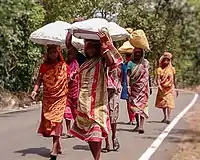
Bagal (pronounced as Bāgāl, Hindi: बागाल, Bengali: বাগাল, Odia: ବାଗାଲ୍/ ବଗାଳ) is a cattle herding caste of East India. Bagal people are living in West Bengal, Jharkhand and Odisha state.[1][2][3][4][5][6] Kudmali is their mother tongue (locally known as Bagal Bhasa) but they also speak Hindi, Bengali and Odia as a secondary language.[7][8][9][10][11]
| Bagal | |
|---|---|
| বাগাল, ବାଗାଲ/ ବଗାଳ, बागाल | |
 | |
| Religions | Hinduism |
| Languages | L1 – Kudmali (Similar to Bengali-Manbhumi dialect) L2 – Hindi, Odia, Bengali |
| Country | India |
| Populated states | Jharkhand, Odisha, West Bengal |
| Region | Balasore, Jhargram, Mayurbhanj, Paschim Medinipur, Sareikela, East Singhbhum |
| Population | est. 40,000 |
| Family names | Bagal, Gop, Khilar, Rout |
| Endogamous | Ahir Bagal Khanroal (Khandait) Bagal Krishna Bagal Mogodha Bagal |
| Related groups | Bhumij, Rajuar, Mahato |
| Historical grouping | Pastoralist, Serving Class |
| Status | General Category |
Overview
According to anthropologist Kumar Suresh Singh, Swapan Kumar Chakraborty, Swaran Singh, Nava Kishore Das, Bagal is a cattle herding caste of India and the literal meaning 'Bagal' is a group of people whose duty is grazing and taking care of cattle and other domestic animals.[12][8] The Bagal people worked as contractual herder in the affluent families of Hindu caste, hence they are also called Bhatua and Baromasia. Historically, they all migrated from central India but in early independence, they started to live in separate hamlet of some multiethnic village of Chota Nagpur division of Bihar.[13][14]
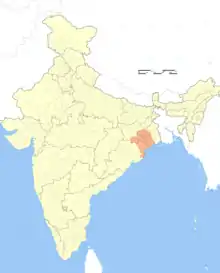
| State | Jharkhand | Odisha | West Bengal |
|---|---|---|---|
| District | Paschim Singbhum | Baleswar | Bankura |
| Jhargram | |||
| Purba Singbhum | Bhadrak | Paschim Medinipur | |
| Sareikela Kharsawan | Kendrapada | Purulia | |
| Mayurbhanj | Purba Medinipur |
As per the Mayurbhanj state census report 1931, the literacy rate was 2.29 per cent of the total population of Bagal people (i.e., 1621 people) in Mayurbhanj state[15][16] and in Medinipur district estimated population was twenty thousand as per anthropological publication 2012.[7]
Social Structure
In the Hindu social structure, Bagal people fall in lower section of the Varna system but they perceive themselves in the middle range of caste hierarchy following tribal characteristics and considered as a clean caste by the Adivasi community.[17][18][19] There are four endogamous subdivision of Bagal society namely Ahir Bagal, Khanroal (Khandait) Bagal (inhabitants of Jharkhand and Odisha) and Krishna Bagal, Mogodha Bagal (inhabitants of West Bengal and Odisha). There are no lineage in Ahir Bagal and Khanroal (Khandait) Bagal but in Mogodha Bagal and Krishna Bagal there are approximately 23–25 mejor lineage i.e., Arikula, Banardiha, Bankuar, Bhatua, Bukuria, Chardiha, Danadiha, Deolia, Gutisukri/ Butisukri, Hajombanda, Jetuar/ Jegoar, Kulmahtu, Kurkutia, Lakul, Manikdiha, Patkam, Punihasa, Samdia/ Samdiha, Sanahatu, Satbhaya, Sikaria, Tetla. Those bigger lineage have sub-lineage also and every lineage has some number of clans (gotra). Nag [Snake], Sal, Kachim [Tortoise], Siyal, Boni [Indian Myna], Singai are totemic clans while Kashyapa and Sandilya are non-totemic clans.[7] Buru Bhatua and Deolia are the community level priest lineage of the Bagal caste.[7] Most of the Bagal people use their caste name Bagal as a surname while others use Rout, Khilar, Gop.[19][8]
History
Mythology
The mythological story about their origin is that they originated from the sweat of Lord Krishna. Therefore, they claim themselves to be 'Krishna Gop'.[14]
Origin & Occupation
Bagal people migrated from central India and they are one of the original settlers of Singhbhum district of Jharkhand.[19] Over a while, some of them migrated to Bengal province and Mayurbhanj Princely State. Bagal settlement is mostly found on both sides of the Subarnarekha river which is the borderline of Jharkhand, Odisha and West Bengal. Origin of this community remained unclear but Mayurbhanj State census 1931 noted that;
The Bagals are the cattle–herds. Herding cattle is their principal occupation. In the census of 1901, the Bagals of Medinapore ware included in the Ahir and Gohala, and those of Bankura in Bauri.
..... But a note has been left to the effect that they form a real caste in Mayurbhanj and Saraikela State, which is a fact. Through the large number of Bagals still follow their traditional occupation, many of them have taken to agriculture.
As a herder caste, they are always in search of forest, hills and grazing land for their animals. At a later date, they started to live near the Subarnarekha river. To make agricultural land people used to occupy forest land by Podu farming but due to modernization, they switched to different occupations from their racial occupation. Now Agriculture, Saltwater fishing, Daily labour are the main sources of income for them.
Culture
Bagal people have some unique culture and tradition, celebrated over the year but the Bagal traditions are observed where the Bagal population is high while only the hereditary traditions are observed in lower population areas.
Rituals of life
Humans go through various stages of age, and those steps are observed in a variety of social disciplines. Although the social customs of the Bagal people are inspired by Hinduism, the methods and purposes of observance are different.
When a baby is born in the Bagal race, they immediately announce the good news to their relatives and celebrate a festival on the ninth day of the baby's birth, called Narta Ghar, and the baby is named in the twenty-first day. In adolescence, the boy grazes domestic animals, assists his parents with household chores. During puberty, the boy tries to learn agricultural and other sustainable work. When a boy or girl reaches their marriage age, the family seeks out a suitable spouse for them, but they don't practice same lineage marriage. There are three types of marriage for the people of Bagal, namely Dekha Chahan Behaghar, Palaniya (Sindur ghasa) Behaghar, Kuta Mala Behaghar and Sanga Behaghar. During pregnancy, a woman has to follow a variety of traditions, as well as a variety of rituals. At seven months of pregnancy, the woman's family member happily brings a variety of food and organizes a small feast with the neighbours which they call the Shad Khia.
Festivals
There are two types of festivals based on how they give importance to those festivals.
Bangsa puja / Gotar puja/ Ghar puja, Gan puja, Asali puja, Mag puja, Jantal puja, Nua khai are community level festivals, which are celebrated within their lineage, sublineage, clan or family. Meanwhile, Makar parab, Durga puja, Bandhna/ Kali puja, Tusu puja, Raja parab, Gamha parab festivals are celebrated with the neighbouring communities of their locality.
Karam Puja is an important festival for the youth of Bagal. In which their elders inform them about their race, tradition and ancestor.[22]
Dance & Music
Bagal people dance to a variety of songs during the festival to make life more enjoyable. Their songs often contain stories and experiences from their lives. Karam dance and song are unique to them.[7]
Politics
The areas inhabited by Bagal people were divided into three political zones after independence due to the amalgamation and division of the various states of India, resulting in mobilization of the community and losing their identity in society. They remain backward in all aspects of society.[23] However, they occasionally raised their demands to their respective state as well as the central government to gain constitutional rights but their demands aren't accepted by Government. Some of the major sociopolitical events are noted below;
In 1970–75, there was a retribalisation by Bagal people in Jharkhand & West Bengal for inclusion of Bagal caste in Scheduled list.[24] On May 15, 1985, Lok Sabha Debate - Second session; Shri Chintamani Jena (Balesore), Member of Lok Sabha asked Shrimati Ram Dilari Sinha, The Ministry of Home Affairs for the inclusion of Bagal caste in the scheduled tribe. Shrimati R.D. Sinha responded that the proposal is considered and will be included after a comprehensive revision.[25] In 2010–11, On the Demand for Grant No. 94 under the control of the Ministry of Tribal Affairs discussion. Dr Pulin Bihari Baske (Jhargram) Member of Lok Sabha mentioned in the Lok Sabha debate that the Bagal community has to be included in the tribal list recommended by West Bengal Government to Central Government through CRI Report.[26] On June 28, 2018, Tribal Advisory Council recommended to ST & SC Development Department, Government of Odisha to not include Bagal Caste in the Scheduled Tribe list.[27]
In 1979, the Government of India set up a commission to identify socially and educationally backward castes (known as the Mandal Commission) in which the Bagal caste was identified as the OBC. Later, a Dalit member of the Mandal Commission refused to sign the commission's report. He urged the commission to categorize the OBC into two groups. i.e., the Backward and Depressed Backward Class. In his report, he categorized the Bagal caste as a Depressed Backward Class. However, the commission report wasn't implemented due to sociopolitical criticism but in pursuit of social justice, the Mandal Commission recommendations were implemented partially and only half of the recommended community was considered as OBC by the National Commission for Backward Classes (NCBC), India and the Bagal caste wasn't considered as a OBC.[28]
The Bagal people are not scheduled to claim any constitutional benefits either as an ST or as an SC, not even OBC/SEBC. As a result, some Bagal people are introducing themselves as Bāgatā, Bāigā, Gop and Rajuar people in sake of reservation.[7][29]
References
- Risley, Sir Herbert Hope (1981). The Tribes and Castes of Bengal: Ethnographic Glossary. Firma Mukhopadhyay. p. 36.
- Davis, Marvin (1983-03-10). Rank and Rivalry: The Politics of Inequality in Rural West Bengal. CUP Archive. p. 60. ISBN 978-0-521-28880-4.
- Singh, Swaran (1994). Bathudi and Sounti Tribes: A Bio-anthropological Profile. Gyan Publishing House. p. 31. ISBN 978-81-212-0466-8.
- Bhowmick, P. K. (1963). Caste and Service in a Bengal Village. Department of Anthropology, Calcutta University. p. 279.
- Orissa (India) (1967). Orissa District Gazetteers: Balangir. Superintendent, Orissa Government Press. p. 109.
- Taradatt, Dr. Basa, Kishor K (ed.). "Odisha District Gazetteer (Mayurbhanj)" (PDF). gopabadhuacademy.gov.in. Gopabandhu Academy of Administration [Gazetters Unit], General Administration Department Government Of Odisha. p. 97.
- Chakraborty (Anthropologist), Swapan Kumar (2012). Bagals of Border Bengal: A Cattle Herding Community in Search of Identity. Anthropological Survey of India, Government of India. ISBN 978-81-922974-2-2.
- Das, Nava Kishor (2012). Odisha. Anthropological Survey of India by Seagull Books. p. 210. ISBN 978-81-7046-293-4.
- Singh, K. S.; Manoharan, S. (1993). Languages and Scripts. Anthropological Survey of India. ISBN 978-0-19-563352-8.
- Singh, K. S.; India, Anthropological Survey of (1998). India's Communities. Oxford University Press. p. 166. ISBN 978-0-19-563354-2.
- Saha, Atanu (2018-07-28). "Census and the Aspects of Growth and Development of Bangla vs. Bangla-Hindi Bilingualism-With Special Focus on West Bengal". Cite journal requires
|journal=(help) - Bhaumika, Saritā (1987). Tribal Odyssey: A Journey Between Two Worlds. Institute of Social Research and Applied Anthropology. p. 53.
- Bhattacharya, Sudhibhushan (1968). Ethno-musicology and India. Indian Publications. p. 68.
- Singh, Kumar Suresh; India, Anthropological Survey of (2008). People of India. Anthropological Survey of India. ISBN 978-81-7046-302-3.
- India Census Commission (1931). Census of Mayurbhanj state, 1931. I. Kolkata, West Bengal: Census Commission India. JSTOR saoa.crl.25352830.
- Mayurbhanj (Princely State); Laeequddin, Muhammad (1935). Census of Mayurbhanj State, 1931. II. Calcutta: Calcutta, 1937. JSTOR saoa.crl.25352831. OCLC 496724918.
- Memoir. Anthropological Survey of India. 1966. p. 34.
- Bengal (India), West (1985). West Bengal District Gazetteers: Puruliya. State editor, West Bengal District Gazetteers. p. 143.
- Singh, Kumar Suresh (1992). People of India: Odisha (2 pts.). Anthropological Survey of India. p. 210. ISBN 978-81-7046-294-1.
- India Census Commission (1931). Census of Mayurbhanj state, 1931. I. Kolkata, West Bengal: Census Commission India. JSTOR saoa.crl.25352830.
- Mayurbhanj (Princely State); Laeequddin, Muhammad (1935). Census of Mayurbhanj State, 1931. II. Calcutta: Calcutta, 1937. JSTOR saoa.crl.25352831. OCLC 496724918.
- Bengal, India Superintendent of Census Operations, West (1965). District Census Handbook, West Bengal: Purulia. Superintendent, Government Print.
- Pramanick, Swapan Kumar; Manna, Samita (2007). Explorations in Anthropology: P.K. Bhowmick and His Collaborative Research Works. Serials Publlications. pp. 10, 553. ISBN 978-81-8387-100-6.
- Institute, West Bengal (India) Cultural Research (1978). Bulletin of the Cultural Research Institute. The Institute. p. 11.
- Sabha, India Parliament Lok (1985). Lok Sabha Debates. Lok Sabha Secretariat. p. 147.
- Sabha, India Parliament Lok (2010-04-23). Lok Sabha Debates. Lok Sabha Secretariat. p. 669.
- Government of Odisha, ST & SC Development Department. "Tribes Advisory Council Meeting Report" (PDF). Forest Rights Act. Archived (PDF) from the original on 5 July 2021.
- Commission, 1980, India Backward Classes; Mandal, Bindhyeshwari Prasad (1991). Reservations for Backward Classes: Mandal Commission Report of the Backward Classes Commission, 1980, Alongwith Introduction. Akalank Publications.
- Bhadra, Ranjit K; Mondal, S. R, eds. (1991). "Ethnicity, Ethnic groups and Survival Strategy". Stratification, hierarchy, and ethnicity in North-east India. Delhi: Daya Pub. House. p. 19. ISBN 978-81-7035-086-6. OCLC 26858289.
In West Bengal, there is a group of people who are popularly known as Bagal, which means 'cattle herding' ...But they do not belong to Scheduled Caste or tribe. As a result, they are trying to re - name themselves as 'Baiga', because the Baigas are Scheduled tribe and are getting all Constitutional benefits.
Further reading
- Chakraborty, Swapan Kumar (2012). Bagals of border Bengal: a cattle herding community in search of identity. Memo. Anthropological Survey of India. Kolkata: Anthropological Survey of India, Government of India. ISBN 978-81-922974-2-2. OCLC 829240406.
- Census of India. Village Survey Monograph of Bhumij Dhan Sol (PDF). Census of India 1961 – West Bengal and Sikkim. Volume–XVI, Part –VI (5). Delhi: Manager Publication. OCLC 1220213.
|volume=has extra text (help) - "District Census Reports, 1891 Chota Nagpur Division, Bihar" (PDF). lsi.gov.in. Retrieved 15 February 2012.
- Singh, Ekta (2005). Caste System in India: A Historical Perspective. Kalpaz Publications. ISBN 978-81-7835-301-2.