Baghor stone
Baghor stone is an Upper Paleolithic archaeological object that was found in the Son river valley near the village of Medhauli, in the Sidhi District, Madhya Pradesh, India. The stone was found at the site of Baghor I, which is located near the base of the Kaimur Escarpment. It was first excavated in 1980.
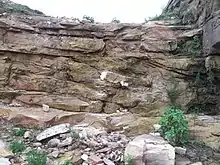
Baghor stone is a natural triangular piece of local sandstone; it is rather colourful, and had been decorated with yellow pigment. These types of stones may be found on top of the escarpment. The Baghor site, with all its many lithic artefacts, is dated between 9000 B.C and 8000 B.C.[1]
Site description
The site was first excavated under the direction of archaeologists G. R. Sharma of Allahabad University and J. Desmond Clark of University of California, and assisted by Jonathan Mark Kenoyer and J.N. Pal.
This was determined as a short term occupation site. The floor was composed of rubble, and there was a lot of manufacturing waste from stone tool manufacture. Many varieties of backed blades and geometric microliths were found, as well as grinding stones and ring stones.
Later, as a lot of material was removed, a stone platform was identified, with the Baghor triangular stone in the center. This platform was interpreted as a site for ritual ceremonies. Baghor shrine is a modest temple that only has a stone platform under Neem tree and a triangular shaped Yantra worshiped as Goddess in the middle of platform.
Yet, it has been worshiped continuously since 11,000 years from Paleolithic hunter gatherers to modern day inhabitants[2][3]
Thus, it took archaeologists quite a lot of time to correctly identify the original role and meaning of the Baghor stone.[4]
See also
Notes
- Kenoyer, J. M.; Clark, J. D.; Pal, J. N.; Sharma, G. R. (1983-07-01). "An upper palaeolithic shrine in India?" (PDF). Antiquity. 57 (220): 88–94. doi:10.1017/S0003598X00055253. ISSN 0003-598X.
- Kenoyer, J. M.; Clark, J. D.; Pal, J. N.; Sharma, G. R. (1983-07-01). "An upper palaeolithic shrine in India?" (PDF). Antiquity. 57 (220): 88–94. doi:10.1017/S0003598X00055253. ISSN 0003-598X.
- James, Hannah V.A.; Petraglia, Michael D. (2005). "Modern Human Origins and the Evolution of Behavior in the Later Pleistocene Record of South Asia". Current Anthropology. 46 (S5): S3–S27. doi:10.1086/444365. hdl:11858/00-001M-0000-002B-0DBC-F. ISSN 0011-3204.
- "An Archaeologist at Work in African Prehistory and Early Human Studies: Teamwork and Insight – Interview with archaeologist J. Desmond Clark". www.oac.cdlib.org. Retrieved 2017-04-11.
Bibliography
- Chattopadhyaya, Indrani (2016). "Living Tradition: A Study of Prehistoric Rock-paintings and Indigenous Art from District Sonbhadra, Southern Uttar Pradesh, India". Athens Journal of Humanities and Arts. 3 (4): 251–270. doi:10.30958/ajha.3.4.3. ISSN 2241-7702.
- Misra, V. N. (2001). "Prehistoric human colonization of India". Journal of Biosciences. 26 (4): 491–531. doi:10.1007/BF02704749. ISSN 0250-5991.
- Jones, Sacha C.; Pal, J.N. (2009). "The Palaeolithic of the Middle Son valley, north-central India: Changes in hominin lithic technology and behaviour during the Upper Pleistocene". Journal of Anthropological Archaeology. 28 (3): 323–341. doi:10.1016/j.jaa.2009.05.003. ISSN 0278-4165.