Ballet Royal de la Nuit
The Ballet Royal de la Nuit (Royal Ballet of the Night), Ballet Royal de la Nuict in its original spelling and often referred to simply as the Ballet de la Nuit, is a ballet de cour with a libretto by Isaac de Benserade and music by Jean de Cambefort, Jean-Baptiste Boësset, Michel Lambert, Giovanni Battista Lulli, who is better known by his French name, Jean-Baptiste Lully, and possibly others, which premiered on February 23, 1653, at the Salle du Petit-Bourbon in Paris.[2] It took 13 hours to perform and debuted fourteen year old Louis XIV as Apollo, the Sun King (Le Roi Soleil).[3]
.png.webp)
Plot and music outline
The Ballet de la Nuit concerned the four Watches (veilles) of the night, beginning at 6 o'clock in the evening and ending at 6 o'clock in the morning: the first watch (sunset) lasted from 6 p.m. to 9 p.m.; the second, from 9 p.m. to 12 a.m.; the third, from 12 a.m. to 3 a.m., and the fourth (sunrise), from 3 a.m. to 6 a.m.[3] With airs by Jean de Cambefort, it was an extravagant court spectacle featuring forty-five entrees and three ballets within a ballet, which took about 13 hours to perform. The plot included mythological goddesses such as Venus and Diana, werewolves, demonic creatures and witches who celebrated a black Sabbath in the horrors of the night. Shepherds, gypsies, thieves, lamplighters, beggars and crippled are among the “realistic” characters of the play. King Louis XIV appears with the coming of the day as the sun god Apollo, one of his many personifications as the rising sun, emphasizing the power of the monarchy and its closeness to the divine.[4]
Purpose
The Ballet de la Nuit served a similar purpose to other ballets of the time, which was subjugating nobles. Putting the nobles into a ballet production kept them dancing, both literally and metaphorically, in the monarch's orbit. A scripted ballet allowed for even further levels of control; their movements were dictated by a choreographer, their characters were designed by a librettist. The court ballets were designed for the appearance of continuity and stability in a time where there really wasn't any. The ballet served a huge political purpose at the time. The entire point was really just to cement in the French subjects minds that Louis XIV was not only the new king, but a great king who was going to lead them out of darkness and into a time of prosperity. This is done, not so subtly, through the imagery of night, which is the four Watches, which then leads to light, which is represented by Louis XIV who played Apollo, the Sun God. This imagery had long been associated with the 14 year old king, but this was the first time that Louis XIV had ever actually personified the Sun God.
Characters
At this time, there was much concern with "appropriateness". As such, children would be cast for roles such as cherubs, women would be cast as water nymphs, and older performers would be assigned the statelier roles. Since nobles would often be cast in these shows as a way to keep them dancing around for the monarchy, a social expectation developed for the nobles to carry themselves in an appropriate manner. The expectation became that the nobles would balance the character they were assigned with the image that they wanted projected of themselves to the court. This could get messy sometimes, if there were characters with less decorum than expected from a noble, so they would usually get a professional dancer to play those roles to avoid the social ridicule that could come from portraying a less than ideal version of a noble. Dancers would oftentimes sacrifice their autonomy and individualism in order to create and share the best version of their character with the audience. In the Ballet de la Nuit, the beggars were all played by professionals. This choice was made for this particular performance to preserve the dignity of the nobles performing. Since the main purpose of the performance was as a political statement about the greatness of Louis XIV and the monarchy, it makes sense that they may have chosen to preserve the dignity of the nobles over the dignity of the performance.
Costumes
Henri de Gissey (c. 1621–73), Dessinateur ordinaire du Cabinet du Roy, was in charge of dress design for the royal ballets. A collection of 10 scenic and 117 costume designs for the ballet made for Louis Hesselin (1602-1662) and attributed to Gissey are now at Waddesdon Manor. Another folio with 119 costume designs made for Denis-Pierre-Jean Papillon de la Ferté (1727-1794) is now in Paris at the Bibliothèque de l'Institut (MS 1004).
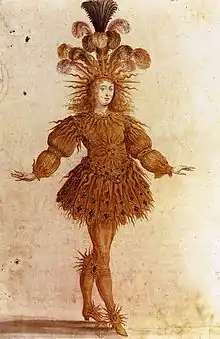 The costume of Apollon, performed by Louis XIV
.jpg.webp) The costume of the lute player
The costume of the lute player.jpg.webp) The costume of the soldier
The costume of the soldier
Guest Dancers
The Ballet de la Nuit was a very unique performance for the time. They casted two very talented and celebrated English dancers in a show that was meant to celebrate the French ruler and communicate the political message of Louis XIV being the king that would bring France out of darkness. The two English dancers that they cast in this show were the Duke of York and the Duke of Buckingham. The Duke of York appeared twice throughout this ballet. He first appeared in the seventh entry of the fourth Watch of the ballet, which required him depict occult activities in the dark of night. He then later appeared again, this time in the final number as a "génie d'honneur". Even though his first role may have seemed less than flattering, the social expectations attached to the idea that the Duke was the one performing seemed almost more important to the audience than anything that may have been suggested by this role.
Ballet de la Nuit in facsimile
The Ballet de la Nuit was the subject of the annual Oxford Dance Symposium in 2004, and there is an extensive study of the work by a group of scholars.[5] The symposium met at Waddesdon Manor, where the folio volume (Rothschild B1/16/6) with the arms of Louis Hesselin on the cover that contains stage and costumes designs is kept. It also met at Oxford on the same day, where papers were given on many aspects of the ballet. Michael Burden and Jennifer Thorp subsequently published a volume Ballet de la Nuit: Rothschild B1/16/6 with the Pendragon Press in New York. The essays in the volume are: Michael Burden "The Ballet de la Nuit"; David Parrott: "Art, ceremony and performance: Cardinal Mazarin and cultural patronage at the court of Louis XIV"; Jennifer Thorp: "Dances and dancers in the Ballet de la Nuit"; and Catherine Massip: "The Ballet de la Nuit: a political and musical statement". The foreword is by Jacob Rothschild, 4th Baron Rothschild. The volume also includes some of the surviving sources for the ballet, including a facsimile of the livret and a reproduction of the scenography from Rothschild B1/16/6. It also includes a modern edition of the surviving music by Lionel Sawkins. This was the first ballet de cour to be published in complete form.
Film
There is one scene from Ballet Royal de la Nuit in the historical movie Le Roi danse (scene used in this movie is from the end of ballet, called The sun rise, fr. Le Roi représentant le soleil levant).
See also
Notes
- "Ballet // Royal // De la Nuict // Divisé en quatre Parties ou quatre Veilles // Dansé // Par sa Majesté le 23e Fevrier 1653. // Recueilly // Par Philidor Laisnée En 1690" (BnF, département Musique, RES F-501) published online at Gallica on November 11, 2018.
- Bjurström 1962, pp. 157–159.
- Burden & Thorp 2009, p. 3.
- Susan Au,Ballet and Modern Dance, second edition
- Burden & Thorp 2009, revised 2010. According to an email from Pendragon, early copies are missing the scenography plates. Based on Pendragon's product page the title of Michael Burden's essay ("A spectacle for the King" in the 2009 edition) is "The Ballet de la Nuit".
Bibliography
- Bjurström, Per (1962). Giacomo Torelli and Baroque Stage Design, 2nd revised edition, translated from the Swedish. Stockholm: Almqvist & Wiksell. OCLC 10226792.
- Burden, Michael; Thorp, Jennifer (2009; revised 2010). Ballet de la Nuit: Rothschild B1/16/6. Hillsdale, New York: Pendragon Press. ISBN 9781576471432. Product page for the revised edition at Pendragon.
- Apollo's Angels A history of Ballet by Jennifer Homans 2010
External links
- Waddesdon Manor the ballet livret, costumes and scenery