Banded bullfrog
The banded bullfrog (Kaloula pulchra) is a species of frog in the narrow-mouthed frog family Microhylidae. Native to Southeast Asia, it is also known as the Asian painted frog, Malaysian painted frog, Burmese painted frog, rice frog, and bubble frog. In the pet trade, it is sometimes called the chubby frog. Adults measure 5.4 to 7.5 cm (2.1 to 3.0 in) and have a dark brown back, with stripes that vary from copper-brown to salmon pink.
| Banded bullfrog | |
|---|---|
.jpg.webp) | |
| Calls of several banded bullfrogs | |
Scientific classification  | |
| Kingdom: | Animalia |
| Phylum: | Chordata |
| Class: | Amphibia |
| Order: | Anura |
| Family: | Microhylidae |
| Genus: | Kaloula |
| Species: | K. pulchra |
| Binomial name | |
| Kaloula pulchra (Gray, 1831) | |
 | |

The banded bullfrog lives at low altitude and is found in both urban and rural settings, as well as in forest habitats. They bury themselves underground during dry periods and emerge after heavy rainfall to emit calls and breed. They feed primarily on ants and termites; predators of adults and tadpoles include snakes, dragonfly larvae, and snails. When threatened, they inflate their lungs and secrete a noxious white substance. The species is prevalent in the pet trade and is a potential invasive species.
Taxonomy
The banded bullfrog was first described in 1831 by the British zoologist John Edward Gray, as Kaloula pulchra (pulchra meaning "beautiful" in Latin).[2] Cantor (1847) described the species under the name Hylaedactylus bivittatus,[3] which was synonymized with K. pulchra by Günther (1858).[4] The subspecies K. p. hainana was described by Gressitt (1938) as having a shorter snout and hind legs compared to the nominate subspecies, K. p. pulchra.[5] A former subspecies in Sri Lanka, originally named K. p. taprobanica by Parker (1934), has since been reclassified as a separate species, Uperodon taprobanicus.[6] Bourret (1942) described a subspecies K. p. macrocephala that is now considered by several authors to be a distinct species, K. macrocephala.[7][8][9]
Description
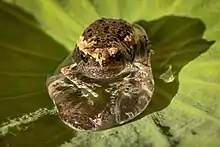
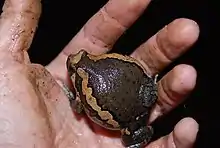
The banded bullfrog is medium-sized with a stocky, triangular body and a short snout.[10][11] Males grow to a snout–vent length (SVL) of 5.4 to 7.0 cm (2.1 to 2.8 in) and females are slightly larger, reaching an SVL of 5.7 to 7.5 cm (2.2 to 3.0 in). Other than the slight difference in length, there is very limited sexual dimorphism.[12] They have a body weight of 80–120 g.[13] The back is dark brown with stripes that vary from copper-brown to salmon pink, and the abdomen is cream-colored.[10][14]
Tadpoles are about 0.5 cm (0.20 in) long after hatching and reach an SVL of about 1.1 cm (0.43 in) at the end of metamorphosis. They have an oval body that is brown or black with a pale belly, a round snout, and a moderately long, tapered tail with yellow speckles and tall fins. The eyes are relatively small and the side of the head, with black or dark gray irises and a golden ring around the pupil. They do not possess any tail filament.[15] During metamorphosis, their eyes increase in size and bulge and they develop slender limbs and digits with rounded tips.[16] The tadpoles can metamorphose in as little as two weeks.[17]
Distribution and habitat
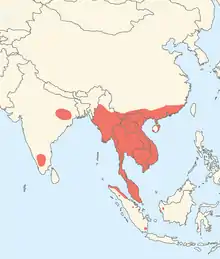
The species is native to Southeast Asia.[18] It is common over a range from northeastern India,[19] and Nepal,[20] to southern India and Sri Lanka[20] to southern China[19][20] (especially Hainan) and Myanmar,[20] and south to the islands of maritime Southeast Asia.[19][21][20] Its wide distribution, compared to the related species Kaloula assamensis, has been attributed to its burrowing ability.[22]
The banded bullfrog has been found at elevations between sea level and 750 m (2,460 ft) above sea level.[1] It can occur in both urban and rural settings, and in forest habitats.[23]
As an invasive species
The species is a potential invasive species. It has been introduced through both the pet trade and maritime transport, and has become established in Taiwan, the Philippines,[24] Guam,[25] Singapore, Borneo and Sulawesi[20][26] with specimens noted in Australia and New Zealand.[26][27][28] Its introduction into the Philippines was likely accidental, via contamination of plant nursery materials or stowaways on ships and boats.[18]
An invasive population was observed in Florida in 2006 and later in 2011, likely through the pet trade; however, the invasive population is under control.[29] In 2005 the frog was observed at an airport in Perth, and at a cargo port in New Zealand, but no established invasive population has been found in either Australia or New Zealand.[29]
Behaviour and ecology
Breeding is stimulated by heavy monsoon rains, after which the frogs relocate from underground to rain pools or ponds.[21][30] They are more commonly found on wetter nights, and while they are not reproductively active during dry periods, their gonads remain ripe so that they can mate as soon as rain falls.[30] In India, the frogs call after the first heavy monsoon showers in April–May. The males call while afloat in pools of water. The pulses of the calls recorded in India were 28–56 per second with a frequency range of 50–1760 Hz. In Thailand the dominant frequency was 250 Hz (duration 560–600 ms long) and 18–21 pulses per call.[31]
Their form is suited for walking and burrowing, rather than jumping.[32] They are able to survive dry conditions by burying themselves in the ground and waiting for rain; the burrowing also helps them avoid predators. When burrowing they dig their way down back hindlimb first and use their forelimbs to push themselves several inches under the soil, where they can remain for a long time.[22] Banded bullfrogs hide under leaf litter during the day hours and eat in the evening. They have been found in trees and have been observed hunting termites in them.[33]
Diet, predators, and parasites
In the wild, the banded bullfrog primarily eats ants and termites.[33] It also feeds on other small invertebrates including flies, crickets, moths, grasshoppers, and earthworms.[34] Its relatively small head and mouth mostly limit its diet to small and slow-moving prey.[34][35] The feeding cycle (from opening of the mouth to closing) is about 150 milliseconds and is relatively symmetrical, meaning that the bullfrog spends an equal amount of time extending its tongue and bringing the prey into the mouth.[36] Banded bullfrogs kept as pets can be fed insects such as crickets, mealworms, insect larvae, and beetles.[37]
Snakes such as the kukri snake are predators of adult banded bullfrogs.[23] For eggs and tadpoles, predators include dragonfly larvae and snails such as the golden apple snail.[38][39] Banded bullfrogs display deimatic behaviour when threatened, greatly inflating their lungs in an attempt to distract or startle predators.[11] By inflating its body and bending its head down, the bullfrog can appear larger than its actual size.[22] It also secretes a noxious white substance through its skin that is distasteful, though non-toxic, to predators.[40][41] The secretion contains a trypsin inhibitor and can induce hemolysis (rupturing of red blood cells).[40][13]
Parasites include parasitic worms that have been found in the frog's intestinal mesentery and leeches that attach to the frog's back.[10][42]
Pet trade
Banded bullfrogs are commonly sold in pet stores. They are sensitive to chlorine in water. They are maintained in aquariums with substrate choices consisting of peat–soil mixes or potting soil with sphagnum moss. They need high humidity and prefer temperatures of 70–80 °F (21–27 °C).[37]
References
- Kuangyang L, Zhigang Y, Haitao S, et al. (2004). "Kaloula pulchra (errata version published in 2016)". The IUCN Red List of Threatened Species. 2004: e.T57855A86163405. doi:10.2305/IUCN.UK.2004.RLTS.T57855A11694615.en.
- Gray JE (1831). "Description of two new genera of Frogs discovered by John Reeves, Esq. in China". The zoological miscellany: to be continued occasionally. London: Treuttel, Wurtz and Co., G.B. Sowerby, W. Wood. p. 38. doi:10.5962/bhl.title.113722. OCLC 2319292.
- Cantor T (1847). Catalogue of reptiles inhabiting the Malayan peninsula and islands. Calcutta: J. Thomas. pp. 143–145. doi:10.5962/bhl.title.5057.
- Günther A (1858). Catalogue of the Batrachia Salientia in the collection of the British Museum. London: Taylor & Francis. p. 123. doi:10.5962/bhl.title.8326. OCLC 1098151.
- Gressitt JL (1938). "A new burrowing frog and a new lizard from Hainan Island". Proceedings of the Biological Society of Washington. Biological Society of Washington. 51: 127–130 – via Biodiversity Heritage Library.
- Garg S, Senevirathne G, Wijayathilaka N, et al. (2018). "An integrative taxonomic review of the South Asian microhylid genus Uperodon". Zootaxa. 4384 (1): 1–88. doi:10.11646/zootaxa.4384.1.1. PMID 29689915.
- Bourret R (1942). Les batraciens de l'Indochine. Hanoi: L'Institut océanographique de l'Indochine. pp. 490–491. OCLC 715507054.
- Pauwels OS, Chérot F (2006). "Translation of the original description of Kaloula aureata Nutphand, 1989 (Anura: Microhylidae), with lectotype designation". Hamadryad. 30 (1–2): 172–175. ISSN 0972-205X.
- Mo Y, Zhang W, Zhou S, et al. (2013). "A new species of Kaloula (Amphibia: Anura: Microhylidae) from southern Guangxi, China". Zootaxa. 3710 (2): 165–178. doi:10.11646/zootaxa.3710.2.3. PMID 26106681.
- Nakano T, Sung YH (2014). "A New Host Record for Tritetrabdella taiwana (Hirudinida: Arhynchobdellida: Haemadipsidae) from the Asian Painted Frog Kaloula pulchra (Anura: Microhylidae) in Hong Kong, China, with a Taxonomic Note on T. taiwana". Comparative Parasitology. 81 (1): 125–129. doi:10.1654/4667.1.
- Shahrudin S (2021). "Defensive behavior of Banded Bullfrogs, Kaloula pulchra Gray 1831 (Anura: Microhylidae) from Kedah, peninsular Malaysia". Reptiles & Amphibians. 28 (1): 139–141. doi:10.17161/randa.v28i1.15371.
- Ruiz-Fernández MJ, Jiménez S, Fernández-Valle E, et al. "Sex Determination in Two Species of Anuran Amphibians by Magnetic Resonance Imaging and Ultrasound Techniques". Animals (Basel). doi:10.3390/ani10112142. PMC 7698606. PMID 33217993.
- Wei S, Chi T, Meng A, et al. (2013). "Characteristics of hemolytic activity induced by skin secretions of the frog Kaloula pulchra hainana". Journal of Venomous Animals and Toxins including Tropical Diseases. 19 (9).
- Bhattacharjee PP, Laskar D, Majumder J, et al. (2011). "Sighting of Asian Painted Frog (Kaloula pulchra) from West Bhubanban (near Agartala city), West Tripura district, Tripura". NeBIO. 2 (1): 18–19.
- Bowles P. "Asian Banded Bullfrog". The Online Field Guide. Archived from the original on 21 January 2020. Retrieved 3 December 2021.
- Vassilieva AB (2021). "Larval morphology of three syntopic species of Kaloula Gray (Anura: Microhylidae) from Vietnam". Zootaxa. 4952 (1): 71–86. doi:10.11646/zootaxa.4952.1.4. PMID 33903379.
- Bartlett RD, Bartlett PP (1996). Frogs, toads, and treefrogs: everything about selection, care, nutrition, breeding, and behavior. Hauppage, NY: Barron's Educational Series. p. 98. ISBN 978-0-8120-9156-4. OCLC 859029562.
- Pili AN, Sy EY, Diesmos ML, et al. (2019). "Island Hopping in a Biodiversity Hotspot Archipelago: Reconstructed Invasion History and Updated Status and Distribution of Alien Frogs in the Philippines". Pacific Science. 73 (3): 321–343. doi:10.2984/73.3.2.
- Christy MT, Clark CS, Gee DE, et al. (2007). "Recent Records of Alien Anurans on the Pacific Island of Guam". Pacific Science. 61 (4): 469–483. doi:10.2984/1534-6188(2007)61[469:RROAAO]2.0.CO;2.
- Lever, Christopher (2003). Naturalized reptiles and amphibians of the world. Oxford, New York City: Oxford University Press. p. 318. ISBN 978-0-19-850771-0. OCLC 52055624.
- Yeung HY (2021). "Heterospecific Amplexus Between a Male Paddy Frog, Fejervarya multistriata (Hallowell 1861) (Anura: Dicroglossidae), and a Male Banded Bullfrog, Kaloula pulchra Gray 1831 (Anura: Microhylidae), from Hong Kong". Reptiles & Amphibians. 28 (2): 350–351. doi:10.17161/randa.v28i2.15471.
- Soud R, Mazumdar K, Gupta A, et al. (2012). "Defensive and burrowing behaviour of Kaloula assamensis Das et al., 2004 and Kaloula pulchra Gray, 1831 (Microhylidae)" (PDF). Frog Leg. 18: 48–50.
- Bringsøe H, Suthanthangjai M, Suthanthangjai W, et al. (2021). "Gruesome twosome kukri rippers: Oligodon formosanus (Günther, 1872) and O. fasciolatus (Günther, 1864) eat Kaloula pulchra Gray, 1831 either by eviscerating or swallowing whole". Herpetozoa. 34: 49–55. doi:10.3897/herpetozoa.34.e62688.
- Brown RM, Oliveros CH, Siler CD, Fernandez JB, Welton LJ, Buenavente PA, Diesmos ML, Diesmos AC (2012). "Amphibians and Reptiles of Luzon Island (Philippines), VII: Herpetofauna of Ilocos Norte Province, Northern Cordillera Mountain Range". Check List. 8 (3): 469–490. doi:10.15560/8.3.469. S2CID 18375419.
- Christy MT, Savidge JA, Rodda GH (2007). "Multiple pathways for invasion of anurans on a Pacific island". Diversity and Distributions. 13 (5): 598–607. doi:10.1111/j.1472-4642.2007.00378.x.
- Tyler M, Chapman T (2007). "An Asian species of frog (Kaloula pulchra, Microhylidae) intercepted at Perth International Airport, Australia". Applied Herpetology. 4 (1): 86–87. doi:10.1163/157075407779766697.
- Gill BJ, Bejakovtch D, Whitaker AH (2001). "Records of foreign reptiles and amphibians accidentally imported to New Zealand". New Zealand Journal of Zoology. 28 (3): 351–359. doi:10.1080/03014223.2001.9518274. S2CID 85031652.
- Inger RF (1966). The systematics and zoogeography of the amphibia of Borneo. Fieldiana: Zoology vol. 52. doi:10.5962/bhl.title.3147.
- Fuller P, Howell RS (2019). "Kaloula pulchra Gray, 1831". Nonindigenous Aquatic Species Database. United States Geological Survey. Archived from the original on 17 April 2021. Retrieved 3 December 2021.
- Berry PY (1964). "The Breeding Patterns of Seven Species of Singapore Anura". Journal of Animal Ecology. 33 (2): 227–243. JSTOR 2629.
- Kanamadi RD, Kadadevaru GG, Schneider H (2002). "Advertisement Call and Breeding Period of the Frog, Kaloula pulchra (Microhylidae)" (PDF). Herpetological Review. 33 (1): 19–21. Archived from the original (PDF) on 11 February 2012.
- Emerson SB (1976). "Burrowing in frogs". Journal of Morphology. 149 (4): 437–458. doi:10.1002/jmor.1051490402. PMID 30257534. S2CID 52845429.
- Major T, Knierim T, Barnes C, et al. (2017). "Observations of Arboreality in a Burrowing Frog, the Banded Bullfrog, Kaloula pulchra (Amphibia: Anura: Microhylidae)". Current Herpetology. 36 (2): 148–152. doi:10.5358/hsj.36.148. S2CID 89688886.
- Jabon KJ, Gamalo LE, Responte M, et al. (2019). "Density and diet of invasive alien anuran species in a disturbed landscape: A case in the University of the Philippines Mindanao, Davao City, Philippines". Biodiversitas. 20 (9): 2554–2560. doi:10.13057/biodiv/d200917.
- Berry PY (1965). "The diet of some Singapore Anura (Amphibia)". Journal of Zoology. 144 (2): 163–167. doi:10.1111/j.1469-7998.1965.tb05171.x.
- Emerson SB (1985). "Skull Shape in Frogs: Correlations with Diet". Herpetologica. 41 (2): 177–188. JSTOR 3892256.
- Willis AT (2014). "Asian Painted Bullfrog Care". Reptiles. Archived from the original on 3 December 2021. Retrieved 15 December 2021.
- Karraker NE, Dudgeon D (2014). "Invasive apple snails (Pomacea canaliculata) are predators of amphibians in South China". Biological Invasions. 16: 1785–1789. doi:10.1007/s10530-014-0640-2.
- Karraker NE (2011). "Are toad tadpoles unpalatable: evidence from the behaviour of a predatory dragonfly in South China". Amphibia-Reptilia. 32: 413–418.
- Zhang Y, Wang M, Wei S (2010). "Isolation and characterization of a trypsin inhibitor from the skin secretions of Kaloula pulchra hainana". Toxicon. 56 (4): 502–507. doi:10.1016/j.toxicon.2010.05.006.
- Evans CM, Brodie DE (1994). "Adhesive Strength of Amphibian Skin Secretions". Journal of Herpetology. 28 (4): 499–502. JSTOR 1564965.
- Amin OM, Wongsawad C, Marayong T, Saehoong P, Suwattanacoupt S, Sey O (1998). "Sphaerechinorhynchus macropisthospinus sp. n. (Acanthocephala: Plagiorhynchidae) from Lizards, Frogs, and Fish in Thailand". Journal of the Helminthological Society of Washington. 65 (2): 174–178.
External links
 Media related to Kaloula pulchra at Wikimedia Commons