Banjo fitting
A banjo fitting or internally relieved bolt comprises a perforated hollow bolt and spherical union for fluid transfer.[1] They are commonly found in automotive fuel,[2] motor oil and hydraulic systems (e.g.: brakes and clutch). The pipe connected may be either rigid or a flexible hose.[1]
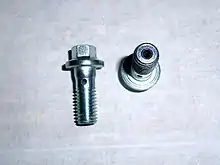
The main advantage of the fitting is in high pressure applications (i.e. more than 50 bar). The name stems from the shape of the fitting, having a large circular section connected to a thinner pipe, generally similar to the shape of a banjo.[1]

Compared to pipe fittings that are themselves threaded, banjo fittings have the advantage that they do not have to be rotated relative to the host fitting. This avoids damage that can be caused by twisting the hose during installation. It also allows the pipe exit direction to be adjusted relative to the fitting, then the bolt tightened independently.
Common applications
- Hydraulic power systems
- Power steering fluid
- Variable valve timing systems
- Brake caliper connectors[1]
- Turbo charger oil feeds
- Fuel filter connectors[3]
- Carburetor connector[2]
- Hydraulic clutch systems
- Fuel dosing for SCR systems
References
- Erjavec, Jack (2003). Automotive Brakes. Cengage Learning. p. 144. ISBN 1401835260.
- Mavrigian, Mike (2008). High Performance Fasteners and Plumbing: A Guide to Nuts, Bolts, Fuel, Brake, Oil and Coolant Lines, Hoses, Clamps, Racinghardware and Plumbing Techniques. Penguin. pp. 12–14. ISBN 978-1-55788-523-4. Retrieved September 15, 2020.
- LaCourse, Jon; Haynes, John Harold. Chevrolet Nova & Geo Prizm Automotive Repair Manual. Haynes Publishing Group. p. 49. ISBN 978-1-85010-642-5. Retrieved September 15, 2020.