Kamaitachi no Yoru
Kamaitachi no Yoru (Japanese: かまいたちの夜, "The Night of the Sickle Weasel"), released in English as Banshee's Last Cry,[1] is a visual novel created by Chunsoft. It was first released for Super Nintendo Entertainment System in 1994 and was later ported to other consoles. An English localized version of the game was translated by Jeremy Blaustein and was released for Android and iOS by Aksys Games in 2014.[1][2][3] The game is the second sound novel by Chunsoft and brought a myriad of other companies to develop similar games. The term "sound novel" was a registered trademark, but is regarded as a genre. The game was a financial success. It sold 750,000 units for Super Nintendo Entertainment System[4] and over 400,000 units for PlayStation.[5] The game sold 1.25 million units with remakes and ports in April 2002.[6]
| Kamaitachi no Yoru | |
|---|---|
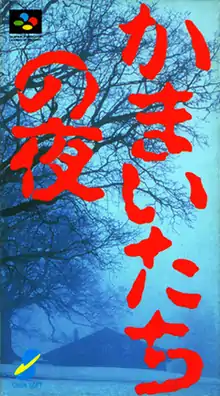 Super Famicom cover art | |
| Developer(s) | Chunsoft |
| Publisher(s) |
|
| Director(s) | Kazuya Asano |
| Producer(s) | Koichi Nakamura |
| Writer(s) | Takemaru Abiko |
| Composer(s) | Kota Kano Kojiro Nakashima |
| Platform(s) | Super Nintendo Entertainment System, PlayStation, Game Boy Advance, PC, mobile, iOS, PlayStation Vita, Microsoft Windows |
| Release | November 25, 1994 |
| Genre(s) | Visual novel, adventure, crime, horror, mystery |
| Mode(s) | Single player |
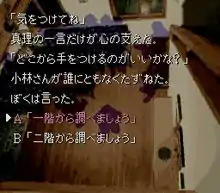
Plot
After finding a note and losing phone calls, a group of guests solve the case about the murder. Additional deaths occur for a bad ending if the player lacks all clues.
Development
The game was revealed in the official guidebook. The contest called for readers to write the storyline with the event. It was allotted for submissions and many readers cannot finish it. Ten were published in a book titled Anata dake no Kamaitachi no Yoru (あなただけのかまいたちの夜, lit. "Your Own Night of the Sickle Weasels") for the short story and gamebook. The book was a success, despite the fact that it targeted readers. Prize money was awarded to writers whose compositions made it into a book. A similar competition started upon the release of Kamaitachi no Yoru 2. It went out of print after many years, but was re-published after releasing the sequel.
Music
Kōjirō Nakashima and Kōta Katō composed the game. It gained significant popularity and was reused in television shows about Aum Shinrikyo. The background for the crime was used in the show. Two songs, "Sequence" and "Two People Return Alive" were orchestrated for the fourth volume for Orchestral Game Music Concerts.
Graphics
Images were used for backgrounds, including the lodge in Hakuba, Nagano. Exceptions are the background for bathrooms and the wine cellar with miniatures. All characters have animated silhouettes. The English localization changed the setting including the graphics in British Columbia.
Ports
Releases
The game was ported to PlayStation on December 3, 1998 and for Game Boy Advance on June 28, 2002. It was released on SoftBank Mobile on April 1, 2002, and on PC on July 1, 2002. i-mode released it on January 30, 2004. The story had minor changes for the script in Kamaitachi no Yoru × 3 for PlayStation 2. Aksys Games released the game in English for iOS on January 24, 2014, entitled Banshee's Last Cry.[7]
Changes
- PlayStation version
- A flow chart was added and choices were colored according to whether they chose in previous arcs. The player may replay the scenes.
- Vibration added.
- Two stories were added.
- Changes in unlocking the extra storylines and parodies.
- Improved graphics.
- Added background information on characters.
- Game Boy Advance version (comparison with PlayStation version)
- The characters were changed after the ones for the sequel
- A commercial message for the sequel can be unlocked.
- No vibration.
- Two extra stories were excluded after lacking cartridge spaces.
- Some minor changes in the script.
Related media
Radio drama
A radio drama was released on Compact Disc. The same characters appeared in a different story-line with biochemical weapons. It stars Hikaru Midorikawa and Yumi Tōma.
Television drama
The two-hour drama series was produced by Tokyo Broadcasting System, and aired on July 3, 2002. Kamaitachi no Yoru 2 was released on July 18 of the same year, and the first edition of the game contained a bonus DVD of the entire drama. Like the radio drama version, the television is not a rendition of the actual game (the premise is that the fans gathered to shoot a film based on the game, when one of the cast members are killed). It recreated the tense and mysterious atmosphere.
Reception
Famitsu scored the Game Boy Advance game 31 out of 40,[8] and for Super Famicom version with 30 out of 40.[9]
References
- http://www.aksysgames.com/2014/01/24/tales-of-murder-await-you/
- Karen [@Aksys_June] (25 January 2014). "The English localization of Kamaitachi is out on iTunes today (Android version coming soon)! I worked on it!" (Tweet) – via Twitter.
- "Aksys Games Releases Kamaitachi no Yoru Visual Novel on iOS". Anime News Network. January 24, 2014. Retrieved January 24, 2020.
- "Press Release: 「au one Market」にて Android™搭載スマートフォン対応アプリ" (PDF). Chunsoft. 2010-11-19. Archived (PDF) from the original on 23 March 2016. Retrieved 29 December 2019.
- "業界に一石を投じたジャンル"サウンドノベル"を今一度振り返る". ねとらぼ (in Japanese). ITmedia. July 26, 2006. Retrieved 29 December 2019.
- "チュンソフト、怖さの中の美しさを描く「かまいたちの夜2」。ゲーム業界外のクリエイターが集結". Impress Watch. Impress Corporation. 2002-04-03. Retrieved 29 December 2019.
- "Aksys Games Releases Kamaitachi no Yoru Visual Novel on iOS".
- ゲームボーイアドバンス - かまいたちの夜 ~アドバンス~. Weekly Famitsu. No.915 Pt.2. Pg.122. 30 June 2006.
- おオススメ!! ソフト カタログ!!: かまいたちの夜. Weekly Famicom Tsūshin. No.335. Pg.115. 12–19 May 1995.
External links
- Official page (iOS version)
- Virtual Console page (in Japanese)
- Knulp (the ski lodge used in background graphics) (in Japanese)
- Instruction manual (Super Famicom) at Giant Bomb