Battle of Arbedo
The Battle of Arbedo was fought on June 30, 1422, between the Duchy of Milan and the Swiss Confederation.
| Battle of Arbedo | |||||||
|---|---|---|---|---|---|---|---|
| Part of Transalpine campaigns | |||||||
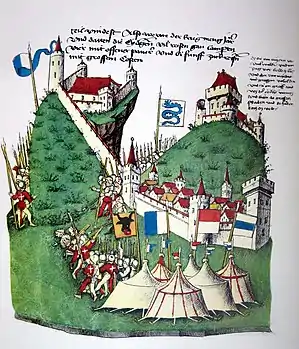 Illustration from the Tschachtlanchronik of 1470 | |||||||
| |||||||
| Belligerents | |||||||
.png.webp) Duchy of Milan Duchy of Milan |
Old Swiss Confederacy: Uri Uri Unterwalden Unterwalden Luzern Luzern Zug Zug | ||||||
| Commanders and leaders | |||||||
|
Carmagnola Angelo della Pergola [nb 1] |
Ulrich Walker (P) Johannes Rodt † Peter Kolin † Bartholome Zinderist † [nb 2] | ||||||
| Strength | |||||||
|
16,000 (including 4,000 cavalry) [nb 3] |
8,000 Infantry [nb 4] | ||||||
| Casualties and losses | |||||||
|
heavy [4] ~900 killed [2][7][nb 5] 400 horses killed [1] |
heavy [4][6] ~400 killed [5][nb 6] baggage and 1,200 sumpters lost [4][6] | ||||||
In 1419, Uri and Unterwalden bought the Bellinzona stronghold from the Sacco barons, but were unable to defend it adequately. When, in 1422, they rejected the Milanese proposal to buy back the fortified town, their troops stationed in Bellinzona were put to rout by the Visconti army under the command of Francesco Bussone, Count of Carmagnola. An attempt to reconquer the fortified area with the support of other confederates led to the battle at Arbedo, a village 3 km (1.9 mi) north of Bellinzona. The Count of Carmagnola led the forces of the Duchy of Milan against the Swiss and was victorious.

The Swiss were mainly equipped with halberds and had an initial success against the cavalry charge. Then Carmagnola brought his crossbowmen forward, while dismounting his cavalry. The dismounted men-at-arms used pikes which outreached the halberds. The Swiss were further under pressure by the crossbow fire on the flanks.
The Milanese force began to push back the Swiss, who were only saved from total disaster by the appearance of a band of foragers, whom the Milanese were convinced represented a major new force. When the Milanese force pulled back to reform, the Swiss fled the battlefield, having taken heavy casualties.
In a historiographical tradition of Zug, the bearer of the cantonal banner, Peter Kälin, was slain, and the banner was taken up by his son, who was slain in his turn. The banner was saved by one Hans Landwing, and was later lost against the French.[9]
The victory secured Bellinzona and the Leventina to the Duchy. In addition the Duchy gained back the Val d'Ossola, thus the Swiss lost all the territorial gains they had made. The defeat discouraged the Swiss expansionist intentions towards Lake Maggiore for a long time. It was the defeat at Arbedo that made the Swiss increase the number of pikemen.
See also
Sources
- P. Pieri: Il Rinascimento e la crisi militare italiana
- M. Mallett: Mercenaries and their Masters: Warfare in Renaissance Italy
- E. Pometta: Come il Ticino venne in potere degli Svizzeri. Bellinzona
- A. Battistella: Il conte di Carmagnola
References
- Oechsli, Wilhelm (1918). Quellenbuch zur Schweizergeschichte. Zürich. p. 142.
- Bullinger, Heinrich (1573). Tigurinerchronik. p. Book 9, Ch. 6.
- Meyer, Karl (1915). Schweizer Kriegsgeschichte. Bern. p. 54.
- White Book of Sarnen. Obwalden. 1470–1472.CS1 maint: date format (link)
- Chronik der Stadt Zürich. Zürich. 1420–1477.CS1 maint: date format (link)
- Rötteler Chronik. Rötteln Castle. 1376–1428.CS1 maint: date format (link)
- Brennwald, Heinrich (1508–1516). Schweizerchronik.CS1 maint: date format (link)
- Luzerner Bürgerbuch. Lucerne. 1191–1489. p. f.49r.CS1 maint: date format (link)
- Illustrirte Zeitung No. 1360, 24 July 1869, p. 72f.
Footnotes
- Andreas Billius 1402-1431(+1435) cites Carmagnola and Angelo [della Pergola] as commanders of the cavalry and Zenone [di Capo d'Istria] and [Piacentino] Brescia as commanders of the infantry [1] link text p. 142
- Heinrich Bullinger (1573) [2] maintains that Lucerne had to impose a tax to ransom its prisoners, among whom was Ulrich Walker, Schultheiss and Hauptmann of Lucerne, who faced a trial after his release link text p. 101. The Landammann of Uri Johannes Rodt link text p. 257, the Landammann and knight banneret of Zug Peter Kolin [2] and the Landammann and knight banneret of Unterwalden Bartholome Zinderist link text pp. 112-113 were all killed in the battle.
- Bartolomeo Morone (1392–1461) maintains that Carmagnola and Angelo della Pergola moved to Bellinzona with 16,000 men (might include campfollowers) including 4-5,000 cavalry. An account of the fortress-governor of Bellinzona, from 27. November 1478, however maintains that the total strength of Carmagnola and Angelo della Pergola was 4,000 cavalry and 4,000 infantry, including 500 Genoese crossbowmen.[3] link text p. 54
- Both Andreas Billius (+1435) [1] text link p. 142 and Flavius Blondus (1392-1463) text link p. 400 maintain that the Swiss mustered 8,000 men (might include campfollowers) but that around half rushed ahead by a day to plunder the valleys, and what is known from the White Book of Sarnen[4] text link pp. 69-71 together with the Chronik der Stadt Zürich 1420-1477 [5] link text p. 189 and the Rötteler Chronik [6] link text pp. 179-180 is that indeed on the day of battle the continingent of Zug arrived later on the battlefield while that of Schwyz was still behind and never arrived. The Rötteler Chronik does however describe the mobilisation of Uri, Lucerne, Unterwalden and Zug as "very strong".
- The Luzerner Bürgerbuch, Anno domini mccccxxii,[8] link text describes the Milanese killed in the battle as ...ob nunhundert... around 900
- The Chronik of Zürich mentions ~400 Swiss killed in the battle. The Luzerner Bürgerbuch, Anno domini mccccxxii,[8] link text lists 368 killed while Brennwald [7] link text p. 499 and Bullinger [2] list 375 killed
Authority control  | |
|---|---|
| National libraries | |
| Other | |