Battle of Dandanaqan
The Battle of Dandanaqan (Persian: نبرد دندانقان) was fought in 1040 between the Seljuq Turkmens and the Ghaznavid Empire near the city of Merv (present-day Turkmenistan).[6][7] The battle ended with a decisive Seljuq victory, which subsequently brought down the Ghaznavid domination in Khorasan.[1]
| Battle of Dandanaqan | |||||||
|---|---|---|---|---|---|---|---|
| Part of the Seljuk-Ghaznavid Wars | |||||||
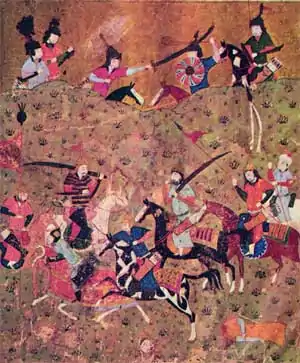 Artwork of the battle of Dandanaqan | |||||||
| |||||||
| Belligerents | |||||||
| Ghaznavid Empire | Seljuk Turks | ||||||
| Commanders and leaders | |||||||
|
Mas'ud I Ali Daya Ahmad Shirazi Abu Sahl Zawzani Abd al-Razzaq Maymandi Begtoghdi Subashi |
Chaghri Tughrul Faramurz[2] | ||||||
| Strength | |||||||
|
Unknown (large army) 60[3] or 12[4] war elephants | 16,000[5] | ||||||
| Casualties and losses | |||||||
| Unknown, likely heavy | Unknown | ||||||
Preparations
When the Seljuq leader Tughrul and his brother Chaghri began raising an army, they were seen as a threat to the Ghaznavid territories. Following the looting of border cities by Seljuq raids, Sultan Mas'ud I (son of Mahmud of Ghazni) decided to expel Seljuqs from his territories.
The battle
During the march of Sultan Mas'ud's army to Sarakhs, the Seljuq raiders harassed the Ghaznavid army with hit-and-run tactics. Swift and mobile Turkmens were better fit to fight battles in the steppes and deserts than conservative, heavily laden army of Ghaznavid Turks. Seljuq Turkmens also destroyed the supply lines of Ghaznavids, cutting them off from the nearby water wells. The discipline and morale of the Ghaznavid army dropped seriously. Finally, on May 23, 1040, around 16,000 Seljuk soldiers engaged in battle against a large, starving and demoralised Ghaznavid army in Dandanaqan and defeated them near the city of Merv.[6][5]
Aftermath
The Seljuks occupied Khorasan and the cities of the area, encountering little resistance.[8] Tughrul's successful siege of Isfahan in 1050–1051,[9] led to the establishment of the "Great Seljuk Empire". As of Mas'ud's fate after the battle, he initially retreated to India, then was overthrown and later murdered in prison.[10]
Notes
- Grousset, Rene, The Empire of the Steppes: A History of Central Asia , (Rutgers University, 2002), 147.
- Abū Manșūr Farāmarz, C. E. Bosworth, Encyclopaedia Iranica, (July 19, 2011). Archived 2013-11-10 at the Wayback Machine
- Christian, David, A history of Russia, Central Asia, and Mongolia , (Wiley-Blackwell, 1998), 373.
- C.E. Bosworth, The Ghaznavids:994-1040, (Edinburgh University Press, 1963), 115.
- Ann K. S. Lambton (1988). Continuity and Change in Medieval Persia. SUNY Press. pp. 5–. ISBN 978-0-88706-133-2.
- Bosworth, Edmund (2017). The Turks in the Early Islamic World. Routledge. p. xliv.
In their pursuit of the Turkmens across Khurasan, the Ghaznavid forces...
- Saray, Mehmet (2003). The Russian, British, Chinese and Ottoman Rivalry in Turkestan Four Studies on the History of Central Asia. Turkish Historical Society Printing House. p. 189.
...brothers Tughrul and Chaghri, grandsons of Seljuk, the Turkmens defeated the Ghaznavids at Dandanakan...
- The Histories of Herat, Jürgen Paul, Iranian Studies, Vol. 33, No. 1/2 Winter - Spring, 2000, 106.
- Tony Jaques, Dictionary of Battles and Sieges: F-O, (Greenwood Publishing Group, 2007), 476.
- Ghaznawids, B. Spuler, The Encyclopedia of Islam, Vol. II, Ed. B.Lewis, C. Pellat and J. Schacht, (Brill, 1991), 1051.
References
- Bosworth, C.E., The Ghaznavids:994-1040, Edinburgh University Press, 1963.
- Christian, David, A History of Russia, Central Asia, and Mongolia , Wiley-Blackwell, 1998.
- Grousset, Rene, The Empire of the Steppes: A History of Central Asia , Rutgers University, 2002.
- Mallett, Alex (2013). "Dandanakan, battle of". In Fleet, Kate; Krämer, Gudrun; Matringe, Denis; Nawas, John; Rowson, Everett (eds.). Encyclopaedia of Islam, THREE. Brill Online. ISSN 1873-9830.
- Spuler, Bertold (2014). Iran in the Early Islamic Period: Politics, Culture, Administration and Public Life between the Arab and the Seljuk Conquests, 633-1055. Brill. ISBN 978-90-04-28209-4.
Authority control  |
|---|