Battle of Veere
The Battle of Veere was a small naval battle that took place in late May 1351 during the Hook and Cod wars.
| Battle of Veere | |||||||
|---|---|---|---|---|---|---|---|
| Part of Hook and Cod wars | |||||||
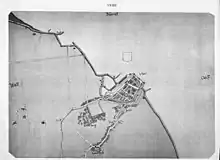 Map of Veere in about 1570 | |||||||
| |||||||
| Belligerents | |||||||
| William V of Holland | |||||||
| Commanders and leaders | |||||||
| Margaret, Countess of Hainaut | William V of Holland | ||||||
Context
Just like the County of Holland, the County of Zeeland had been very restive after the death of the last male Avesnes count William IV of Holland and Zeeland. In 1349-1350 William of Bavaria attempted to become count of Holland and Zeeland without keeping the conditions his mother Margaret, Countess of Hainaut had demanded.
In February 1351 this led to open war between William supported by the Cod faction, and Margaret supported by the Hook faction. An attempt to negotiate in Dordrecht failed in April 1351.[2]
The strategic Situation
In April 1351
William was supported by the Cod faction. This consisted of most of the cities in Holland, and a small part of the nobility. Of the cities in Holland some, like Delft, Haarlem, Leiden, Amsterdam, Rotterdam and Schiedam were fierce supporters of William.[3] Others cities might have been lukewarm. Only a small part of the nobility supported the Cods, and these were not the mightiest lords. Margaret's Hook side was supported by the small cities Gouda and Schoonhoven and held Geertruidenberg. It had many supporters among the nobility. Its leadership consisted of some high nobles with mighty castles.
After the failed negotiations of April 1351, many Hook lords withdrew to their castles. The Hook leadership was with Margaret. William was not able to quickly take all of the Hook castles. He started to besiege some, while other castles were left alone. As the Hook side was evidently unable to stop William, this would in time lead to William becoming master of all the Hook castles. Therefore, Margaret had to act.
In Zeeland, Middelburg, and the recently subdued city Zierikzee held on to Margaret's side. However, after the failed April 1351 negotiations Wolfert III van Borselen, lord of Veere then sided with William. It led to Middelburg switching to William's side.
Margaret's alliance with Edward III
After the failed April 1351 negotiations in Dordrecht, Margaret sought aid in England. Edward III of England was married to Margaret's sister Philippa of Hainault, and therefore had some pretention to possibly inherit Holland, Zeeland and Hainaut. He was especially interested in Zeeland, which was useful for his trade relations with the County of Flanders.[4] Margaret was so desperate for aid, that she offered Edward III temporary custody of Holland and Zeeland.[2]
The battle
Summary of events
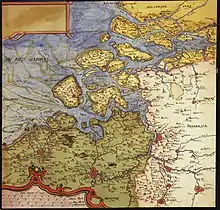
Not much is known about the battle. It is said that an English fleet came to Zeeland, and united with Margaret's army. William also sent a fleet, and near Veere the battle was fought. Van Borselen died soon after.[2]
In an old chronicle printed in 1517 the battle was described as follows: She (Margaret) collected a choice army to fight against her own son. The queen of England also sent her sister a good army, carefully selected and experienced in the art of war. When both armies were ready to fight, the empress (i.e. Margaret) was in command of a large group of ships that had been made ready for combat. With many flags and trumpets this fleet arrived before the city of Veere on Walcheren.[5]
From his side Duke (i.e. count) William collected many soldiers in Holland, and on ships, these arrived in Zeeland to fight his mother. When these two forces met, there was fierce fighting, and many casualties on both sides. Many were drowned. In the end, the empress won. Duke William managed to escape and arrived back in Holland. This happened in 1351.[5]
The battle in Dutch Historiography
The above was the prevailing version of events in the Dutch Historiography about the Battle of Veere. About 250 years after the above chronicle, the historian Wagenaar told the same story.[6] In about 1812 the historian Van Wijn performed some research about the battle.[7] The reason was that some doubted whether the Battle of Veere had actually taken place. The primary reason was that some writers did not mention the battle of Veere, but did mention the later Battle of Zwartewaal. Johannes de Beke's almost contemporary Chronicle of the County of Holland and Bishopric of Utrecht is one of these.
Van Wijn solved some doubts about the battle by pointing to two documents by Margaret. One of 24 June 1315 and one of 29 June 1351, respectively referring to a battle 'at Arnemuiden',[8] and 'between Arnemuiden and Veere'.[9] Van Wijn then continued about whether it would have been a land battle or a sea battle. He found that Johan Reygersberg called it a sea battle, and others a land battle. Van Wijn choose to believe Reygersberg, because he was a local historian, who might have seen unknown sources. Reygersberg stated that the fight was between Veere and Arnemuiden, near the Vingerling of Der Veere.[10][11]
The date of the battle
Van Wijn also investigated the date of the battle. He put it at between 26 and 30 May 1351.[1]
Results
The same documents that refer to the battle also refer to some people from Domburg having to serve against Margaret's enemies in Middelburg.[8] A specific result of the battle was that Middelburg and the whole of Zeeland came under Margaret's authority.[2] This success of course reinforced Margaret's position. She also gained some allies, notably the lords of Heenvliet on the south bank of the Meuse.[12]
Meanwhile the battle did not prevent the fall of several castles in Holland to William. He even started and completed the Siege of Polanen Castle in June. The defeat probably did interrupt or stall the siege of Brederode Castle. William now had to focus on rebuilding a fleet and army, and was probably prevented from starting major sieges.
Margaret had gained a major victory. However, in essence she still had to act quickly if she wanted to save her remaining Hook allies in Holland. This led to her attempt at invasion by the Meuse, leading to her defeat in the Battle of Zwartewaal.
References
- Aurelius, Cornelis; De Hamer, Aarnoud (2011), Die cronycke van Hollandt, Zeelandt ende Vrieslant, met die cronike der biscoppen van Uutrecht (Divisiekroniek), HES Uitgevers, Utrecht
- Blok, P.J. (1923), Geschiedenis van het Nederlandsche Volk, I, A.W. Sijthoff's, Leiden
- Van Mieris, Frans (1754), Groot charterboek der graaven van Holland, van Zeeland, en heeren van Vriesland, II, Pieter vander Eyk, Leyden
- Prevenier, W.; Smit, J.G. (1991), Bronnen voor de geschiedenis der dagvaarten van de Staten en steden van Holland, I, Instituut voor Nederlandse Geschiedenis
- Reygersberg, Johan (1551), Dye Cronijcke van Zeelandt
- Wagenaar, Jan (1770), Vaderlandsche historie, III, Isaak Tirion, Amsterdam
- Van Wijn, Hendrik (1812), "Iets nopens Heer Diederik, Heer van Brederode, en de Water- en Landslagen, tussen Hertog Willem van Beieren, en zijn moeder keizerin Margareta", Huiszittend Leeven, bevattende eenige mengelstoffen betrekkelijk tot de letter-, historie- en oudheid-kunde van Nederland, Johannes Allart, Amsterdam, II
Notes
- Van Wijn 1812, p. 257.
- Blok 1923, p. 325.
- Prevenier & Smit 1991, p. 78.
- Blok 1923, p. 321.
- Aurelius & De Hamer 2011, p. 213v.
- Wagenaar 1770, p. 279.
- Van Wijn 1812, p. 240.
- Van Mieris 1754, p. 797.
- Van Mieris 1754, p. 798.
- Reygersberg 1551.
- Van Wijn 1812, p. 246.
- Van Mieris 1754, p. 799.