Battle of Ma'aleh Levona
The Battle of Ma'aleh Levona or Battle with Apollonius was the first battle fought between the Maccabees and the Seleucid Empire in 167 or 166 BCE. The Jewish forces were led by Judas Maccabeus (Judah Maccabee) and the Seleucid army force was under the command of Apollonius, described by Josephus as "the strategos (general) of the Samaritan forces".[1]
| Battle of Ma'aleh Levona (Battle of Wadi Haramia) | |||||||
|---|---|---|---|---|---|---|---|
| Part of Maccabean Revolt | |||||||
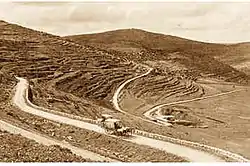 Presumed location of the battle, 1912 | |||||||
| |||||||
| Belligerents | |||||||
| Judean rebels | Seleucid army | ||||||
| Commanders and leaders | |||||||
| Judas Maccabeus | Apollonius † | ||||||
| Strength | |||||||
| 600 men | "A large force" | ||||||
| Casualties and losses | |||||||
| Unknown | "Many" | ||||||
In the earliest stages of the Maccabean Revolt, Judas had a small band of guerrilla combat units in the hills of northern Judea and southern Samaria. Apollonius was sent with the local Samaritan armies to link up with Seleucid forces from Jerusalem. The exact location of the battle is not known, but presumably it was along a road between Samaria and Jerusalem. The date of the battle is not precisely known either, but occurred early in the revolt. It is the first battle discussed in the book of 1 Maccabees, hence generally being dated to 167–166 BCE.
The precise details of the battle are not known either, but 2 Maccabees writes that the rebels fought using guerrilla warfare in the early stage of the revolt, by "coming unexpectedly" on their foes and at night. It is reasonably possible that this battle was similar, with a surprise attack while the enemy was unaware. The larger Syrian Greek army was defeated, and Judas defeated Apollonius in personal combat.[2][3] Another force was soon sent against Maccabees, which led to the Battle of Beth Horon.
Narrative according to the First Book of Maccabees
Apollonius now gathered together Gentiles and a large force from Samaria to fight against Israel. When Judas learned of it, he went out to meet him, and he defeated and killed him. Many were wounded and fell, and the rest fled. Then they seized their spoils; and Judas took the sword of Apollonius, and used it in battle for the rest of his life.
— 1 Maccabees 3:10-12 (NRSV)[4]
Analysis
The book of 1 Maccabees, likely used as a source by Josephus, is very vague about the nature of the battle compared to the other battles in the revolt. The duel described may be more of a scriptural reference than a historical one. It falls back to Biblical phrases taken from the battle of David and Goliath; 1 Maccabees uses many phrases exactly as in 1 Samuel 17:50–54 to describe the duel and its results. This fits in with the agenda of the author of 1 Maccabees to present the Hasmoneans as heirs to the legacy of heroes of the Hebrew Bible and against Jews in the early Hasmonean kingdom who saw the Hasmoneans as usurpers, such as the Essenes.[5] Historian Bezalel Bar-Kochva considers it unlikely that the author of the book was an eyewitness or was able to interview someone who was, unlike the later battles which are described in greater detail. He also warns that the claims of the Seleucid force being a "large army" should be taken with skepticism, as soldiers routinely overestimate the size of opposing armies, and claiming to have defeated more enemies would naturally make for a more impressive and inspiring story to rally the cause.[2]
The precise date of the battle is not known. Mattathias's death is recorded as happening in the 146th year of the Ancient Macedonian calendar of the count used in Babylon & Judea, the equivalent to between Spring 166 BC to Spring 165 BC of the Gregorian calendar, so if the battle happened after Mattathias's death, then 166 BCE is a likely date.[6] If Judas had taken up leadership of the rebels earlier, then a date such as 167 BCE becomes more plausible.
References
- Flavius Josephus "Book XII, Chapter 7" in The Antiquities
- Bar-Kochva, Bezalel (1989). Judas Maccabaeus: The Jewish Struggle Against the Seleucids. Cambridge University Press. p. 200–206. ISBN 0521323525.
- Brandon Marlon (2013-01-17). "What Judea & Samaria Mean to the Jewish People". The Jewish Press. Retrieved 2013-07-23.
- 1 Maccabees 3:10–12
- Harrington, Daniel J. (2009) [1988]. The Maccabean Revolt: Anatomy of a Biblical Revolution. Eugene, Oregon: Wipf and Stock. pp. 57–59. ISBN 978-1-60899-113-6.
- Bar-Kochva 1989, p. 472