Bayonet lug
A bayonet lug is a standard feature on most military muskets, rifles, and shotguns, and on some civilian longarms. It is intended for attaching a bayonet, which is typically a long spike or thrusting knife. The bayonet lug is the metal mount that either locks the bayonet onto the weapon or provides a base for the bayonet to rest against, so that when a bayonet thrust is made, the bayonet does not move or slip backwards. Less than 400 years ago, bayonet lugs or their predecessors that allowed them to slip over the barrel did not exist.
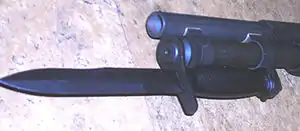
Prior to the lug's invention plug bayonets were used, which were stuffed into the muzzle's end from a tight-fitting stub, rendering the firearm virtually useless and certainly preventing it from being discharged.[1][2] But by the late 17th century, this type of bayonet was entirely phased out and subsequently replaced with the socket bayonet, that slides over the muzzle with the blade offset to the side, just above or underneath. The socket bayonet would be replaced by the press stud and bayonet lug.[3] Bayonet lugs are usually located near the muzzle end of a musket, rifle, or other longarm barrel.[4] The lug is occasionally placed on top of the barrel, if serving as the base of the front sight, or more often mounted to the side or bottom of the barrel.[5][6][7]
Legality
Unlike collection worthy firearms that were military issue, civilian firearms based on their military versions are often subject to legal issues in various states. Many manufacturers do not make them with bayonet lugs. The Assault weapons ban in 1994 issued that new firearms could not have bayonet lugs. In the context of that law, the National Rifle Association deemed telescoping stocks a "cosmetic feature". Law-abiding citizens, however, will once again be free to purchase semi-automatic firearms, regardless of their cosmetic features, for target shooting, shooting competitions, hunting, collecting, and self-defense.
It was allowed to sunset, and bayonets are legal once again.
The 10-year ban was passed by the US Congress on September 13, 1994, following a close 52–48 vote in the US Senate, and was signed into law by US President Bill Clinton on the same day. The ban applied only to weapons manufactured after the date of the ban's enactment. It expired on September 13, 2004, in accordance with its sunset provision. Several constitutional challenges were filed against provisions of the ban, but all were rejected by the courts. There were multiple attempts to renew the ban, but none succeeded.
Studies have shown the ban had little effect on overall criminal activity, firearm homicides, and the lethality of gun crimes. There is tentative evidence that the frequency of mass shootings may have slightly decreased while the ban was in effect.[1]
See also
- Bayonet mount, a fastening mechanism
References
- Norris, John (2016-01-03). Fix Bayonets!. Pen and Sword. ISBN 978-1-4738-8378-9.
- Jones, Gareth, ed. (2012-10-01). Military History: The Definitive Visual Guide to the Objects of Warfare. DK Publishing. ISBN 978-1-4654-1158-7.
- Bulletin. Vol 24. University of Michigan: Military Historical Society (Great Britain). 1973.
|volume=has extra text (help) - Office, United States Patent and Trademark (1987). Official Gazette of the United States Patent and Trademark Office: Patents. U.S. Department of Commerce, Patent and Trademark Office.
- Chapel, Charles Edward (2012-05-24). Guns of the Old West: An Illustrated Guide. Courier Corporation. ISBN 978-0-486-16306-2.
- Moller, George D. (2011-11-15). American Military Shoulder Arms, Volume I: Colonial and Revolutionary War Arms. UNM Press. ISBN 978-0-8263-4996-5.
- Pauly, Roger (2008-04-28). Firearms: The Life Story of a Technology. Northwestern University: Johns Hopkins University Press. ISBN 978-0-8018-8836-6.