Navel piercing
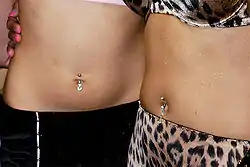
A navel piercing (also referred to as a belly button piercing) is a type of piercing located through, in, or around, the navel. It may heal quickly and with no irritations, like an ear piercing, or may heal more like a surface piercing with the associated extended healing time. Healing usually takes around 6–9 months, or even more and as long as it is cleaned, it will heal nicely.[1] Unlike most surface piercings, this is one of the few that do not usually reject, although the rejection rate is higher than non-surface piercings, such as ear piercing. A 'true' navel piercing involves piercing the actual navel itself, and is achieved by passing the needle through a protruding outie. However, the term 'navel piercing' more commonly refers to innies, where the skin surrounding the navel is pierced at one or more positions. The most prevalent form of navel piercing is through the upper rim of the navel.
| Navel piercing | |
|---|---|
 | |
| Nicknames | Belly button piercing |
| Location | Navel |
| Jewelry | Barbell, captive bead ring |
| Healing | 6- 12 months |
History and culture

In ancient times, the body piercing was a sign of manliness and courage. According to some sources, Egyptian pharaohs believed that navel rings were emblems of the ritual transition from life on earth to eternity.[2]
The history of navel piercing has been particularly misrepresented as many of the myths promulgated by Malloy in the pamphlet Body & Genital Piercing in Brief continue to be reprinted.[3][4] For instance, according to Malloy's colleague Jim Ward, Malloy alleged that navel piercing was popular among ancient Egyptian aristocrats and was depicted in Egyptian statuary,[4] an allegation that is widely repeated.[5][6] In spite of its currency, other sources deny that the historical record supports the allegation.[7]
The navel piercing is one of the most prevalent body piercings today.[8] Pop culture has played a large role in the promotion of this piercing. The navel piercing first hit the mainstream when model Christy Turlington revealed her navel piercing at a fashion show in London in 1993. The popularization of the piercing, however, is accredited to the 1993 Aerosmith music video for their song "Cryin'," wherein Alicia Silverstone has her navel pierced by body piercer Paul King.[9] The easy concealment of a navel piercing with clothing, even during the healing process, has contributed to the widespread adoption of this piercing. In the USA, it is worn by many female celebrities such as Fiona Apple, Madonna, Britney Spears, Christina Milian, Janet Jackson, Beyoncé, Serena Williams, Jessica Alba, Kourtney Kardashian, Hayden Panettiere, Miley Cyrus, Vanessa Hudgens, Paris Hilton, Lindsay Lohan, Normani, Hailey Bieber and Bhad Bhabie.
Jewelry
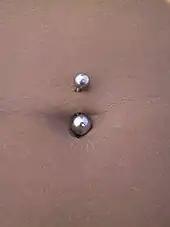
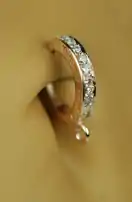
The jewelry used here is commonly called as "belly rings". Belly rings are a midriff-revealing version of earrings.
Navel jewelry has become more extensive in recent years. Many new designs, such as the ancient Bali jewelry designs, have been added to modern navel cultures. Barbells remain the most prevalent. The world's first huggy was designed and patented by TummyToys belly rings.[10] Vogue fashion published an article in 2015 about the circular captive bead belly rings and TummyToys snap lock clasps becoming the latest trend for navel piercings. Most kinds of ring or bar jewelry can be worn in a navel piercing. Navels are most often pierced with a 14g curved barbell, which is recommended to be worn until the piercing has completely healed, the healing time is typically anywhere between 6 – 12 months. A wide variety of embellished jewelry is available for navels - simple curved barbells, captives, TummyToys huggies, flexible PTFE and deluxe long length styles with dangling pendants. Currently, real diamond and solid gold belly rings are also available in a wide range of styles. Most kinds of ring or bar jewelry can be worn in a navel piercing, both for top and bottom piercings.
There has been a special standard established for navel barbells (also called "bananabells" or "bananabars", a reference to their curved shape). The standard barbell is 1.6 mm (1/16") thick and 9.5 mm (3/8") or 11.1 mm (7/16") long and is most commonly referred to as a 14-gauge post. The silver caps on the barbell post usually measure 5mm in diameter for the upper and 8mm in diameter for the lower.
Although navel bananabells are different from full rings, such as captive bead rings (CBRs), which can also be worn in navel piercings, online body jewelry retailers and wholesalers tend to refer to these barbells as "belly rings".
A new version of navel jewelry is on the market for those without pierced navels, which is based on the idea of clip-on earrings.
Risks
Although navel piercings are fashion symbols and may make the bare midriff look more sexually attractive, they carry the many risks of body piercing, notably:
- Infection: A new piercing may take up to 6–9 months before it can be taken out, during which time sweat and bacteria may cause infection. Bacterial infections can result in cysts.
- Scarring: Skin tissue rarely heals to match the surrounding tissue. It heals in varying thickness, in many ways for different types of people, and forms various sorts of scarring for all kinds of 'damage'. It is likely that any piercing worn for a significant time (months to years) will leave a scar if removed.
- Rejection: Rejection is when the body senses an external object and begins to push it out of the system. This can happen even if the wearer takes very good care of the navel piercing. There is no way to stop rejection as it is just the body's natural healing process. If rejection occurs the jewelry should be removed as soon as feasible to minimize the scarring.
- Migration: Migration can happen when there is too much movement for the piercing to heal comfortably around the navel area. The skin will push the barbell out a few millimeters, again, breaking the skin tissue in order to find a more comfortable place to allow the piercing to heal. To avoid migration, avoid excessive movement with a fresh belly ring.
- Infertility: It may leads to infertility among as it is being piercing nearer to nerves in uterus. A wrong piercing may leads to Infertility among womens but not in most of the cases.[11]
- Death: An estimated 9 people have died in the United States between 2006 and 2019 via incorrect navel piercing, according to the Office of National Statistics Records.
Though Belly Button Piercing has so many risks, it has only one advantage. Wearing a belly button piercing does not allow the formation of navel stones as our belly button is cleaned regularly.[12]
References
- Unknown (June 4, 2015). "Can I go swimming after a piercing?". www.nhs.co.uk. National Health Service. Retrieved September 14, 2018.
- "THE PIERCING SUBCULTURE – A RISKY OBSESSION OR AN OBSESSIVE RISK". FASHION LIFESTYLE. Retrieved February 19, 2012.
- Angebring itl, Elayne (2009). The Piercing Bible: The Definitive Guide to Safe Body Piercing. The Crossing Press. ISBN 978-1580911931.
- Ward, Jim (January 23, 2004). "Who was Doug Malloy". BMEzine. Archived from the original on May 22, 2016. Retrieved May 7, 2010.
- Miller, Jean-Chris (2004). The Body Art Book. Penguin. ISBN 0425197263.
- Vale, V.; Andrea Juno (1989). Modern Primitives: an Investigation of Contemporary Adornment & Ritual. Re/Search Publications. ISBN 9780940642140.
- "Navel piercing. Unlike the other body piercings, this one has not been recorded in history." (Parents 2007, p. 151)
- Marc Oxoby (2003). The 1990s American popular culture through history. Greenwood Publishing Group. p. 117. ISBN 0313316155. Retrieved May 15, 2015.
- "Aerosmith - BME Encyclopedia". Archived from the original on February 10, 2012. Retrieved February 19, 2012.
- "TummyToys About Us". tummytoys.com.
- "are-belly-rings-piercing-your-chance-at-fertility".
- "How to Clean Your Belly Button". wikiHow. Retrieved December 6, 2021.
External links
 |
Wikimedia Commons has media related to Navel piercings. |