Belorusneft
Belorusneft (Russian: Государственное производственное объединение «Белоруснефть», Gosudarstvennoje proizvodstvennoje objedienije Belorusneft, Belarusian: Беларуснафта, Belarusnafta) is a company operating in Belarus, which together with its parent company Belneftehim, is responsible for the country's largest network of service stations. According to Belorusneft's own announcement, its distribution network includes more than 500 stations, or 65% of all service stations in Belarus. The company is headquartered in Gomel.[1][2][3][4]
 | |
Native name | Белоруснефть |
|---|---|
| Industry | Petrochemical industry |
| Founded | 1966 |
| Headquarters | , |
Area served | Belarus, Russia, Venezuela, Ecuador |
Key people | Alexander Lyakhov (CEO) |
| Products | oil, gas, fuel |
| Parent | Belneftehim |
| Website | www |
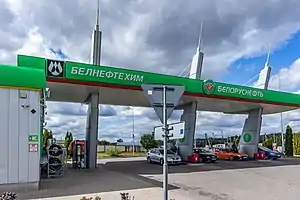
Belorusneft is a production company and was established in 1966.[5] In 1980s, Belorusneft engineers and drillers were active in the exploration of the West Siberian petroleum basin in Russian SFSR. In 1986, 5729 workers of Belorusneft worked in Siberia (38.9% of overall number of workers of the organization). After the dissolution of the Soviet Union, the cooperation between Belarusian Belorusneft and Russian government continued.[6] Its activities include exploration and production of natural gas and oil (including abroad), natural gas processing, thermal energy production (Svietlahorsk thermal power plant: electricity generation capacity 21 MW, heat generation capacity 19 Gcal/h) and service station operations.[5][4]
Belorusneft's fuel distribution stations, for example, are in competition with Russian Lukoil's highway and metropolitan service stations, although they are nowhere near as numerous in number.[7]
In 2011, Belorusneft was sanctioned by the United States Department of State for doing business with Iran.[8]
The company was excluded from the Belneftekhim concern on 16 July 2021.[9] Western sanctions imposed on Belneftekhim, including its placement in the Specially Designated Nationals and Blocked Persons List, were suggested to be the reason of the move.[10]
References
- "Petrol Station and Gas Station Chain". Belorusneft, beloil.by. Archived from the original on 20 August 2013. Retrieved 12 June 2013.
- "Belorusneft - Map (of fuel stations)". Belorusneft, beloil.by. Archived from the original on 13 August 2013. Retrieved 12 June 2013.
- "Kontaktnaja informatsija" (in Russian). Belorusneft, beloil.by. Archived from the original on 17 June 2013. Retrieved 12 June 2013.
- "Company Overview of Republic Unitary Enterprise Production Association Belorusneft". Bloomberg Businessweek, businessweek.com. Retrieved 12 June 2013.
- "History". Belorusneft, beloil.by. Archived from the original on 20 August 2013. Retrieved 12 June 2013.
- Monzul U. «Исходя из взаимной заинтересованности» (участие БССР в освоении Западно-Сибирского нефтегазового комплекса). In: Archives and office work. 2020. No 3. P. 118–125.
- "Lukoil - Karta AES". Lukoil, lukoil.by. Archived from the original on 2 July 2013. Retrieved 12 June 2013.
- State Department sanctions Belarus firm for doing business with Iran; GOP not satisfied
- «Белоруснефть» вывели из подчинения попавшего под санкции «Белнефтехима»
- Бегом от санкций. «Белоруснефть», как когда-то «Беларуськалий», вывели из состава «Белнефтехима»