Benfotiamine
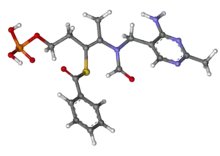
Benfotiamine (rINN, or S-benzoylthiamine O-monophosphate) is a synthetic S-acyl derivative of thiamine (vitamin B1) that sold as a medication or dietary supplement to treat diabetic neuropathy. Combination drugs with pyridoxine or cyanocobalamin are also marketed.
 | |
 | |
| Clinical data | |
|---|---|
| Trade names | Milgamma |
| Other names | S-Benzoylthiamine O-monophosphate |
| AHFS/Drugs.com | International Drug Names |
| Routes of administration | Oral |
| ATC code | |
| Legal status | |
| Legal status |
|
| Identifiers | |
| |
| CAS Number | |
| PubChem CID | |
| ChemSpider | |
| UNII | |
| ChEBI | |
| ChEMBL | |
| CompTox Dashboard (EPA) | |
| ECHA InfoCard | 100.040.906  |
| Chemical and physical data | |
| Formula | C19H23N4O6PS |
| Molar mass | 466.45 g·mol−1 |
| 3D model (JSmol) | |
| |
| |
  (what is this?) (verify) (what is this?) (verify) | |
Benfotiamine was developed and invented in Japan then reported internationally by Wada, Takagi, Minakami et al. in 1961.[1]
Uses
Benfotiamine is primarily marketed as an over-the-counter drug to treat diabetic neuropathy;[2] clinical trials results are mixed, finding it mildly useful or no different from placebo.[3][4]
Adverse effects
There is little published data on adverse effects; in one study of a combination drug of benfotiamine, pyridoxine, and cyanocobalamin, around 8% of people taking the drug experienced nausea, dizziness, stomach ache and weight gain, all of which are strongly associated with the common, normal aging process. [5]
Pharmacology
Benfotiamine is more bioavailable than thiamine salts,[6] providing higher levels of thiamine in muscle, brain, liver, and kidney.[5]
Benfotiamine is dephosphorylated to S-benzoylthiamine by ecto-alkaline phosphatases present in the intestinal mucosa, and is then hydrolyzed to thiamine by thioesterases in the liver.[7]
Benfotiamine mainly acts on peripheral tissues through an increase in transketolase activity.[7][5][8]
Chemistry
Benfotiamine is a synthetic S-acyl Vitamin B1 analogue; its chemical name is S-benzoylthiamine O-monophosphate.[9] Benfotiamine is a lipid derivative of thiamine vitamin. It has very low solubility in water or other aqueous solvents.[7]
Society and culture
As of 2017, benfotiamine was marketed as a pharmaceutical drug in Argentina, Bosnia & Herzegowina, Bulgaria, Colombia, Czech Republic, Estonia, Georgia, Germany, Hong Kong, Hungary, India, Indonesia, Japan, Latvia, Lithuania, Poland, Portugal, Romania, Serbia, Slovakia, Slovenia, Russian Federation, Taiwan, and Vietnam under the following brand names: Benalgis, Benfogamma, Benforce, Benfotiamina, Biotamin, Biotowa, Milgamma, and Vilotram.[10]
It was also marketed in some jurisdictions as a combination drug with cyanocobalamin as Milgamma, in combination with pyridoxine as Milgamma, in combination with metformin as Benforce-M, and with thiamine as Vitafos.[10]
Research
Benfotiamine has been studied in laboratory models of diabetic retinopathy, neuropathy, and nephropathy.[11] As of 2015 there had been one clinical study of benfotiamine in diabetic nephropathy.[12]
Administration of benfotiamine may increase intracellular levels of thiamine diphosphate, a cofactor of transketolase,[11] and based on metabolic theories of Alzheimer's disease, it has been studied in preclinical models of Alzheimer's disease.[13] If proven to be effective in humans, as it was shown in mouse models, the use of benfotiamine could provide a safe intervention to reverse biological and clinical processes of Alzheimer's disease progression.
References
- Wada, T.; Takagi, H.; Minakami, H.; Hamanaka, W.; Okamoto, K.; Ito, A.; Sahashi, Y. (21 July 1961). "A New Thiamine Derivative, S-Benzoylthiamine O-Monophosphate". Science. 134 (3473): 195–196. Bibcode:1961Sci...134..195W. doi:10.1126/science.134.3473.195. PMID 13782394. S2CID 10384617.
- McCarty, Mark F.; Inoguchi, Toyoshi (2008). "11. Targeting Oxidant Stress as a Strategy for Preventing Vascular Complications of Diabetes and Metabolic Syndrome". In Pasupuleti, Vijai K.; Anderson, James W. (eds.). Nutraceuticals, glycemic health and type 2 diabetes (1st ed.). Ames, Iowa: Wiley-Blackwell/IFT Press. p. 213. ISBN 9780813804286.
- Javed, S; Alam, U; Malik, RA (December 2015). "Burning through the pain: treatments for diabetic neuropathy". Diabetes, Obesity & Metabolism. 17 (12): 1115–25. doi:10.1111/dom.12535. PMID 26179288. S2CID 23570792.
- Javed, S; Petropoulos, IN; Alam, U; Malik, RA (January 2015). "Treatment of painful diabetic neuropathy". Therapeutic Advances in Chronic Disease. 6 (1): 15–28. doi:10.1177/2040622314552071. PMC 4269610. PMID 25553239.
- Panel on Food Additives and Nutrient Sources added to Food (2008). "Scientific Opinion: Benfotiamine, thiamine monophosphate chloride and thiamine pyrophosphate chloride, as sources of vitamin B1 added for nutritional purposes to food supplements" (PDF). The EFSA Journal. 864: 1–31.
- Bitsch, Roland; Wolf, Martin; Moeller, Joerg; Heuzeroth, Lothar; Grueneklee, Dieter (1991). "Bioavailability Assessment of the Lipophilic Benfotiamine as Compared to a Water-Soluble Thiamin Derivative". Ann Nutr Metab. 35 (5): 292–296. doi:10.1159/000177659. PMID 1776825.
- Patel, S. M.; Patel, R. P.; Prajapati, B. G. (2012). Patel, S (ed.). "Solubility enhancement of benfotiamine, a lipid derivative of thiamine by solid dispersion technique". Journal of Pharmacy & Bioallied Sciences. US National Library of Medicine and National Institutes of Health: J Pharm Bioallied Sci. 4 (Suppl 1): S104–S105. doi:10.4103/0975-7406.94157. PMC 3467834. PMID 23066179.
- Yamazaki, M (1968). "Studies on the absorption of S-benzoylthiamine O-monophosphate : (I) Metabolism in tissue homogenates". Vitamins. 38 (1): 12–20.
- Balakumar, P; Rohilla, A; Krishan, P; Solairaj, P; Thangathirupathi, A (June 2010). "The multifaceted therapeutic potential of benfotiamine". Pharmacological Research. 61 (6): 482–8. doi:10.1016/j.phrs.2010.02.008. PMID 20188835.
- "Benfotiamine International brands". Drugs.com. Retrieved 14 March 2017.
- Balakumar P, Rohilla A, Krishan P, Solairaj P, Thangathirupathi A (2010). "The multifaceted therapeutic potential of benfotiamine". Pharmacol Res. 61 (6): 482–8. doi:10.1016/j.phrs.2010.02.008. PMID 20188835.
- Raval, AD; Thakker, D; Rangoonwala, AN; Gor, D; Walia, R (12 January 2015). "Vitamin B and its derivatives for diabetic kidney disease". The Cochrane Database of Systematic Reviews. 1: CD009403. doi:10.1002/14651858.CD009403.pub2. PMID 25579852.
- Gibson, GE; Hirsch, JA; Cirio, RT; Jordan, BD; Fonzetti, P; Elder, J (July 2013). "Abnormal thiamine-dependent processes in Alzheimer's Disease. Lessons from diabetes". Molecular and Cellular Neurosciences. 55: 17–25. doi:10.1016/j.mcn.2012.09.001. PMC 3609887. PMID 22982063.