Benjamin Scott
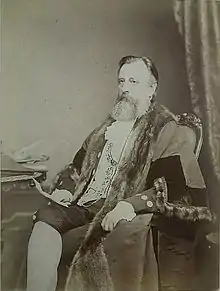
Benjamin Scott (15 April 1814 – 17 January 1892) served as Chamberlain of the City of London from 1858 until his death. He was also a committed social activist of the age working with figures such as Josephine Butler and W. T. Stead.
Life
The son of Benjamin Whinnell Scott, Chief Clerk to the Chamberlain of London, and grandson of the banker John Scott, he was born 15 April 1814 in Islington, and entered the Chamberlain's office as a junior clerk. In 1841 upon the death of his father, he succeeded him as Chief Clerk, and remained in the service of the Corporation in that capacity during the Chamberlainship of Sir James Shaw, Sir William Heygate, and Anthony Brown.[1]
Chamberlain of the City of London
On the death of Brown early in 1853, Scott received a requisition as a liveryman of the Wheelwrights' Company, to stand for Chamberlain; the office was in the gift of the liverymen of the various Livery companies. For nearly a century the post had been filled from the ranks of aldermen who had been Lord Mayor of London. Scott had for his opponent Alderman Sir John Key, who had been twice Lord Mayor (in 1830 and 1831). After a four days' poll, costing the candidates £10,000, Key was elected by a small majority (224 votes).[1] At the end of 1853, after continuing friction produced by the contest, Scott resigned his appointments under the corporation, and a year later became secretary of the new Bank of London, which he had taken part in establishing. In July 1858, on the death of Sir John Key, he again became a candidate for the office of Chamberlain and was elected without opposition. As a shrewd financier, Scott enabled the corporation to weather Black Friday of the panic of 1866 without loss.[1]
During over thirty years in his post as Chamberlain, Scott extended the Freedom of the City of London to many notable figures of the period, always at an impressive ceremony at Guildhall, preceded by a speech and followed by a banquet in their honour. During his tenure these recipients included: Richard Cobden (1861), George Peabody (1862), H.R.H. Albert Edward, Prince of Wales (1863), Giuseppe Garibaldi (1864), Ferdinand de Lesseps (1870), Angela Burdett-Coutts (1872), Ulysses S. Grant (1877), Benjamin Disraeli (1878), H.R.H. Prince Albert Victor (1885), Rowland Hill (1879), General Sir Frederick Roberts (1880), William Gladstone (1881), The Earl of Shaftesbury (1884), Henry Morton Stanley (1887) and many others.
Purity campaign
With Josephine Butler, W. T. Stead and the Salvation Army, Scott sought support to raise the age of consent, which was 12 years in the UK for most of the century.[2] Scott and Alfred Stace Dyer set up the London Committee for Suppressing the Traffic in British Girls for Purposes of Continental Prostitution in 1879, seeking a rise in "social purity" and an end to the double standard between sexes, with support from Butler and other campaigners against the Contagious Diseases Acts.[3]
Dyer and Scott were both members of the Gospel Purity Association that in April 1885 achieved a prosecution against a brothel run by a notorious London madame, defended by Montagu Williams; it was sentenced to a fine rather than closure.[4] May of that year saw a change of tactics, the case having shown prostitution had support in high places.[5] In the run-up to the sensational Eliza Armstrong case, Scott met with Bramwell Booth and Stead at Salvation Army Headquarters, in an effort to get Stead to publish a child prostitution story in the Pall Mall Gazette.[6] The campaign culminated in the passing of the Criminal Law Amendment Act 1885, and Scott published an account of his efforts in a pamphlet, Six Years of Labour and Sorrow.[1]
Family & Weybridge
He married Kate Glegg (1812-1892), daughter of Captain Thomas Glegg (of the Dragoon Guards) and his wife Sophia, on 2 August 1842 at Byfleet in Surrey, with whom he had four children. The family moved to the small town of Weybridge in 1854, having had a large house built for them close to the railway station. Scott was heavily involved with local matters and purchased at his own expense the plot of land to build a Congregational church for the town, inspired by the idea of evening services for the working classes. The construction of the church was completed in 1865 and still stands today as the Weybridge United Reformed Church. Scott's local collaborator François Baron was ordained as the church's first minister. Scott continued to foster local societies and champion local causes; a schoolroom was built behind the church and for a time free weekly lectures were given at his residence Heath House. The family retained strong connections to Weybridge for at least another two generations.
Death
Benjamin Scott died on 17 January 1892, it was understood as a result of the influenza pandemic which he had contracted from his wife who had died just three days earlier. The couple were removed from their home in Stanley Crescent, Notting Hill and taken for burial in the cemetery at Weybridge. He had continued in his official duties until within a short time of his death.[1]
Interests and works
Scott was a liveryman with the Worshipful Company of Glovers and the Worshipful Company of Wheelwrights. He served for the Wheelwrights as both Clerk and Master, as did his brother James Renat Scott, following in the footsteps of their father Benjamin Whinnell Scott, who had been Clerk of the company for over twenty years.
He was a nonconformist, temperance advocate, and social reformer; and worked for the abolition of church rates, the promotion of ragged schools, state education, and preservation of open spaces. Towards the endowment of the nonconformist church in Southwark in memory of the Pilgrim Fathers, he had contributed £2,000.[1]
In his spare time Scott lectured to working-class audiences, and in December 1851 was the chief promoter of the Working Men's Educational Union based in King William Street. For the Union he wrote and published Lectures on the Christian Catacombs at Rome, Lectures on Artificial Locomotion in Great Britain, and a Manual on Popular Lecturing. He was a fellow of the Royal Astronomical Society and had had an observatory constructed in his house in Weybridge. Following the banking crash of 1866, he published A Statistical Vindication of the City of London; or Fallacies Exploded and Figures Explained.[1]
His other publications include:[1]
- The Pilgrim Fathers; neither Puritans nor Persecutors, 1866; 2nd edit. 1869.
- Suggestions for a Chamber of Commerce for the City of London, 1867.
- Municipal Government of London, 1882.
- London's Roll of Fame, 1884, a collection of addresses and replies on occasions when the freedom of the city was granted, during the previous 127 years.
- A State Iniquity - its Rise, Extension and Overthrow: A Concise History of the System of State Regulated and Licensed Vice, 1890
Notes
- Lee, Sidney, ed. (1897). . Dictionary of National Biography. 51. London: Smith, Elder & Co.
- Patricia Hollis (20 May 2013). Women in Public, 1850-1900: Documents of the Victorian Women's Movement. Routledge. p. 200. ISBN 978-1-136-24790-3.
- Anne Cossins (2000). Masculinities, Sexualities, and Child Sexual Abuse. Martinus Nijhoff Publishers. p. 8 note 6. ISBN 90-411-1355-X.
- Julia Laite; Laite Julia Palgrave Connect (2 December 2011). Common Prostitutes and Ordinary Citizens: Commercial Sex in London, 1885-1960. Palgrave Macmillan. p. 54. ISBN 978-0-230-35421-0.
- Gretchen Soderlund (3 June 2013). Sex Trafficking, Scandal, and the Transformation of Journalism, 1885-1917. University of Chicago Press. pp. 29–30. ISBN 978-0-226-02136-2.
- David Malcolm Bennett (1 December 2003). The General: William Booth. Xulon Press. pp. 216–7. ISBN 978-1-59467-206-4.
Attribution
 This article incorporates text from a publication now in the public domain: Lee, Sidney, ed. (1897). "Scott, Benjamin". Dictionary of National Biography. 51. London: Smith, Elder & Co.
Authority control  | |
|---|---|
| General | |
| National libraries | |
| Other | |