Bentorite
Bentorite is a mineral with the chemical formula Ca6(Cr,Al)2(SO4)3(OH)12·26(H2O). It is colored violet to light violet. Its crystals are hexagonal to dihexagonal dipyramidal. It is transparent and has vitreous luster. It has perfect cleavage. It is not radioactive. Bentorite is rated 2 on the Mohs Scale.
| Bentorite | |
|---|---|
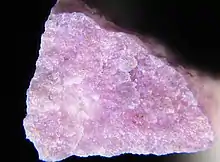 Bentorite found in Israel | |
| General | |
| Category | Mineral |
| Formula (repeating unit) | Ca6(Cr,Al)2(SO4)3(OH)12·26(H2O) |
| Strunz classification | 7.DG.15 (9th Ed) |
| Dana classification | 31.10.2.2 |
| Unit cell | 2,355.60 ų |
| Identification | |
| Colour | Violet to rose-purple |
| Twinning | (1010) |
| Cleavage | Perfect |
| Fracture | Sub-Conchoidal |
| Mohs scale hardness | 2 |
| Luster | Resinous, Waxy, Earthy |
| Streak | Very pale purple |
| Specific gravity | 2.025 |
| Density | 2.025 g/cm3 (Measured) |
| Birefringence | 0.006 |
| Pleochroism | Visible |
| Extinction | Parallel |
| Ultraviolet fluorescence | Not fluorescent |
| Absorption spectra | E > O |
The mineral was first described in 1980 by Shulamit Gross for an occurrence in the Hatrurim Formation of Danian age along the western margin of the Dead Sea, Israel. It was named by its discoverer, Shulamit Gross, for Yaakov Ben-Tor (1910–2002), Professor at the Hebrew University of Jerusalem and the University of California, San Diego, California, US, for his contributions to geology and mineralogy in Israel.[1][2]
Formation
The only naturally occurring bentorite that has been discovered is in the Hatrurim Formation near the Dead Sea in Israel. The formation consists of a mixture of metamorphosed clays, limestones, and marls that have experienced heating to >1000C at atmospheric pressure. This formed a natural Portland cement which has since been hydrated from groundwater and/or rainwater to form a natural concrete. The source of the heat is thought to be due to combustion of coal, oil or gas. The combustion produced carbon monoxide which became involved in the metamorphic reactions by mobilizing various transition metals - hence explaining the rare and unique minerals found in the Hatrurim Formation.
A leading theory is that carbon monoxide concentrates chromium as a carbonyl complex into gaseous veins. This is then deposited when it comes into contact with oxygen (i.e. from the atmosphere). It is then hydrated by rain or groundwater.[3]
Applications
Bentorite has potential applications trapping chromium from contaminated wastewater. Combined with its sealing properties, it could be mixed with cement to extract and bind dissolved chromium.[4]
References
- Handbook of Mineralogy
- - Webmineral data
- Anenburg, Michael. "Bentorite Discussion". Twitter.
- McKinnon, Mika. "Bentorite Properties and Applications". Twitter.