Bison schoetensacki
Bison schoetensacki, also known commonly as the Pleistocene woodland bison or the Pleistocene wood bison, was a species of bison that lived until Middle or Upper Pleistocene among western Europe to southern Siberia.[1]
| Bison schoetensacki Temporal range: | |
|---|---|
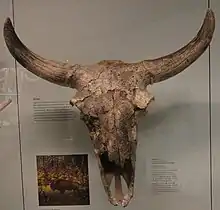 | |
| Fossil of Bison schoetensacki at the State Museum of Natural History Stuttgart | |
Scientific classification  | |
| Kingdom: | Animalia |
| Phylum: | Chordata |
| Class: | Mammalia |
| Order: | Artiodactyla |
| Family: | Bovidae |
| Subfamily: | Bovinae |
| Genus: | Bison |
| Species: | †B. schoetensacki |
| Binomial name | |
| †Bison schoetensacki Freudenberg, 1910 | |
Description
B. schoetensacki was generally similar to extant European bison in shape although there could have been morphological variations among European bisons during late Early Pleistocene and Early Holocene.[2]
In comparison to B. priscus, B. schoetensacki was either smaller or similar in size but with slenderer leg bones and metapodials, and had shorter and differently shaped horns.[3]
Diet
Despite its common name, B. schoetensacki was probably not a mix-feeder, like the extant wood bison. Instead, dental mesowear of the species shows similar pattern to that of extant European bison, a grazer.[1]
Paleobiology
Numbers of fossils have been obtained from Czech Republic, France, Germany, Greece, Italy, Spain,[4] and mass excavations from the paleolithic site, dating back to around 700,000 years ago, in Isernia in Italy indicate B. schoetensacki was the most heavily targeted animal by human hunters,[5] meanwhile European bison likely didn't inhabit Italian and Iberian Peninsulas.[1]
Ranges of B. schoetensacki and steppe bison presumably overlapped for some extents.[1]
References
- Roman Uchytel. "Pleistocene woodland bison". Prehistoric-Fauna.com. Retrieved 2021-10-11.
- Leonardo Sorbelli, Marco Cherin, David M. Alba, Joan Madurell Malapeira, 2021, A review on Bison schoetensacki and its closest relatives through the early-Middle Pleistocene transition: Insights from the Vallparadís Section (NE Iberian Peninsula) and other European localities, edited by Danielle Schreve, Quaternary Science Reviews, Volume 261, DOI:106933, The Early-Middle Pleistocene Transition in Mediterranean Europe
- Marsolier-Kergoat, Marie Claude (2017). Evolutionary Biology: Self/Nonself Evolution, Species and Complex Traits Evolution, Methods and Concepts. Springer International Publishing. pp. 187–198. ISBN 9783319615691.
- Leonardo Sorbelli, Marco Cherin, David M. Alba, Joan Madurell Malapeira, 2019, The Epivillafranchian Bison schoetensacki sample from the Vallparadís Section, The Early-Middle Pleistocene Transition in Mediterranean Europe
- Thun Hohenstein, Ursula; Di Nucci, Annarosa; Moigne, Anne-Marie (January 2009). "Mode de vie à Isernia La Pineta (Molise, Italie). Stratégie d'exploitation du Bison schoetensacki par les groupes humains au Paléolithique inférieur". L'Anthropologie (in French). 113 (1): 96–110. doi:10.1016/j.anthro.2009.01.009.