Bixi (clothing)
Bixi (Chinese: 蔽膝; pinyin: bìxī; lit. 'Cover knee'), also known as fu (Chinese: 韍),[1] is a type of traditional Chinese decorative piece of fabric which acts as a knee covering.[2] It originated from primitive clothing and since then, it continued to be worn and became part of the ceremonial attire.[2] The bixi was worn by both men and women.[3]

History
The bixi originated from primitive clothing back when animal hides were used to cover the abdomen and the genitals.[2] During the Shang dynasty, the basic style of clothing for men and women consisted of yichang and bixi.[4] Among many other types of female clothing items, the bixi was listed in tomb inventories dating from 361 AD.[5] In the Ming dynasty, the bixi became part of the official clothing.[3]
 A Standing Dignitary wearing a bixi, Shang dynasty, 12th-11th century BC.
Bixi in set of attire
Mianfu
A red bixi was worn as part of the mianfu which was worn by the Chinese emperors.[2]
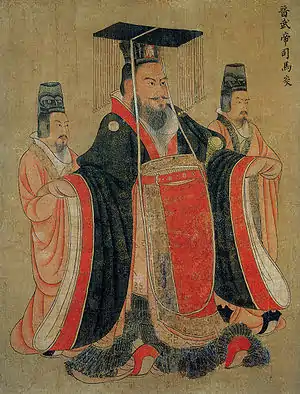 Mianfu of Emperor Wu of Jin dynasty, 7th-century painting by court artist Yan Liben
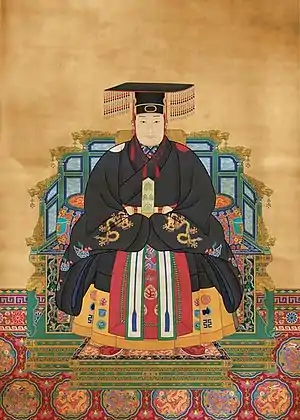 Wanli Emperor wearing a red bixi over his skirt as part of the mianfu set of attire, Ming dynasty.
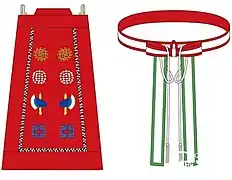 Illustration of a Ming dynasty style Bixi and dadai worn with the mianfu.
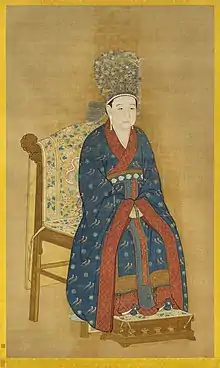
Gallery


See also
References
- Zhang, Fa (2016). History and spirit of chinese art. Honolulu. p. 13. ISBN 978-1-62320-130-2. OCLC 933763535.
- Hua, Mei (2011). Chinese clothing (Updated ed.). Cambridge, United Kingdom. p. 56. ISBN 0-521-18689-7. OCLC 781020660.
- Zhongguo xie zhen hua. Shanming Guan, 關善明 (Di 1 ban ed.). Xianggang: Mu wen tang mei shu chu ban she you xian gong si. 2003. p. 38. ISBN 988-97206-2-0. OCLC 56424659.CS1 maint: others (link)
- Lüsted, Marcia Amidon (2016). Ancient Chinese daily life (First ed.). New York. p. 22. ISBN 978-1-4777-8889-9. OCLC 957525459.
- Dien, Albert E. (2007). Six dynasties civilization. New Haven, Conn.: Yale University Press. p. 324. ISBN 978-0-300-07404-8. OCLC 72868060.
- Zhang, Shuhua; Shanat, Musdi bin Hj; Abdullah, Qistina Donna Lee (2021-03-31). "The Expression of Religious Elements and Factors of Religious Thoughts in the Empress's Ceremonial Costume "Hui Yi" of Song Dynasty". International Journal of Service Management and Sustainability. 6 (1): 89–108. doi:10.24191/ijsms.v6i1.12880. ISSN 2550-1569.
