Semaine sanglante
The semaine sanglante ("bloody week"), from Sunday 21 May until Sunday, 28 May 1871, was a military campaign lby the French Army, led by Marshal Patrice de MacMahon, that recaptured Paris from the Paris Commune. Many Commune prisoners, captured with weapons in hand, were summarily shot by the army. In the final days, the Commune executed about one hundred hostages, including the Archbishop of Paris, Georges Darboy, and burned many Paris landmarks, including the Tuileries Palace, the Hôtel de Ville ;[1] the Ministry of Justice building, the Cour de Comptes, and the Palace of the Legion of Honor.
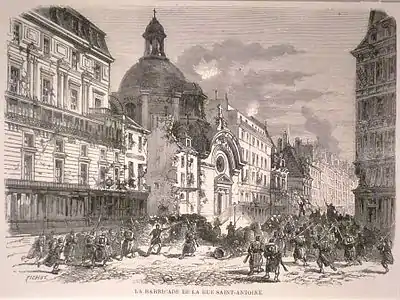
French Army casualties during the battle were 877 killed and 183 missing.[2] 43,000 Communards were taken prisoner, and 6500 to 7500 self-exiled abroad. The number of Communard soldiers killed during the week has long been disputed: Prosper-Olivier Lissagaray put the number at twenty thousand, but estimates by later historians put the probable number between ten and fifteen thousand men, an enormous number for the time.[3]
Prelude
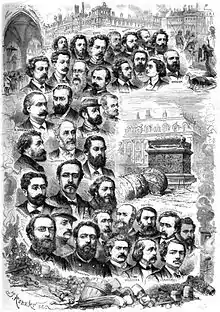 The Commune leaders, with the destroyed Column of the Place Vendome
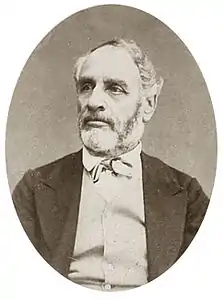 Louis Charles Delescluze, military commander of the Commune during the "Bloody Week"
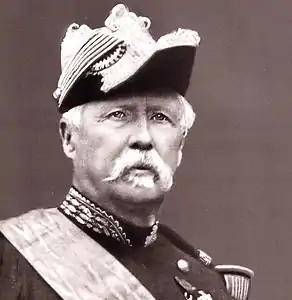 Patrice de Mac-Mahon, commander of French army forces during the "Bloody Week" (1870s)
At the beginning of March a Prussian Army was camped outside of Paris; they had forced the French government to sign a humiliating peace, giving up Alsace and Lorraine, and had triumphantly paraded on the Champs-Élysées on March 1. Soldiers from the National Guard, controlled by the Paris Commune clashed with the French Army on 18 March, when the army tried to remove 227 cannons from a depot on Montmartre. The Commune guardsmen killed two army generals.The red flag of the Commune was hoisted over the Hotel de Ville. Adolphe Thiers, President of France, hurriedly withdrew the government of France from Paris, first to Bordeaux and then to Versailles. this marked the beginning of the campaign to retake Paris and destroy the Commune [4]
On paper, the Commune National Guard was a formidable army, since all male citizens were required to serve. In theory it had 200,000 soldiers organised in 216 battalions, but the actual number of Commune soldiers who fought during the "Bloody Week" was considerably smaller. Historian Jacques Rougerie put the numbers of National Guard fighters at twenty thousand.[5]
The Commune government divided into various political factions, and led by several committees with different political agenda. Most importantly, it lacked a competent commander. In April, the Commune launched an ambitious military expedition against the Versailles government led by Gustave Paul Cluseret, who had had fought with Garibaldi in Italy and had been a general in the Union Army in the American Civil War. The inexperienced soldiers of the National Guard came under fire from the cannons of the fort of Mont-Valerian, broke ranks, and fled back to Paris, reaching the Pont de Neuilly, pursued by the Versailles Army. After the fiasco of Mont-Valerian, Cluseret, resigned on May 1, and was replaced by a Colonel Rossel; but Rossel resigned on May 9, complaining about a government "where everyone deliberates and no one obeys." He was replaced by Louis Charles Delescluze, who led the Commune forces through the Bloody Week. Delescluze was an attorney and journalist, and had extensive political experience, but no military experience.[6]
In the weeks before the Semaine Sanglante, the French army was considerably reorganized and vetted for loyalty. Soldiers suspected of sympathies to the Communards were transferred to other regiments, and often sent to French outposts in North Africa or regions distant from Paris.[7]
On May 8, after heavy fighting. the Versailles occupied Fort Issy, a key defense south of the city, and gradually took several other positions west of the city gates, bringing their trenches and forces directly outside the walls of the city. On Saturday, May 20, they began a heavy artillery bombardment, lobbing shells at the western gates and into the city, particularly the Port de Saint-Cloud. The Commune forces considered themselves safe within the ring of ramparts and fortifications that surrounded the city. On Saturday large concert was held in the Tuileries Gardens to raise funds for widows and orphans. The concert was accompanied by the sound of the Versailles artillery firing at the Place de la Concorde.
Sunday, 21 May
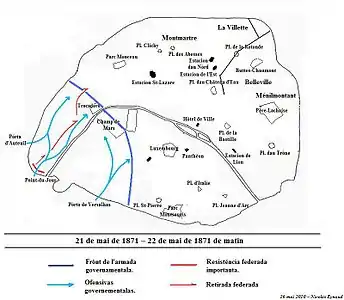 May 21 - Troops of General Douay entered Paris through the Point-du-Jour rampart, which had been left undefended
.jpg.webp) Army units enter Paris at the undefended rampart of Point-du-Jour
Army units enter Paris at the undefended rampart of Point-du-Jour_RADWAN.jpg.webp) Jaroslav Dombrowski,Polish nobleman and military commander early in the Semaine Sanglante
Jaroslav Dombrowski,Polish nobleman and military commander early in the Semaine Sanglante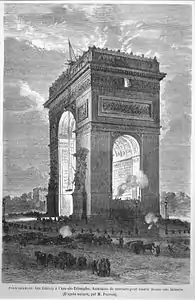 A Commune artillery battery atop the Arc de Triomphe
When the bombardment of southwest ramparts of the city by the Versailles Army began, many of Commune soldiers who manned the walls were moved back to safer positions, apparently to protect them from the bombardment of the walls by the Versailles artillery, but without the knowledge of the Commune Central Committee,
During the morning or early afternoon of 21 May, an agent of the Versailles government inside Paris explored the neighbourhood near the Point du Jouf in the southwest, and saw that that Point-du-Jour rampart was not manned by Commune troops. He crossed the rampart, and gave the information to the Versailles troops camped just outside the city. A Versailles officer made a quick inspection and verified the absence of Communards on the rampart. General Felix Charles Douay telegraphed notified Marshal MacMahon and the high command, and the army immediately began moving troops through the gap into the city. Once inside the city, the Versailles forces quickly spread out, and captured two major city gates, the Port d'Auteuil and the Port de Versailles, from behind. by the late afternoon sixty thousand Versailles soldiers were inside the city. Passy was quickly occupied, and the Trocadero, before the Commune was fully aware of the danger. The Versailles Army reached the Champs de Mars and the Trocadero. [8]
Dombrowski, the Commune military commander, learned of the breach and immediately sent a message to alert the Commmittee of Public Safety and the Council of the Commune. announcing that he would personally take charge of suppressing it.[9] The dispatch reached the Council of the Commune, which was beginning a debate on a proposal to dismiss the Commune military commander, Cluseret, for incompetence. The head of the Council, Billioray, read the message from Dombrowski to the council: "The Versailles forces have entered by the Gate of Saint-Cloud. I am taking measures to push them back. If you can send me reinforcements, I will be responsible for everything." [10] After a stunned silence, Billioray responded calmly, "The batallions have been sent. The Committee of Public Safety is watching the matter." The council voted to retain Cluseret as commander and then adjourned, without taking any further action. [11]
Despite the artillery bombardment, A charity concert to raise funds for orphans and war victims went ahead in the afternoon at the Tuileries Gardens, and attracted some eight thousand people. It was originally planned for the Place de la Concorde, but was moved to the Tuileries because of the risk of shells falling from the bombardment. At the end of the concert, the master of ceremonies promised that the Versailles troops would never ever the city, and that another concert would be held at the same site the following Sunday.
By the afternoon, as word spread that the Versailles forces were already within Paris, the defending forces, with their headquarters at the Hotel de Ville, began to react. The defense of the city was the responsibility of two separate organisations, the Committee of Public Safety (which took its name from the committee that had conducted the Reign of Terror during the French Revolution) and the Central Committee of the Commune. But they had no comprehensive plan for the defense of the city.[12]
The major defensive activity of the Commune before and during Bloody Week was construction of barricades. The most imposing barricade was erected on the Rue de Rivoli, at the entrance of the Place Saint-Jacques and the corner of Rue Saint-Denis, to protect the Hotel de Ville, the headquarters of the Commune. It was six meters high and several meters deep, built of paving stones, with a protective ditch an advanced from line, and sheltered firing positions.It was finished in a few hours, Similar barricades had been or built or were begun on square Saint-Jacques, rues Auber, de Châteaudun, Faubourg Montmartre, Notre-Dame de Lorette, at the Trinité, La Chapelle, Bastille, Buttes Chaumont, boulevard Saint-Michel, and at the Panthéon, and others were begun along the length of Boulevard Saint Michel and Rue Saint-Jacques. But the defenders soon ran into a new problem. The Committee of Artillery of the Central Committee argued about which positions had the greatest need for cannons. As a result, many of the barricades were never finished or fully armed.[13]
Once the Versailles troops entered Paris, several factors worked against the Commune. The wide boulevards were not conducive to defensive urban warfare; the factional nature of the Commune led to a lack of unity in the defense of the city; each neighbourhood had its own commander, and there was no incentive to work together. finally, the Versaillais army had superiority in numbers, command, and technology. By the end of the day, the Versailles forces had occupied a large part of the west of the city, as far as the Champs de Mars and the Trocadero.
Monday, 22 May
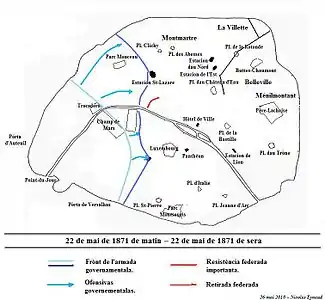 On May 22, the Versailles Army advanced east toward the center of Paris
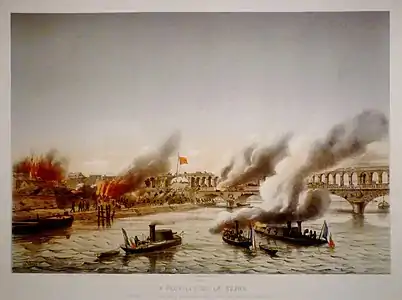 The Versailles forces enter the city via the Porte de Saint Cloud, pushing further east
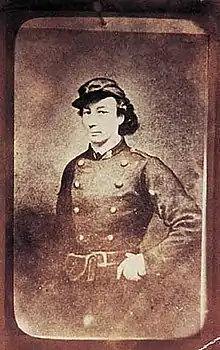 Louise Michel,one of the women soldiers of the Commune, in her uniform
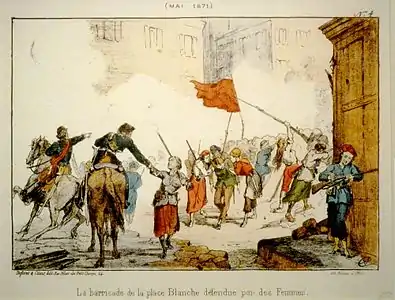 Commune barricade with women soldiers at Place Blanche
At 930 on Monday the 22nd, General Cissey, commander of one wing of the Versailles Army, established his headquarters at the Ecole Militaire, well within the city. Fifty thousand soldiers were already with Paris. [14]
At the commune, the alarm was not formally sounded until early Monday morning. Louis Charles Delescluze issued a proclamation calling on Parisians to rally to the defense of the city.[15] Delescluze was a member of the Committee of Public Safety since May 9, and since May 11 was the civilian delegate of th War Committee, which though he had no military experience, the civilian delegate of the War Committee (11 May), which made him effectively the military leader of the Commune. The proclamation declared, "Enough of militarism! Give place to the People, to the Combatants with arms bare! The alarm of the popular war has sounded! The People know nothing about clever manoeuvres, but when they have a rifle in their hand, and the pavement under their feet, they have no fear of the clever strategies of the monarchist school."[16] The proclamation had the opposite of the intended effect. Instead of joining together into a single force, the troops of the remaining national guards battalions dispersed, each to defend its own neighbourhood. [17]
Other than the soldiers of the National Guard, few Parisians were armed and prepared to fight. Many men who were formally members of the Guard simply stayed home. [18] A women's battalion had been created, which included the activist and future anarchist leader Louise Michel. It was assigned with other national guard units, to defend the Square des Batignolles, or, as other accounts say, Place Blanche, or Place Clignancourt.
Following the entry of the Versailles soldiers into Paris, the Commune soldiers abandoned the Ministry of War, which was near the new front line. They failed to take away or burn the records and documents of the Commune armed forces, which later gave the Versailles government the names and history of all the Commune soldiers. [19]
Only a few barricades were already in place, notably on the Rue Saint-Florentin and Rue de l'Opéra, and the Rue de Rivoli. The Commune defenders concentrated on building new ones; some nine hundred barricades were built hurriedly out of paving stones and sacks of earth. Residents of the neighbourhoods prepared shelters in the cellars. The first serious fighting took place on the afternoon of the 22nd, an artillery duel between regular army batteries on the Quai d'Orsay and the Madeleine, and National Guard batteries on the terrace of the Tuileries Palace.
On May 22, the first documented organised executions of National Guard soldiers by the regular army inside Paris took place at Parc Monceau. Fifteen men and one woman prisoner captured in combat were shot immediately after the battle. The practice of shooting prisoners was not consistent or universal. Some units never shot prisoners; other shot prisoners immediately in some cases, but in later battles handed over prisoners for judgement to the military courts.[20] [21]
By the evening of the 22nd, the Versailles forces had reached the Gare Saint Lazare and the Place de la Concorde, and had occupied the Gare Montparnasse. General MacMahon, the commander of the Versailles forces, established his headquarters near Trocadero. The head of the Versailles government, Adolphe Thiers, entered the city and visited MacMahon at his command post that afternoon.[22] [23]
The Polish nobleman Jaroslav Dombrowski was still formally the senior military commander of the Commune, but rumours had been spreading that he had received a large bribe in exchange for the to surrender the city to the Versailles forces. His advice and commands were largely ignored. At ten o'clock in the evening, a group of Commune officers escorted Dombrowski to the Hotel de Ville to turn him over for judgement by the Committee of Public Safety. "They say I was a traitor!" Dombrowski cried. The Committee of Public Safety accepted his explanation and reassured him. That evening Dombrowski had dinner with a group of officers, and, without speaking, shook all of their hands. They understood that he intended to go into combat immediately, to seek death his own way. [24]
Tuesday, 23 May
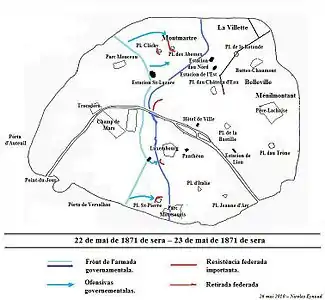
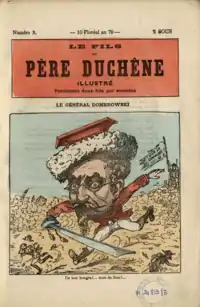 Commune cartoon from May 1871 depicting Jaroslav Dombrowski chasing away the Versailles Army
On the 23th, the primary activity of the Commune was building or strengthening barricades, mostly built of paving stones, at the primary intersections. Hundreds of men and women were engaged in the labor. Early in the morning the army resumed its offensive toward the east. The French army had learned important lessons in street fighting during the 1848 French Revolution, particularly the way to overcome barricades. Instead of attacking them head-on, the army moved slowly and systematically, systematically by tunneling through neighbouring buildings and blocks, and positioning soldiers in the buildings above and behind the barricades that the barricade could be assaulted from the sides or rear. The Communards also tried the same tunneling strategy, but often lacked the tools and manpower to burrow through interior walls.
The strongest resistance against the Versailles army on the 23rd was in Montmartre, where the Commune had originally been launched. Strong barricades had been built at Place Blanche and at Square Jacques, whose defenders included women soldiers, A large number of cannon had been captured by the Communards from the Army at Montmartre at the beginning of the Commune, and they were still there, but the Communards had no ammunition for them. Commune soldiers Place Clichy and Place des Abbesses, were able to repulse several attacks by the army But the Versailles forces received agreement from the Prussian Army, which controlled the zone outside the city walls, to move troops along the city walls to outflank the Commune forces. Pleas for reinforcement and munitions for Montmartre were sent to the Commune headquarters at the Hotel de Ville, where they were given promises, but no reinforcements or ammunition. They anticipated frontal attacks, but the Versailles forces worked their way around and behind the barricades, forcing the Communards to withdraw. By the end of the day the army effectively controlled half the city, along a line from Montmartre on the north to Parc Montsouris in the south.[25]
The most competent military leader of Commune,Jaroslav Dombrowski, found his occasion to prove to Commune skeptics that he was never collaborator with the Versailles forces. He went to the middle of the most violent fighting, where very shortly he was fatally wounded. He died in the ambulance taking him back to the command center. His last reported words were, "Do they still say I was a traitor?"[26]
In the evening, in desperation and lacking an effective strategy to repel the Versailles forces, the Communards adapted a new tactic; they began setting fire to the government buildings they still controlled, beginning with the Tuileries Palace. A group of arsonists spread through the building, soaking the interior with oil, and set it on fire. The buildings set on fire by the Commune, besides the Hotel de Ville and Tuileries Palace, included the Ministry of Justice (which was also damaged by artillery fire from the Versailles army) the Ministry of Finance, the Cour des Comptes, and the Palace of the Legion of Honor.[26]
Wednesday, 24 May
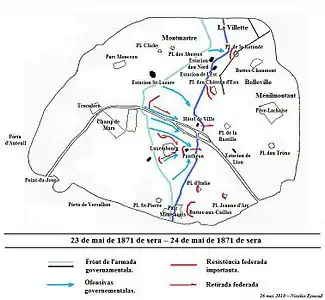 By the end of the 24th, the Versailles forces had captured Montmartre, where the uprising originally began
 Fires were set by the Commune at Tuileries Palace and surrounding buildings on the night of May 23–24
 May 24 - Barricade Fighting on Rue de Rivoli, with fires blazing. In reality, the army rarely made frontal attacks on barricades, preferring to work around them and attack from above and behind.
%252C_Erzbischof_von_Paris%252C_als_Geisel_von_Kommunarden_erschossen_(Zeno_Fotografie).jpg.webp) Georges Darboy, Archbishop of Paris, executed with five other hostages by a Commune firing squad on 24 May.
Georges Darboy, Archbishop of Paris, executed with five other hostages by a Commune firing squad on 24 May.
Early in the morning on the 24th, as the army came closer, the Commune leaders decided to abandon their headquarters at the Hotel de Ville in the center of the city, and move to the city hall of the 11th arrondissement. They set fire to the building, gutting not only the historic structure but also destroying city archives and property records stored inside. This left the Commune without a central command post. Each neighbourhood was on its own.
Commune soldiers were building a bonfire of the chairs and furnishings of Notre Dame de Paris, preparing to burn the cathedral, following the example example of the Tuileries Palace and other government buildings. At three in the morning, an official arrived from the Commune headquarters. He pointed out that a fire in Notre-Dame was certain to set fire to the neighbouring Hotel-Dieu Hospital, which held eight hundred patients. The fire was put out and the cathedral was evacuated, and spared from bombardment through the rest of the Commune.[27]
The remaining government body of the Commune, the Central Committee, issued ia manifesto with its own conditions of peace for delivery to the Versailles military headquarters. They proposed the dissolution of both the Commune and the National Assembly, the withdrawal of the army from Paris, the election of new governments in the large cities, and a general amnesty. This was posted on the walls of the city still controlled by the Commune. The army headquarters ignored the manifesto and continued its methodical reconquest of the city.[28]
On the 24th, a delegate led by Gustave Genton, a member of the Committee of Public Safety, came to the new headquarters of the Commune at the city hall of the 11th arrondissement and demanded the immediate execution of the prisoners held as hostages at the prison of La Roquette. The new prosecutor of the Commune, Théophile Ferré drafted an "Order to the Citizen Director of La Roquette to execute six hostages." Genton went to the prison and was given a list of hostages from which he selected six names. including Georges Darboy, the Archbishop of Paris, and three priests. The governor of the prison, M. François, refused to give up the Archbishop without a specific order from the Commune. Genton sent his deputy back to Ferré who wrote "and especially the archbishop" on the bottom of his note. Archbishop Darboy and five other hostages were taken out into the courtyard of the prison, lined up against the wall, and shot.[29] After the end of the Commune, Ferré was singled out for prosecution because of his order, and was one of two dozen Commune leaders who were executed. In total, the Commune executed about one hundred hostages.[30]
Thursday, 25 May
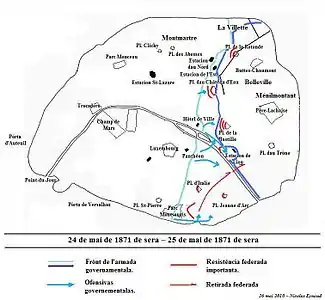 By the 25th, Montmartre had fallen, and the fighting had moved well into the east end of the city
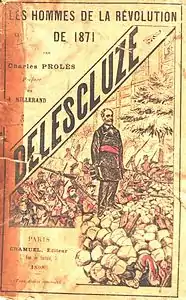 On the 25th, Commune leader Louis Charles Delescluze, showed himself on top of a barricade and was promptly shot dead.
Delescluze and the remaining Communard leaders moved their headquarters to the city hall of the 13th arrondissement on rue Voltaire, but this neighborhood also was soon under attack by the army. At about 7:30 in the evening on the 25th, Delescluze put on his ceremonial sash as the chief executive of the Commune, and walked to the nearest defended Commune barricade, on Place Chateau-d'Eau. Unarmed, he climbed up to the top of the barricade, in clear view of the army soldiers, and was promptly shot dead.
Friday, 26 May
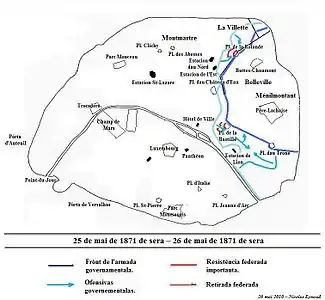
Between the evening of May 25 and May 26, the army succeeded in recapturing the Place de la Bastille and Faubourg Saint-Antoine. Fighting also took place at Place de la Rotonde. By the end of the 26th, resistance was ended on the Left Bank. The Commune-held area was limited to a hemicircle in the northeast, including the Buttes de Chaumont and the Pere Lachaise cemetery.
Saturday, 27 May
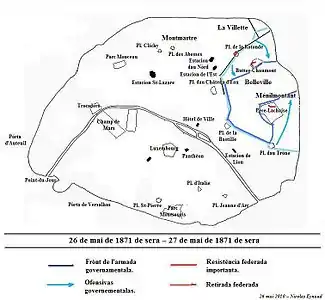
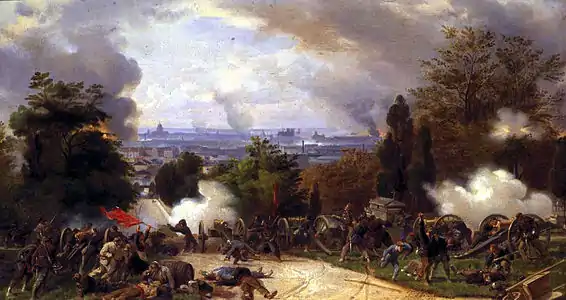 Fighting in Pere Lachaise cemetery 26-27 May
 Combat in Pere-Lachaise om May 27 (Le Monde Illistrated)
The Buttes de Chaumont and the Pere Lachaise Cemetery fell to the army on Saturday, May 27. The Buttes de Chaumont was captured by a unit of the Foreign Legion, while Pere Lachaise as assaulted by battalion of marine infantry. The Defenders of the cemetery were heavily outnumbered, and were low on ammunition. The city hall of the 11th arrondissement omn Place Voltaire became a strong point of resistance for a time, as did Commune position on Rue Overkamptf. Mac-Mahon ordered artillery batteries on Montmartre to fire on the Obkerkampf position, three kilometres away. The artillery fire forced the Communards to abandon their position and take sanctuary in the cellars. The Communards fell back to another barricade on Rue de Temple. The remaining 150 Communards were taken prisoner.
The other Commune strong points were also forced to surrender under the coordinated onslaught of infantry and artillery. The Versailles Army took 1500 prisoners on Rue Haxo, and two thousand prisoners near Pere Lachaise. The Second Division of the 5th corps was able to capture 93 barricades in the course of the week, as only ten were fully defended, and forty-one were not defended at all. The Division of six thousand men lost only thirty-five men killed and two hundred seventy two wounded during the Bloody Week.Commune soldiers who resisted were captured and immediately shot, or taken to the nearby military headquarters for a rapid trial and then execution.[31]
One large group of prisoners, consisting of officers of the National guard, was collected at Mazas Prison and La Roquette prison. They were given brief trials before the military tribunal, sentenced to death, and then delivered to Pere Lachaise. There they were lined up in front of a wall and executed in groups, and then buried in a common grave. The wall is now marked with a plaque to the victims of the Bloody Week, and is the site of annual commemorations of the event.[32]
Sunday, 28 May
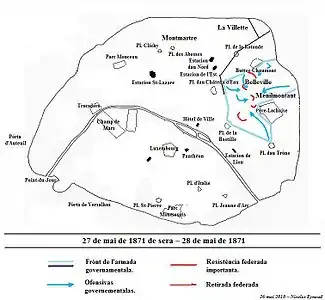 The last major fighting took place within the Pere Lachaise cemetery, the Buttes-Chaumont and Belleville.
.jpg.webp) Walery Antoni Wróblewski, one of the last Commune commanders. He was pardoned and died in Nice in 1908.
Walery Antoni Wróblewski, one of the last Commune commanders. He was pardoned and died in Nice in 1908.
The battle continued in Belleville. The last barricade falls, but the exact location is unknown. There is a commemorative plaque rue de la Fontaine-au-Roi, but according to Gaston Da Costa, it was situated not far in the faubourg du Temple. Further fighting continued at Chateau de Vincennes, which surrendered on the 28th. The captured Commune soldiers were imprisoned and the officers were summarily executed in the moat of the chateau.
Aftermath and legacy
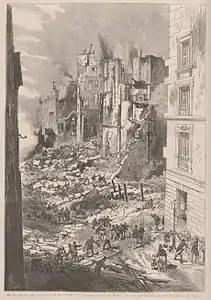 Rue de Lille and Rue de Bac after the fighting ended
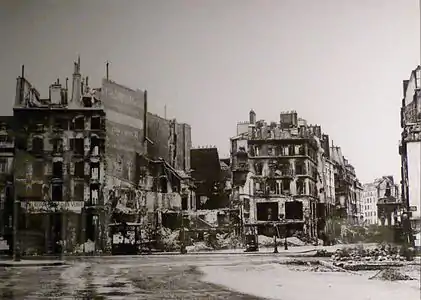 Place de la Bastille after fighting ended
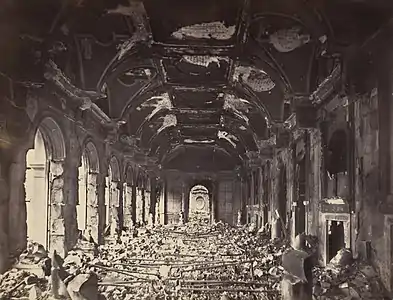 Grand Salle of Council of State in the Palais d'Orsay after Bloody Week. It was later replaced by the Musée d'Orsay
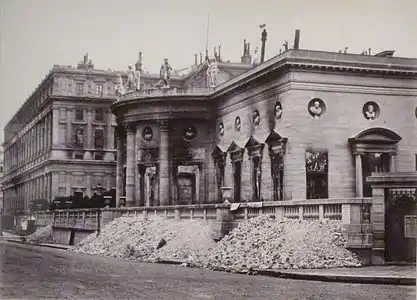 Ruins of the Palace of the Legion of Honor
 The burnt-out Hotel de Ville
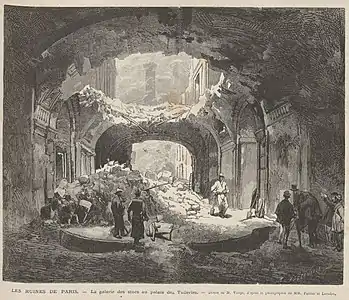 Interior of the Tuileries Palace
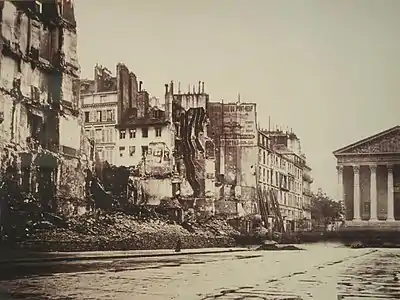 Rue Royal after the fighting
On 29 May, the Fort of Vincennes, surrounded by the Germans, surrendered. The nine officers of the garrison are shot in the ditches.
Prosper-Olivier Lissagaray in his History of the Paris Commune of 1871 reports that one of them, colonel Delorme declared to the Versaillais officer commanding the firing squad :"check my pulse, see if I'm scared!"
Court Martials, Executions, and a Pardon
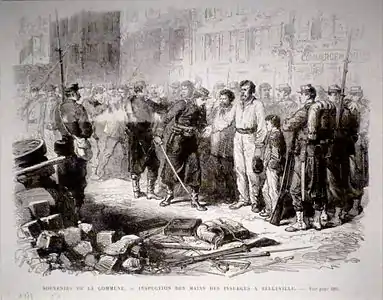 Army inspecting hands for gunpowder traces to identify Commune soldiers at Belleville
 Execution of Commune prisoners at the Luxembourg gardens
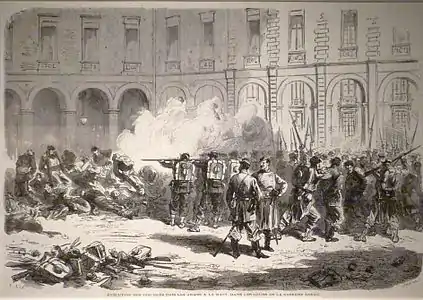 Execution of Commune prisoners at Lobau Barracks
Even before the Bloody Week, executions of prisoners brought complaints from officers that the executions created "a painful impression among the population who claim that we are shooting en masse and without judgement." In response, on May 5 General Cissey, following orders of Marshal Mac-Mahon, issued an order to his generals forbidding any executions of deserters or insurgents after the end of combat. Following this instruction, prisoners were to be divided into categories, such as foreigners, army deserters, those already condemned by a military court, and those who had volunteered for service in the Commune. For a short time executions were halted. However, once the army entered Paris, the army was overwhelmed by the number of prisoners, for which no preparations had been made. A new system was hastily organised where prisoners were sent to the Ecole Militaire, Parc Monceau, Place Vendome and other locations to be guarded and processed. Firing squads were organised, and summary trials and executions began at designated sites, including Parc Monceau and later at the Pere Lachaise Cemetery.
Many Commune prisoners were executed immediately after they were captured, at the place of battle, particularly if they were captured with a weapon or if powder burns on they showed that they had recently fired a weapon. This was not a universal practice, but not uncommon. Another large number were taken after their capture to the headquarters of the Versailles military unit in that military of a summary court martial. There were fifteen such headquarters, at locations including the Pantheon, the Luxembourg Palace, the Cluny theater, the Gobelins tapestry workshop, the city halls of the first and fifth arrondissement, the Ecole Polytechnique and the Ecole des Arts et Metiers. These prisoners were given a brief hearing, and either held for transfer to Versailles for trial, or executed by a firing squad.
1644 Communard soldiers were registered as buried at Montparnasse cemetery.[33] Of these 452 were shot at the various military headquarters; 449 died in ambulances or hospitals, and 783 were collected from barricades and battle sites around the city. One-hundred sixty-five came from one site, the Pantheon, including those who had been killed in combat, and those who had been summarily executed after the fighting. The historian Robert Tombs concluded that probably a quarter to third of the Commune dead were shot by firing squads of the military courts at the fifteen different military headquarters around the city. [34]
Certain types of prisoners, particularly deserters from the regular army and foreigners, those captured with weapons in their hands, or those whose hands showed they had fired weapons, were almost always selected for immediate execution. Those who laid down their weapons were supposed to be spared. Adolphe Thiers, the head of the Versailles government, declared on May 8, "As to the insurgents, assassins excepted, those who lay down their arms will be spared." MacMahon also declared, "When a man lays down his arms, he should be spared," and regretted the execution of those prisoners who had given up their weapons. neither Thiers nor MacMahon condemned the execution of soldiers who were still armed. On May 25 General Cissey ordered that "...men captured with weapons in hand should be executed." On June 3, after Bloody Week, Cissey was named by Thiers the new French Minister of War. "We can conclude" Tombs wrote, "that an important proportion of the deaths during the Bloody Week, very probably a majority of those shot, were victims of massacres that were organised and quasi-legal."[35]
The largest numbers of registered graves of Communards in Paris are found at Montparnasse (1644 graves), Montmartre (1245 graves), and the Carrières d'Amerique (1338 graves) and Pere-Lachaise (878 graves).[36] Additional previously unrecorded graves were later found at Charonne Cemetery, outside of Paris near Pere Lachaise (800 or 900 graves). A scattering of Additional unrecorded burial sites were found in later years during building excavations, and the construction of Paris Metro.
The number of Commune soldiers killed during the Semaine sanglante, both in combat or by firing squad, is estimated by most historians to be between ten and fifteen thousand or possibly as high as twenty thousand.[37] It was an exceptionally high number for the time. For example, during the three days of the Battle of Gettysburg in July 1863, the deadliest battle of the American Civil War, a total of 7,863 soldiers. both Confederate and Union, were killed, or about half as many as the Commune casualties.[38] It also may have equaled or exceeded the number executed during the Reign of Terror during the French Revolution.[39]. 16,594 official death sentences had been carried out throughout France following June 1793.[40]
The Commune itself executed about one hundred hostages, including the Archbishop of Paris, Georges Darboy, a large group of gendarmes, and a smaller group of priests. [41]
The process of arresting, trying and punishing Commune members continued well after the "Bloody Week." Altogether, 43,522 Communards were taken prisoner, including 1,054 women. They were marched to Versailles, where they were held in the outer buildings of the Chateau. More than half were quickly released. Fifteen thousand were tried for their various activities, 13,500 of which were found guilty. Ninety-five were sentenced to death, 251 to forced labor, and 1,169 to deportation, mostly to New Caledonia. Several thousand Commune supporters, including several of the leaders, fled abroad, mostly to England, Belgium and Switzerland. All the prisoners and exiles were pardoned in 1880 and returned home.[42]
Notes and citations
- Milza, 2009a, pp. 397–398
- Rougerie (1971). p. 257.
- Audin, Michele, La Semaine Sanglante, Mai 1871, Legendes et Conmptes, Libertalia Publishers (2021) (in French)
- Fierro, Alfred, "Histoire et Dictionnaire de Paris" (1996), p. 200
- Rougerie, Paris Libre (1871), p. 248
- Fierro 1996, p. 203.
- Tombs (2021), p.118
- Milza, 2009a, pp. 379–380
- Lissagaray (1896), p. 311
- Lissagaray (1896), p. 311
- Lissagaray (1896), p. 311
- Lissagaray (1896), p. 311
- Lissagaray (1896), p. 321
- Tombs, "La guerre contre Paris", p. 320
- Proclamation de Delescluze. delegue a la Guerre, au peuple de Paris, Journal officiel, 22 May 1871
- Tombs, Robert, "La Guerre Contre Paris", p. 325-26
- Rougerie, Jacques, "La Commune de 1871 (1988), p. 115
- Da Costa, Gaston, La Commune vecue, 3 vol. Paris, Librairies-impremeries reunies, 1903–1905, III, p. 81. Serman, William, La Commune de Paris, p. 348
- Lissagaray, "Histoire de la Commune de 1871" (1896), p. 323
- Tombs, "La guerre centre Paris (2021), p. 379,
- Milza, Pierre, "La Commune", p. 391
- Tombs, "La Guerre Contre Paris", p.323
- Rougerie, Jacques, "La Commune de 1871" (1988), p. 116
- Lissagaray, "Histoire de la Commune de 1871" (1896), p. 323
- Lissagaray, "Histoire de la Commune de 1871" (1896), p. 323
- (Milza 2009, p. 394)
- Lissagaray (1896) p. 338.
- Lissagaray (1896), p. 337
- Milza, 2009a, pp. 403–404
- Milza, 2009a, pp. 403–404
- Tombs, Robert, "La Guerre Contre Paris", p. 360.
- Tombs, Robert, "la guerre contre Paris", p. 360.
- Audin, "La Semaine Sanglante" (2021), p. 147
- Tombs, "La Guerre Contre Paris", p.432-434
- Tombs, "La Guerre Contre Paris", p. 434
- Audin, "La Semaine Sanglante" (2021), p. 147
- Tombs, Robert, "La Guerre contre Paris" (2021), p. 421
- Sears, Stephen W., Gettysburg. Boston: Houghton Mifflin, 2003. ISBN 0-395-86761-4
- Tombs, Robert, "La Guerre contre Paris" (2021), p. 421
- Tombs, Robert, "La Guerre contre Paris" (2021), p. 421
- Milza, 2009a, pp. 403–404
- Milza, 2009a, pp. 431–432
Bibliography
In French
- Audin, Michele, La Semaine Sanglante, Mai 1871, Legendes et Conmptes, Libertalia Publishers (2021) (in French)
- Rougerie, Jacques (2014). La Commune de 1871. Paris: Presses universitaires de France. ISBN 978-2-13-062078-5.
- Fierro, Alfred (1996). Histoire et Dictionnaire de Paris. Paris: Robert Laffont. ISBN 2-221-07862-4.
- Rougerie, Jacques (2004). Paris libre 1871. Paris: Editions du Seuil. ISBN 2-02-055465-8.
- Lissagaray, Prosper-Olivier (200). Histoire de la Commune de 1871 (1876). Paris: La Decouverte/Poche. ISBN 978-2-70-714520-8.
- Milza, Pierre (2009a). L'année terrible: La Commune (mars–juin 1871). Paris: Perrin. ISBN 978-2-262-03073-5.
- Tombs, Robert (2021). La guerre contre Paris -1871: l'ármée met fin à la Commune. Paris: Flammarion. ISBN 978-2-0802-4351-5.
Further reading
- Brown, Howard G. (2018). "The Paris Commune and the "Bloody Week" of 1871". Mass Violence and the Self. From the French Wars of Religion to the Paris Commune. Cornell University Press. pp. 161–215. ISBN 978-1-5017-3072-6. JSTOR 10.7591/j.ctt21h4x01.9.
- Tombs, Robert (2012). "How Bloody Was La Semaine Sanglante of 1871? A Revision". The Historical Journal. 55 (3): 679–704. ISSN 0018-246X. JSTOR 23263269.