Blue-tailed day gecko
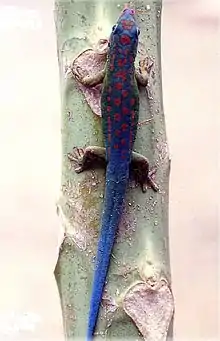
The blue-tailed day gecko (Phelsuma cepediana) is a diurnal species of gecko, a lizard in the family Gekkonidae. The species is endemic to the island Mauritius. It typically inhabits warm and humid places and dwells on different trees and bushes.
| Blue-tailed day gecko | |
|---|---|
 | |
Scientific classification  | |
| Kingdom: | Animalia |
| Phylum: | Chordata |
| Class: | Reptilia |
| Order: | Squamata |
| Family: | Gekkonidae |
| Genus: | Phelsuma |
| Species: | P. cepediana |
| Binomial name | |
| Phelsuma cepediana | |
 | |
| Synonyms[1] | |
Additionally, it is noteworthy that the blue-tailed day gecko can change colors and patterns ontogenetically. Depending on the activity, coloration can differ.
Etymology
The specific name, cepediana, is in honor of French naturalist Bernard Germain de Lacépède.[2]
Description
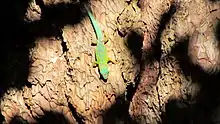
P. cepediana belongs to the middle-sized day geckos. It can reach a total length (including tail) of about 15 centimetres (5.9 in). There is always a dorso-lateral stripe present, which may be broken. A red stripe extends from the nostril to the shoulder. The male body colour is light green or bluish green. The backs of males have a bright blue colour and are covered with dark red spots and dashes. The males have deep blue tails. Females lack the brilliant blue colour of the males. They have a bright green back and rust-coloured spots.
The blue tailed gecko typically has brown and red stripes across their bodies. Between these stripes, they have spots that can also be brown or red in color. Frequently, they have a bright blue streak that extends from their mid body to their hindlimb and stops at the end of their back. This blue color may also be found on their face.[3]
Male blue tailed geckos are typically more vivid than female blue tailed geckos. This is because male blue tailed geckos have bright blue or turquoise coloring on their tails in addition to the red spots that largely cover their backs. Female blue tailed geckos, while still brightly colored, do not have all of the same physical traits of the males. For example, the female blue tailed geckos are usually smaller in size than the male. Also, the females typically have more subtle colors that are not as bright or noticeable as the colors that are on males.[4]
Habitat and Distribution
Blue tailed geckos and other reptiles are sensitive to artificial light at night and will change their behaviors as a result of being exposed to this light. These geckos are primarily diurnal, as are most of the geckos in their genus (Phelsuma). It has been found that blue tailed geckos will change their foraging behavior from diurnal to nocturnal in cases where they have artificial light sources at their disposal. Nocturnal activity includes agnostic or aggressive behaviors, courtship, and foraging. When artificial lights are used in nocturnal situations, it alters the amount of time and effort that visual predators will spend foraging.[5]
The Phelsuma cepediana is one of only seven species of the Mascarene species that is still alive. This species is the sole pollinator and seed disperser of a climbing shrub, the Roussea simplex, which is endemic to the mountains of the Mauritius. [6]
The Phelsuma cepediana is typically found on trees and bushes such as those that produce fruits: coconut palms, banana trees, and papayas. These locations are warm and moist climates, which are preferred by this gecko.
The blue tailed gecko tends to be happiest and most successful in mountainous islands which have high elevations such as Mauritius. These geckos enjoy human forests such as eastern Madagascar. Unfortunately, it seems as though these lizards cannot survive or colonize agricultural areas. However, they can survive in suburban gardens that are heavily watered and planted as long as these gardens are near trees that produce fruit or flowers throughout the year. [7]
The blue-tailed day gecko inhabits the island Mauritius where it is widely distributed. P. cepediana may also have been introduced to Madagascar where it has been reported a few times, amongst others in the region of Iviloina. These observations have not been confirmed though.
P. cepediana is mainly found in bushes and trees such as coconut palms, traveler's palms, banana trees and papayas. It also inhabits gardens and houses in suburban areas. It prefers a moist and warm climate. McKeown (1993) mentions that the original vegetation of Mauritius has been largely replaced with agricultural crops in which this day gecko cannot live.
Population Structure, Speciation, and Phylogeny
The Phelsuma cepediana is of the Animalia kingdom, Chordata phylum, Reptilia class, Squamata order, Sauria suborder, Gekkonidae family, Gekkonidae subfamily, and Phelsuma genus.
There are many geckos in the Phelsuma genus. This genus was discovered by John Edward Gray, a British zoologist. As of know, the genus includes 70 species and subspecies. There is a high possibility that there are more species and subspecies that are not yet known and have not yet been identified.
Diet
The blue-tailed day gecko feeds on various insects and other invertebrates. It also licks soft, sweet fruit, pollen, and nectar. The flowers of the now critically endangered liana Roussea simplex produce copious amounts of nectar and are pollinated only by the blue-tailed day gecko. The blue-tailed day gecko plays a role by licking up a gelatinous substance secreted by the fruit which contains the minute seeds. It disperses the seeds in its droppings. However, the 2 mm long ant Technomyrmex albipes that was introduced to Mauritius from the Indo-Pacific area seals the flowers of Roussea with clay to protect mealy bugs. These drink the sap and excrete a sugary urine that is collected by the ants. The ants attack animals that visit the plant, preventing the blue-tailed day gecko from pollinating the flowers and eating from the fruit, and in this way seriously hampering Roussea's reproduction.[8]
The blue tailed day gecko preys on both insects and invertebrates and uses them for food. The geckos also engage in licking on sweet fruits that are soft, pollen, and nectar.
Behavior
This Phelsuma species can be quite aggressive both toward its own and to other Phelsuma species. In captivity, where the females cannot escape, the males sometimes seriously wound the female. In this case, the male and female must be separated.
Protective Coloration and Behavior
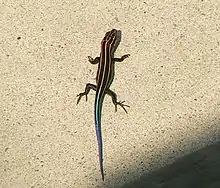
Lizards can change in color and pattern ontogenetically. Conspicuous tail colors appear only in juveniles and can fade by adulthood. Research has been conducted in order to determine if these tail colors compensate for “an increased activity, level, deflecting imminent attacks to the tail.” Research has suggested that alteration of activities can affect the ontogenetic color and pattern changes. Lizards that are active and forage in habitats that are open tend to increase the probability that they will be attacked by ambush predators. Deflection displays and conspicuous colors can shift attacks to the expendable tail. By doing this, the prey’s overall likelihood of surviving the attack is increased.[9]
Reproduction and Life Cycle
Blue tailed geckos lay eggs every 3-4 weeks. They typically lay 2 eggs. [3]
The females will lay their eggs in a location that they feel is safe and protected. The geckos will glue their eggs in order to increase safety. When they are kept at a temperature of 28 degrees Celsius, the eggs take between 40 and 45 days to hatch. When the new borns are measured, they are normally around 40 mm or 1.6 inches.
Enemies
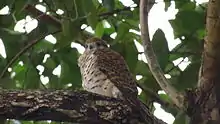
The Phelsuma cepediana is unfortunately preyed on by critically endangered Mauritius kestrel.[10]
P. Cepediana geckos frequently will hide amongst dense patches of palm like Pandanus plants in order to protect themselves from their enemies. One of their major predators is the Mauritian kestrel Falco punctatus. This bird feeds almost exclusively on Phelsuma geckos, making Phelsuma cepediana one of its main prey. Other birds that are endemic to Mauritia also feed off of Phelsuma geckos. [11]
Interactions with Humans and Livestock
Phelsuma cepediana are extremely high in demand as pets. This is because blue tailed geckos are difficult to breed. Specifically, males are more in demand than females at this time. These geckos can be kept as pets in environments with high humidity and high quality diets. [12] This species of lizard can cost anywhere from $100 to $200.[13][14]
Care and Maintenance in Captivity
P. cepediana should be housed in pairs and needs a large, well planted terrarium. It is important to provide the terrarium with sufficient air flow. The temperature should be between 28 and 30 °C (86 °F). The humidity should be maintained between 75 and 100 percent. In captivity, the blue-tailed day gecko can be fed with crickets, wax moths, fruits flies, mealworms, and houseflies.
References
- "Phelsuma cepediana ". The Reptile Database. www.reptile-database.org.
- Beolens, Bo, Michael Watkins and Michael Grayson (2011). The Eponym Dictionary of Reptiles. Baltimore: Johns Hopkins University Press. xiii + 296 pp. ISBN 978-1-4214-0135-5. (Phelsuma cepediana, p. 149).
- "Blue tailed day gecko phelsuma cepediana captive breed".
- "Phelsuma cepediana: Mauritian Blue-Tailed Day Gecko – FEMALES | Phelsuma Farm". Retrieved 2021-10-26.
- Baxter-Gilbert, James; Baider, Claudia; Florens, Francois; Hawlitschek, Oliver; Mohan, Ashwini; Mohanty, Nitya; Wagener, Carla; Webster, Kathleen; Riley, Julia (2021-02-19). "Nocturnal foraging and activity by diurnal lizards: Six species of day geckos (Phelsuma spp.) using the night-light niche". Austral Ecology. doi:10.1111/aec.13012.
- Thébaud, Christophe; Warren, Ben; Cheke, Anthony; Strasberg, Dominique (2009-01-01), "Mascarene Islands, Biology", Encyclopedia of islands, retrieved 2021-10-26
- "Phelsuma cepediana: Mauritian Blue-Tailed Day Gecko – FEMALES | Phelsuma Farm". Retrieved 2021-10-26.
- "Roussea simplex". Kew Royal Botanic Gardens. Retrieved 2016-03-17.
- Hawlena, Dror; Boochnik, Rami; Abramsky, Zvika; Bouskila, Amos (2006-11-01). "Blue tail and striped body: why do lizards change their infant costume when growing up?". Behavioral Ecology. 17 (6): 889–896. doi:10.1093/beheco/arl023. ISSN 1045-2249.
- "The Day-geckos of Mauritius". FROG BLOG MANCHESTER. 2015-08-20. Retrieved 2021-10-26.
- "Gecko key to preventing Mauritian plant extinction".
- "Phelsuma cepediana: Mauritian Blue-Tailed Day Gecko – FEMALES | Phelsuma Farm". Retrieved 2021-10-26.
- "Blue-Tailed Day Gecko - Phelsuma cepediana (Captive Bred) | Josh's Frogs". Blue-Tailed Day Gecko - Phelsuma cepediana (Captive Bred) | Josh's Frogs. Retrieved 2021-11-18.
- "PHELSUMA CEPEDIANA: MAURITIAN BLUE-TAILED DAY GECKO – FEMALES".
Further reading
- Christenson, Leann, and Greg Christenson (2003). Day Geckos In Captivity. Ada, Oklahoma: Living Art Publishing. pp. 123–124. ISBN 0-9638130-2-1.
- Henkel, F.-W., and W. Schmidt (1995). Amphibien und Reptilien Madagaskars, der Maskarenen, Seychellen und Komoren. Ulmer Stuttgart. ISBN 3-8001-7323-9
- McKeown, Sean (1993). The general care and maintenance of day geckos. Advanced Vivarium Systems, Lakeside CA.