Lobelia siphilitica
Lobelia siphilitica, the great blue lobelia,[2] great lobelia,[3] or blue cardinal flower,[4] is a plant species within the family Campanulaceae. It is a herbaceous perennial dicot native to eastern and central Canada and United States. Growing up to three feet tall, it lives in zones 4 to 9 in moist to wet soils. It produces a spike of zygomorphic flowers in the late summer.
| Great blue lobelia | |
|---|---|
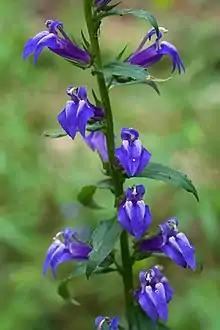 | |
Scientific classification  | |
| Kingdom: | Plantae |
| Clade: | Tracheophytes |
| Clade: | Angiosperms |
| Clade: | Eudicots |
| Clade: | Asterids |
| Order: | Asterales |
| Family: | Campanulaceae |
| Genus: | Lobelia |
| Species: | L. siphilitica |
| Binomial name | |
| Lobelia siphilitica | |
Blooming from August to October,[5] it is short-lived, lasting only for a few years.[5]
Although self-compatible, a flower is unable to offer pollen to itself and it must be pollinated by insects, primarily bumblebees.[5]
 |
Wikimedia Commons has media related to Lobelia siphilitica. |
References
- Maiz-Tome, L. (2016). "Lobelia siphilitica". IUCN Red List of Threatened Species. 2016: e.T64317288A67729987. doi:10.2305/IUCN.UK.2016-1.RLTS.T64317288A67729987.en. Retrieved 12 November 2021.
- "Lobelia siphilitica". Natural Resources Conservation Service PLANTS Database. USDA. Retrieved 26 January 2016.
- BSBI List 2007 (xls). Botanical Society of Britain and Ireland. Archived from the original (xls) on 2015-06-26. Retrieved 2014-10-17.
- "Lobelia siphilitica". Missouri Botanical Garden. Retrieved 2020-08-19.
- Caruso, C. M. (2006), "Plasticity of inflorescence traits in Lobelia siphilitica (Lobeliaceae) in response to soil water availability", American Journal of Botany, 93 (4): 531–8, doi:10.3732/ajb.93.4.531, PMID 21646213
This article is issued from Wikipedia. The text is licensed under Creative Commons - Attribution - Sharealike. Additional terms may apply for the media files.