Blueberry muffin baby
Blueberry muffin baby is a term coined by physicians to describe a neonate born with the characteristic reddish-blue widespread purpura occurring as a result of dermal extramedullary hematopoiesis[1][2]: 826 The rash is most commonly found in infants infected with rubella or the cytomegalovirus.[3] However, the cause of this characteristic rash can be variable and include other TORCH infections, blood disorders, and malignancies.[4] The purpura are often generalized, but occur more often on the trunk, head, and neck.[5] This medical condition is named after its superficial similarity to a blueberry muffin. Diagnosis of this condition involves combination of clinical presentation, physical exam, and laboratory studies. Prognosis is variable based upon the cause of the characteristic rash. Treatment may include supportive care, anti-viral medication, transfusion, or chemotherapy depending on the underlying cause.
| Blueberry muffin baby | |
|---|---|
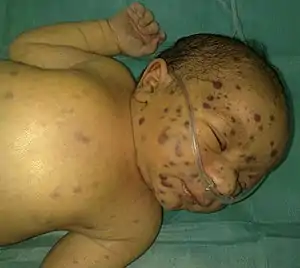 | |
| A newborn baby with typical lesions of a blueberry muffin baby. | |
| Specialty | Pediatrics |
| Symptoms | reddish-blue purpura localized mainly to the face, neck, and trunk |
| Causes | congenital rubella, congenital CMV, other TORCH infections, blood disorders, and malignancies |
| Prevention | MMR vaccine covers for congenital rubella |
| Treatment | treat underlying disease |
| Medication | varies depending on underlying disease |
| Prognosis | varies depending on underlying disease |
Pathophysiology
During normal embryologic development, hematopoiesis can occur in the dermis until the fifth month of gestation.[3] Blueberry muffin lesions in the neonate indicate the prolongation of dermal extramedullary hematopoiesis outside of the gestational period.[3]
These lesions are typically non-blanching macules or papules that present as a generalized rash in the newborn.[3]
Causes
The blueberry muffin rash was originally considered pathognomonic of congenital rubella, but it is now considered to be potentially associated with many other intrauterine infections, hematologic diseases, and malignancies.[3] Other TORCH infections that can cause this rash include cytomegalovirus,[6] herpes virus, and toxoplasma.[4] Blood disorders, such as hereditary spherocytosis and hemolytic disease of the newborn, that increase extramedullary hemotopoeisis can also cause a blueberry muffin baby. It is also possible that a neonate with the blueberry muffin rash can have an underlying malignancy such as metastatic neuroblastoma and congenital leukemia.[7] Listed below are a few known conditions[3][8] that can cause a blueberry muffin baby.
Infectious
- Toxoplasmosis: TORCH infection due to Toxoplasma gondii parasite. Condition is commonly associated with undercooked meat or contact with cat feces. Symptoms of this disease include seizures, hydrocephalus, and chorioretinitis.
- Cytomegalovirus: viral TORCH infection associated with sensorineural hearing loss, hepatomegaly, and jaundice.
- Rubella: viral TORCH infection associated with post-auricular and occipital lymphadenopathy in addition to a maculopapular rash that starts on the face and spreads to the trunk.
- Herpes virus: viral TORCH infection associated with painful vesicular lesions and meningitis.
- Syphilis: bacterial TORCH infection due to Treponema pallidum. Congenital syphilis can present with saber shins, saddle-shaped nose, Hutchinson's teeth, and deafness.
- Epstein Barr virus: viral infection that causes infectious monocleosis. Condition is associated with lymphadenopathy, splenomegaly, and various lymphomas
Hematologic
- Hereditary spherocytosis: autosomal dominant disease that results in formation of aberrant erythrocyte membrane protein. This condition results in structural change of red blood cells (RBCs), shearing of RBCs, and anemia.
- Hemolytic disease of the newborn (ABO or Rh incompatibility): Condition is due to maternal and fetal red blood cell mismatch. Maternal antibodies destroy fetal RBCs which results in anemia.
Neoplastic
- Neuroblastoma: pediatric cancer due to malignancy in neuroblast cells. Tumor is usually localized to the adrenal glands.
- Congenital leukemia: pediatric cancer due to malignancy of white blood cells.
- Congenital rhabdomyosarcoma: pediatric cancer due to malignancy of muscle cells.
Systemic
- Langerhans cell histocytosis (LCH): Condition due to excess build-up of Langerhans cells.
- Lupus: autoimmune disease
Diagnosis
Diagnosis of the medical condition is based on a combination of clinical presentation, physical exam, and laboratory studies. When this characteristic rash is found in a neonate, laboratory workup is prompted.
Initial workup usually includes a complete blood count (CBC) with differential to evaluate for underlying blood disorders.[7] Laboratory confirmation of the cause of the blueberry muffin rash depends on the underlying illness.
For example, serology positive for rubella specific antibodies, viral culture with isolated rubella, or isolation of rubella virus RNA through polymerase chain reaction can all confirm that congenital rubella infection is the underlying cause of the blueberry muffin rash.[9] Other manifestations of congenital rubella disease can also appear in conjunction with the characteristic rash. These include congenital glaucoma, jaundice, hepatosplenomegaly, microcephaly, cataracts, or sensorineural hearing loss. The presence of these features can further bolster the diagnosis of congenital rubella as the cause of the blueberry muffin baby.[9] Laboratory studies for congential rubella infection should be done prior to 1 year of age as diagnosis becomes more challenging afterwards.[10]
In the case of infection with cytomegalovirus (CMV), patients can present with associated symptoms such as deafness and chorioretinitis. On lab studies, there may be a high anti-cytomegalovirus antibody titer, positive CMV urine culture, and thrombocytopenia.[3]
If the cause is due to hemolytic disease of the newborn or hereditary spherocytosis, the neonate will have a positive Coomb's test and unconjugated hyperbilirubinemia.[3]
Malignancies such as neuroblastoma and acute myeloid leukemia are all rare but possible causes of a blueberry muffin baby. Most of the time, these conditions are diagnosed using immunohistochemistry and biopsy.[3]
Prognosis
Prognosis is variable based on underlying cause. Usually the lesions should resolve within three to six weeks post-delivery.[3] There has been a documented case of the rash completely resolving following a blood transfusion to treat severe anemia in a neonate.[8] The rash is usually transient and will resolve once the underlying cause is treated.
Treatment
Treatment is variable based on underlying cause. If significant anemia is present, blood transfusion may be indicated.[8] In the case of congenital rubella infection, there is no known cure. Therefore, the focus of treatment is disease prevention. The MMR vaccine is highly efficacious in preventing congenital rubella and is given routinely as a part of the pediatric vaccine schedule.[11] For neonates with congenital CMV infection, antiviral medication is given. Most commonly, valganciclovir or ganciclovir are used as first-line antiviral therapy for congenital CMV.[12] If the cause is a malignancy, the patient should receive cancer treatment such as chemotherapy.[7] Overall, treatment of the blueberry muffin baby is centered around the underlying cause.
References
- Shaffer MP, Walling HW, Stone MS (August 2005). "Langerhans cell histiocytosis presenting as blueberry muffin baby". J. Am. Acad. Dermatol. 53 (2 Suppl 1): S143–6. doi:10.1016/j.jaad.2005.01.015. PMID 16021165.
- James, William D.; Berger, Timothy G.; et al. (2006). Andrews' Diseases of the Skin: clinical Dermatology. Saunders Elsevier. ISBN 0-7216-2921-0.
- Mehta V, Balachandran C, Lonikar V (2008). "Blueberry muffin baby: a pictoral differential diagnosis". Dermatol. Online J. 14 (2): 8. PMID 18700111.
- Daum, Lisa M.; Sklar, Lindsay R.; Mehregan, Darius R. (February 2018). "Blueberry muffin rash secondary to hereditary spherocytosis". Cutis. 101 (2): 111–114. ISSN 2326-6929. PMID 29554165.
- Blueberry muffin baby: A pictoral differential diagnosis Archived July 11, 2012, at the Wayback Machine Vandana Mehta, C Balachandran, Vrushali Lonikar. Dermatology Online Journal 14 (2): 8 .
- Gaffin JM, Gallagher PG (November 2007). "Picture of the month. Blueberry muffin baby (extramedullary hematopoiesis) due to congenital cytomegalovirus infection". Arch Pediatr Adolesc Med. 161 (11): 1102–3. doi:10.1001/archpedi.161.11.1102. PMID 17984414.
- Debord, Camille; Grain, Audrey; Theisen, Olivier; Boutault, Robin; Rialland, Fanny; Eveillard, Marion (February 2018). "A blueberry muffin rash at birth". British Journal of Haematology. 182 (2): 168. doi:10.1111/bjh.15135. ISSN 1365-2141. PMID 29468630.
- Bagna, R.; Bertino, E.; Rovelli, I.; Peila, C.; Giuliani, F.; Occhi, L.; Mensa, M.; Mazzone, R.; Saracco, P.; Fabris, C. (June 2010). "Benign transient blueberry muffin baby". Minerva Pediatrica. 62 (3): 323–327. ISSN 0026-4946. PMID 20467386.
- "Rubella, Congenital Syndrome (CRS) 2007 Case Definition | CDC". Retrieved 2021-11-03.
- Kimberlin, David (2018). Red Book 2018-2021 Report of Committee on Infectious Diseases. Itasca, IL: American Academy of Pediatrics. p. 705. ISSN 1080-0131.
- Lambert, Nathaniel; Strebel, Peter; Orenstein, Walter; Icenogle, Joseph; Poland, Gregory A. (2015-06-06). "Rubella". Lancet. 385 (9984): 2297–2307. doi:10.1016/S0140-6736(14)60539-0. ISSN 1474-547X. PMC 4514442. PMID 25576992.
- Nassetta, Lauren; Kimberlin, David; Whitley, Richard (May 2009). "Treatment of congenital cytomegalovirus infection: implications for future therapeutic strategies". The Journal of Antimicrobial Chemotherapy. 63 (5): 862–867. doi:10.1093/jac/dkp083. ISSN 1460-2091. PMC 2667137. PMID 19287011.