Bob Maza
Robert Lewis Maza AM (25 November 1939 – 14 May 2000), known as Bob Maza, was an Australian actor and playwright.
Bob Maza | |
|---|---|
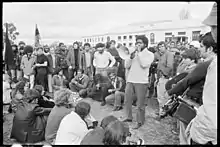 Addressing a protest at the Aboriginal Tent Embassy, July 1972 | |
| Born | Robert Lewis Maza 25 November 1939[1] Palm Island, Queensland, Australia |
| Died | 14 May 2000 (aged 60)[1] Sydney, New South Wales, Australia |
| Occupation | Actor, playwright |
Activism
In the 1960s, he was inspired by Malcolm X Speaks, and became politically active as a member of the Aborigines Advancement League, of which he was subsequently made president.[2]
In 1970, he addressed the United Nations General Assembly on the subject of "the third-world status of Indigenous Australians". In 1972, he took part in the Aboriginal Tent Embassy protest.[2]
Literary career
Maza's plays include Mereki and The Keepers.[3]
He helped found theatre companies, including Nindethana and the National Black Theatre.[2]
Acting career
Maza appeared in many television series, including Bellbird, Harry's War, Wildside, A Difficult Woman, A Country Practice, Women of the Sun and Heartland. He also acted in films, including When the Stars Came Dreaming (1998), Lilian's Story (1996), The Back of Beyond (1995), The Nostradamus Kid (1993), Reckless Kelly (1993), Ground Zero (1987), The Fringe Dwellers (1986), BabaKiueria (1986), White Man's Legend (1984), and 27A (1974).[1][4]
Personal life
Maza was born to a Murray Islander (Torres Strait Islander) father and to a Yidinjdji (Australian Aboriginal) mother.[2]
He married Dutch immigrant to Australia, Vera Blankman, and the couple were parents to actor and director Rachael Maza Long and writer Lisa Maza.[5]
Recognition
In 1993, he was awarded the Order of Australia for services to the arts and to Indigenous people.[6]
Maza won the Red Ochre Award, which has been awarded by the Australia Council for the Arts since 1993 to an outstanding Aboriginal or Torres Strait Islander artist for lifetime achievement.[2]
Legacy
Bob Maza Fellowship
At the Tudawali Awards in 2002, the Australian Film Commission's Indigenous Unit awarded the first Bob Maza Memorial Award (Fellowship?),[lower-alpha 1] to recognise emerging acting talent and support professional development.[7] It was later renamed the Bob Maza Fellowship.[3] Winners include:
- 2002: Ursula Yovich[7]
- 2006: Leah Purcell[7]
- 2007: Aaron Pedersen[7]
- 2008: Luke Carroll, presented at the Message Sticks Indigenous Film Festival at the Sydney Opera House[7]
- 2011: Wayne Blair[8]
Uncle Bob Maza Memorial Award
The Uncle Bob Maza Memorial Award for Outstanding Contribution to Victorian Indigenous Theatre has been awarded at the Victorian Indigenous Performing Arts (VIPA) Awards for some years.[9] Recipients include:
- 2003: Rachael Maza[9][10]
- 2014: Noel Tovey[11]
- ? (twice): Pauline Whyman[12]
Footnotes
- This could be an error, mixed up with the Uncle Bob Maza Memorial Award.
References
- Bob Maza on IMDb
- Bob Maza Archived 24 July 2008 at the Wayback Machine on the website of the Australia Council for the Arts
- "Bob Maza Fellowship". Screen Australia. Archived from the original on 20 July 2008.
- Bob Maza's filmography, New York Times
- "Bob Maza". AustLit. 20 July 2010. Retrieved 16 November 2021.
- It's an Honour
- "Screen Australia's Indigenous Department celebrates 25 years". Screen Australia]. 4 June 2018. Retrieved 16 November 2021.
- "Wayne Blair awarded the 2011 Bob Maza Fellowship". Screen Australia. 12 May 2011. Retrieved 16 November 2021.
- "Rachael Maza". why not theatre. 2 November 2020. Retrieved 16 November 2021.
- "Rachael Maza". AustLit. 27 January 2020. Retrieved 16 November 2021.
- "Victorian Indigenous artists honoured at awards". VicHealth. 18 February 2014. Retrieved 16 November 2021.
- "Pauline Whyman". The Wheeler Centre. 24 May 2017. Retrieved 16 November 2021.
Further reading
- Van Straten, 2007, Frank (2007). "Bob Maza AM 1939 – 2000". Live Performance Australia.</ref>
Authority control  | |
|---|---|
| General | |
| National libraries | |
| Other | |