Barthélemy Boganda
Barthélemy Boganda (c. 1910 – 29 March 1959) was the leading nationalist politician from what is now the Central African Republic. Boganda was active prior to his country's independence, during the period when the area, part of French Equatorial Africa, was administered by France under the name of Oubangui-Chari. He served as the first Prime Minister of the Central African Republic autonomous territory.
Barthélemy Boganda | |
|---|---|
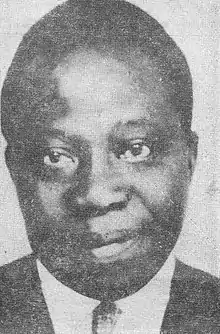 Boganda in 1958 | |
| Prime Minister of the Central African Republic autonomous territory | |
| In office 8 December 1958 – 29 March 1959 | |
| Succeeded by | Abel Goumba |
| Personal details | |
| Born | 1910 Bobangui, Oubangui-Chari |
| Died | 29 March 1959 (aged 48–49) Boukpayanga, Central African Republic |
| Cause of death | Airplane explosion |
| Nationality | Central African |
| Political party | MESAN |
| Spouse(s) | Michelle Jourdain (m. 1950) |
| Children | 3 |
| Ecclesiastical career | |
| Church | Roman Catholic Church |
| Ordained | 17 March 1938 |
| Laicized | 1950 |
Boganda was born into a family of subsistence farmers, and was adopted and educated by Roman Catholic Church missionaries. In 1938, he was ordained as the first Roman Catholic priest from Oubangui-Chari. During World War II, Boganda served in a number of missions and after was persuaded by the Bishop of Bangui to enter politics. In 1946, he became the first Oubanguian elected to the French National Assembly, where he maintained a political platform against racism and the colonial regime. He then returned to Oubangui-Chari to form a grassroots movement in opposition of French colonialism. The movement led to the 1949 foundation of the Movement for the Social Evolution of Black Africa (MESAN), which became popular among villagers and the working class. Boganda's reputation was slightly damaged when he was laicized from the priesthood after marrying Michelle Jourdain, a parliamentary secretary. Nonetheless, he continued to advocate for equal treatment and civil rights for blacks in the territory well into the 1950s.
In 1958, after the French Fourth Republic began to consider granting independence to most of its African colonies, Boganda met with Prime Minister Charles de Gaulle to discuss terms for the independence of Oubangui-Chari. De Gaulle accepted Boganda's terms, and on 1 December, Boganda declared the establishment of the Central African Republic. He became the autonomous territory's first Prime Minister and intended to serve as the first President of the independent CAR. He was killed in a mysterious plane crash on 29 March 1959, while en route to Bangui. Experts found a trace of explosives in the plane's wreckage, but revelation of this detail was withheld. Although those responsible for the crash were never identified, people have suspected the French secret service, and even Boganda's wife, of being involved. Slightly more than one year later, Boganda's dream was realized, when the Central African Republic attained formal independence from France.
Biography
Early life
Little is known about Boganda's early life.[1] He was born around the year 1910[2] to a family of subsistence farmers in Bobangui, a large M'Baka village in the Lobaye basin located at the edge of the equatorial forest some 80 kilometres (50 mi) southwest of Bangui.[3] His father, Swalakpé, was wealthy owner of several palm plantations and had taken numerous wives. Boganda's mother was Swalakpé's third wife.[4] French commercial exploitation of Central Africa had reached an apogee around the time of Boganda's birth, and although interrupted by World War I, activity resumed in the 1920s. The French consortia used what was essentially a form of slavery—the corvée—and one of the most notorious was the Compagnie Forestière de la Haute Sangha-Oubangui (CFSO), involved in rubber gathering in the Lobaye district.[5] Coercive labor practices, violence, and disease had severely disrupted traditional society by the time Boganda was born. Bobangui was particularly affected by these elements.[6] His uncle, whose son Jean-Bédel Bokassa would later crown himself as the Emperor of the Central African Empire, was beaten to death at the colonial police station as a result of his alleged resistance to work.[7]
Both of Boganda's parents died when he was young; his father was reportedly killed in a punitive campaign conducted by colonial forces shortly after his birth. His mother died before 1915, probably having been murdered by a CFSO militiaman for not having met a rubber collection quota. Boganda was then given to the care of a guardian who joined the French Army during World War I and was killed at the Battle of Verdun.[4] Boganda was then placed in the tutelage of other relatives, and in 1920 he contracted smallpox. In June his brother was instructed to take him to an uncle, and along the way they encountered a French patrol led by Lieutenant Mayer. His brother fled out of fear. Left alone, Boganda said, "Gboganda." This was probably a Ngbaka phrase meaning "I am [from] elsewhere," and he was probably hoping to explain that he was lost. The soldiers believed this was his name, rendering it "Boganda" and using it as such for the rest of his life.[8] Mayer took him to the orphanage in the nearby town of Mbaïki. Once there, a Spiritan missionary touring the area decided to take him to the mission station of Saint Jean Baptiste in Bétou, a town further south on the Oubangui River which was home to a school.[9]
At Bétou Boganda was instructed in reading and writing in Lingala. In December 1921 he was taken to the main Spiritan mission of Saint Paul des Rapides in Bangui, the capital of Oubangui-Chari. He was baptised there under the name "Barthélémy" in late 1922. At Saint Paul he learned French, the catechism, and agricultural labour. By mid-1924 Boganda had completed his primary education and had indicated his desire to become a priest. In November he was sent to the Jesuit petit séminaire in Lemfu, Belgian Congo. The school's curriculum included Latin, French, mathematics, history, and philosophy and was scheduled to take six years to complete, though Boganda had left by 1928/1929.[10][lower-alpha 1] After failing to enroll in a school in France due to lack of money, he entered the Spiritian petit séminaire in Brazzaville. He spent his final year of studies in Bangui, where he was tutored by Monsignor Grandin, the head of the Catholic Church in Oubangui-Chari.[12] Once this was completed, Grandin enrolled Boganda in the Saint Laurent grand séminaire in Mvolyé, Yaoundé, French Cameroon, in 1931. The first African student at the school, he learned history, Latin, philosophy, theology, and other subjects.[13]
On 17 March 1938[14] Boganda was ordained and became the first Roman Catholic priest native to Oubangui-Chari.[15] He was subsequently posted to the new Saint Marcel petit séminaire in Bangui as a teacher.[16] In 1939 his bishop denied his request to join the French Army, deeming it necessary for him to remain, as many Frenchmen involved with the church had been recalled to the metropole to fight in World War II.[17] He was posted in the Grimari region from 1941 to 1946 to evangelize the resident Banda population. Boganda was enthusiastic work and was angered by local resistance to some of his teachings and practices. This especially included his efforts which contravened local cultural norms, such as his encouragement to abandon polygamy and fetishism and work to enroll girls in school.[16] His response to such hesitation sometimes included violence, and he was accused of beating people and once suggesting a recalcitrant chief be shot with a cartridge of salt.[18] Boganda also believed that the church was providing him with insufficient support and, by the mid-1940s, was in conflict with the local government administrator and felt he was facing racial discrimination from colonial officials, settlers, and some missionaries.[19] Further strain on his position was incurred when he fathered a child in the Bakala region, an action his missionary colleagues saw as scandalous. As a result of these tensions, in 1946 Boganda was transferred to a mission at Bangassou.[20]
Beginnings in politics and marriage
After World War II, Boganda was urged by Grandin, to involve himself in politics.[17] In particular, Grandin hoped he would seek election to the National Assembly of France. Some Oubanguians had already indicated that they would support Boganda if he contested a seat in the assembly, and Grandin hoped that Boganda could preserve the interests of the Catholic Church from the local growth of Protestantism and increasing leftist and anti-colonial thought in both France and its colonies.[20] Boganda decided to compete, and on 10 November 1946, he was elected deputy for Oubangui-Chari,[21] becoming the first native Oubanguian to join assembly after winning almost half of the total votes cast and defeating three other candidates, including the incumbent, François Joseph Reste, who had formerly served as the Governor-General of French Equatorial Africa. Formally, Boganda identified with the Popular Republican Movement (MRP).[17] He arrived in Paris attired in his clerical garb and introduced himself to his fellow legislators as the son of a polygamous cannibal,[22] probably in a deliberate attempt project a personal aura of omnipotence.[23] Grandin sought to maintain influence over his former pupil and had requested that the Spiritans in France welcome him, provide lodging, and introduce him to Catholic politicians and keep him away from left-leaning groups. They did not do this, and Boganda expressed disappointment at the lack of a reception upon his arrival and the weak support from French deputies for his proposals to help his constituents in Oubangui-Chari.[24]
Boganda left the MRP in 1950 and served as an independent thereafter.[17] He was reelected to the National Assembly in 1951 and 1956.[24] He spoke two times before the body, in 1947 on the abuses of colonialism and in 1950 on the lack of social justice in French Equatorial Africa. After 1956, he largely stopped attending the Paris parliament, though he remained a deputy until 1958.[17] Frustrated by the faults of colonial rule in Oubangui-Chari and an unwillingness on the part of local officials to accept reforms, he quickly resorted to vocal criticism of French administration in the colony. He paid particular attention to racism and highlighted incidents of settler violence against black Africans to boost his own political following.[25] In April 1947, Grandin complained to the governor of Oubangui-Chari that Boganda had "escaped from his cage" and was "flying like an idiot."[26] While his rhetoric was anti-colonial, Boganda nominally supported French political ideals and did not oppose continuing connections between France and Oubangui-Chari. He also identified as a staunch anti-communist and accused colonial administrators of being "anti-French" and "worthy sons of Stalin," making it difficult for them to criticise him.[27] Seeking to improve Oubanguian farmers' incomes and spur colonial reform, he launched a co-operative project,[28] the Société Coopérative Oubangui, Lobaye, Lesse (SOCOULOLE), which aimed to provide food, clothing, lodging, medical care and education. SOCOULOLE disbanded after a few months.[17][29]
Boganda soon returned to Oubangui-Chari to organise a grassroots movement of teachers, truck drivers and small producers to oppose French colonialism.[30] On 28 September 1949, at Bangui, he founded the Movement for the Social Evolution of Black Africa (MESAN), a quasi-religious political movement and party that sought to affirm black humanity and quickly came to dominate local politics.[17] Framing his political goals as a matter of fundamental rights, he coined the Sango phrase "zo kwe zo", which translated to "every human being is a person".[17][31] Effectively, he was looking for equal treatment and civil rights for blacks within the French Union rather than independence, at least for the time being.[32] He demarginalised large masses of people—women, youth, workers, poor cultivators—with the intent of unleashing the creativity of the Oubanguian people by placing them centre stage in the making of their country's history.[33]
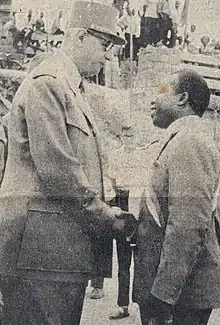
The movement was more popular among villagers than among évolué townsmen, whom Boganda considered servile and to whom he applied the derogatory term "Mboundjou-Voko" ("Black-Whites").[34] Additionally, he created the Intergroupe Liberal Oubanguien (ILO) in 1953,[35] which aimed to elect an equal number of black and white politicians to the assembly, so that a united electoral college could be established.[36] MESAN's activities angered the French administration and the companies trading in cotton, coffee, diamonds and other commodities. The Bangui chamber of commerce was controlled by these companies, and the men who gathered at this club strongly resented the demise of forced labour and the resultant rise of black nationalism. They hated Boganda in particular, viewing him as a dangerous revolutionary demagogue and a threat to their "free enterprise", and they resolved to get rid of him.[37] They also set up local RPF branches to counter MESAN, and the presence of African Democratic Rally (RDA) in the other three territories of French Equatorial Africa posed some menace for MESAN, but by 1958, although other parties were allowed, they had been reduced to tiny groups.[38] On many occasions, General Charles de Gaulle expressed his sympathy for Oubangui-Chari, which had supported de Gaulle's Free French Forces as early as August 1940, and refused to support the violent intrigues of the RPF against Boganda and his men. He received Boganda, by then head of the Grand Council of French Equatorial Africa and pushing for independence, in Paris in July 1958 and was in turn received at Brazzaville in August. The discussions there led to the General accepting Boganda's demands for independence and the endorsement of the French Community in September throughout French Equatorial Africa.[39]
Boganda's attachment to the clergy weakened when he met and fell in love with a young Frenchwoman, Michelle Jourdain, who was employed as a parliamentary secretary.[37] By 1949 they were cohabitating and Boganda wrote a letter to his Catholic superiors, pointing out that clerical celibacy was a rule created by the Catholic Church and had no biblical basis.[40] The two were married on 13 June 1950, for which Boganda was expelled from the priesthood and cut off from the Catholic hierarchy's support. Boganda and Jourdain would later have two daughters and a son. The affair caused a minor scandal in Paris, but it did little to dent his popularity with his people.[37] Despite this, Boganda remained a devout Catholic and sympathetic to missionary interests.[31] In the National Assembly he continued to battle, often in vain, against repressive features of the French administration in Oubangui-Chari. Arbitrary arrest, low wages, compulsory cotton cultivation, and the exclusion of blacks from restaurants and cinemas were all targets of his rhetoric.[37]
Increasing popularity and move toward autonomy
On 29 March 1951, Boganda was sentenced to two months in prison[41] following his arrest on 10 January for "endangering the peace" after intervening in a local market dispute (the "Bokanga incident" in Lobaye).[42] His wife was sentenced to 15 days in prison, but neither served their terms. On 17 June, he was re-elected to the National Assembly with 48% of the vote despite the obstacles placed in his way by the administration and strong opposition by the authorities, colonists, and the missions, with two prominent French candidates seeking to oust him.[17] At this time, he emerged as an extraordinarily popular messianic folk hero and his country's leading nationalist; MESAN became the majority party in the Territorial Assembly elections in March 1952. In this period he divided his time between his coffee plantation, his emancipation work and new political positions.[17] In April 1954, an incident that would showcase Boganda's talent and appeal with crowds erupted at Berbérati. A white public works agent, who had recently been reprimanded for his brutality toward Africans, announced that his cook and the cook's wife had died.[36] A riot broke out and the governor sent in parachutists while armoured vehicles patrolled the streets. Boganda hesitated to appear in a village that was not one of his strongholds, but did so anyway and declared before the rioters that justice would be the same for blacks and whites. Upon hearing Boganda's words, the crowd became calm and dispersed.[43]

He played a crucial role at the beginning of internal autonomy (1956–1958), although the relatively conservative Boganda remained sympathetic to French interests and still did not advocate immediate independence.[44][lower-alpha 2] For Boganda, the 1956 election, in which he took 89% of the vote against another Oubanguian, was an uncontested speaker's platform with which the colonial administration had come to terms; the French had realised that opposing him would be dangerous and sought to accommodate him. That year he agreed to European representation on election lists in exchange for the financial support of French business leaders, and on 18 November, was elected as the first mayor of Bangui. On 31 March 1957, MESAN won all seats in the Territorial Assembly election; on 18 June, Boganda was elected president of the Grand Council of French Equatorial Africa (a forum he used to broadcast his views on African unity)[45] and in May was appointed vice-president of the Oubangui-Chari Government Council (the French governor was still its president).[46]
A pragmatist, Boganda spoke before the local assembly on 30 December 1957 in praise of the new Comité de Salut Economique, which envisioned joint administration of the economy between French colonials and MESAN territorial councilors (he called it "the union of capital and Oubanguian labour"), but lack of French investment and opposition by Oubanguians soon led him to turn away from the idea.[47] With the numerous declarations of independence being made in much of Francophone Africa, Boganda advised that an independent Oubangui-Chari would face major economic problems from the onset. Instead, he advocated the independence of all of French Equatorial Africa and its integration into a United States of Latin Africa comprising the former French, Belgian, and Portuguese colonies of Central Africa;[42] he intended for Oubangui-Chari to become a federal unit within that structure. However, such a federation proved unrealistic, foundering on the rocks of regional jealousy and personal ambition,[48] and Boganda came to accept a constitution covering only Oubangui-Chari as the Central African Republic. Thus, after 1 December 1958, when Boganda declared the establishment of the Central African Republic as an autonomous member of the French Community, the name was applied only to the former Oubangui-Chari.[41] On 8 December, the CAR's first government came into being with Boganda as prime minister; a French governor remained in the country but was now called high commissioner. The new government began by adopting a law banning nudity and vagabondage, Boganda's missionary education still showing through.[49] Its main objective, however, was to draw up a constitution. Democratic in nature, the document provided for a unicameral parliament with a five-year term and a prime minister for the same period. It was approved by the assembly on 9 February 1959 and signed by the government a week later. Formal independence came on 13 August 1960.[50]
Death and aftermath
Boganda was poised to become the first president of the independent CAR when he boarded a plane at Berbérati for a flight to Bangui on 29 March 1959, just prior to legislative elections. The aircraft exploded in midair over Boukpayanga in the sub-prefecture of Boda (about 160 kilometres (100 mi) west of Bangui), killing all passengers and crew.[51][52] No clear cause has ever been ascertained for the mysterious crash[41] and no commission of inquiry was ever formed;[52] sabotage was widely suspected.[lower-alpha 3] The nation was shocked at the death of its revered leader, whose funeral on 2 April at the cathedral of Notre-Dame de Bangui saw a great outpouring of grief from thousands of Oubanguians.[53] The 7 May edition of the Paris weekly L'Express revealed that experts had found traces of explosive in the wreckage, but the French high commissioner banned the sale of that magazine edition when it appeared in the CAR. Many suspected that expatriate businessmen from the Bangui chamber of commerce, possibly aided by the French secret service, played a role.[49] Michelle Jourdain was also suspected of being involved: by 1959, relations between Boganda and his wife had deteriorated, and he thought of leaving her and returning to the priesthood. She had a large insurance policy on his life, taken just days before the accident. According to Brian Titley, author of Dark Age: The Political Odyssey of Emperor Bokassa, there are good reasons for suspecting her involvement in the plane crash.[49]
Abel Goumba, the vice-premier and finance minister whom Titley describes as "intelligent, honest, and strongly nationalistic",[54] emerged as Boganda's logical successor. However, his close confidant and cousin, interior minister David Dacko, more likely to lead a regime deferential to foreign interests, was backed by the high commissioner, Colonel Roger Barberot, with the support of the chamber of commerce and Michelle Jourdain.[55] He thus brushed aside Goumba and by 1962 had shut down the opposition, with MESAN becoming the country's single party.[56] The events after Boganda's death are strongly evocative of other French efforts to maintain economic domination by ensuring that compliant leaders came to power in its former colonies.[57] It also robbed the country of a charismatic leader in the Houphouët-Boigny or Senghor mould, whose prestige alone might have sufficed to retain civilian rule, which ended when Bokassa deposed the unpopular Dacko in 1966.[58]
Legacy
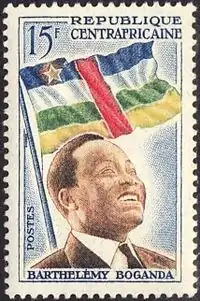
Boganda is not only considered the hero and father of his nation but also as one of the great leaders of decolonization in Africa; the historian Georges Chaffard described him after his death as "the most prestigious and the most capable of Equatorial political men,"[41] while political historian Gérard Prunier called him "probably the most gifted and most inventive of French Africa's decolonization generation of politicians."[59] Among the places named after him are an avenue in Bangui, one of the city's largest high schools, a Château Boganda and Barthélemy Boganda Stadium. 29 March, the anniversary of his death, is Boganda Day, a public holiday. Boganda was also the designer of the flag of the Central African Republic, originally intended for the United States of Latin Africa.[60] His phrase, zo kwe zo, was later incorporated into the CAR's coat of arms.[31] The preamble of the CAR's 2004 Constitution read, in part, "Animated by the wish of assuring to man his dignity with respect to the principle of "ZO KWE ZO" enunciated by the Founder of the Central African Republic Barthélemy BOGANDA".[61]
Boganda is one in a long line of African political leaders who, in an attempt to develop specifically national political cultures, were presented (or presented themselves) as the great national leader, glorified and sometimes nearly deified. They were hailed as the fathers of their nations and considered wise in the ways of understanding the best interests of their peoples. Others who became particular objects of hero-worship include Léopold Sédar Senghor, Félix Houphouët-Boigny, Moktar Ould Daddah, Ahmed Sékou Touré, Modibo Keïta, Léon M'ba and Daniel Ouezzin Coulibaly.[62] Boganda did little to discourage wide circulation of tales about his supernatural powers, putative invulnerability and even immortality. Shortly before his death, a large crowd waited on the shore of the Ubangui River to see him cross by walking upon the waters. He did not show up, but apparently a good many people still believed that he could have made the miraculous crossing.[62] More than just a charismatic political leader, he was seen as the "black Christ", a great religious figure endowed with extraordinary powers. Along with Congo-Brazzaville's Fulbert Youlou, who remained a priest while president, Boganda was not particularly concerned with his religious mission once he entered politics, but he unabashedly used the enormous popular respect for the Church and the cloth to political advantage. He successfully manipulated religious symbols (clerical garb, crosses, baptism, disciples, acolytes, etc.) for political purposes.[63]
After his death, his mystique grew: he was a national martyr, and miracles were regularly attributed to him. The Boganda myth continues to exercise a strong hold on many people in the CAR, and it has frequently been used by his successors in their appeals for national unity. Those who were related to him even tenuously, such as Bokassa (who was from the same village and minority ethnic group, was the son of his mother's uncle, justified his coup using Boganda's name and created a cult of Boganda as founder of the party and state),[38] or Dacko (who posed as the ideological successor of Boganda by championing for "national reconciliation" during the 1981 election)[64] were able to capture some of his aura and use it to their advantage.[49][62]
Boganda's life has some presence in French histography, but much of what has been written about his biographical details, especially by Central African authors, is hagiographic in nature.[65] His ideas and speeches have been more thoroughly incorporated into general analyses of political philosophies.[66] Boganda is rarely mentioned in English historiography, and where he is included it is generally within the context of his Pan-African project of the United States of Latin Africa.[65]
Notes
- The reasons for Boganda dropping out of the school are not entirely clear. Biographer Pierre Kalck wrote that Boganda was uncomfortable with the strict method of instruction. Historian Klaas van Walraven wrote, "More probably, [his] dissatisfaction stemmed from the predominant place of Kikongo as language of instruction, as well as the cultural differences between seminarists from Brazzaville (and elsewhere) and the rural world of Lemfu seminarists."[11]
- As late as April 1958, with the French Fourth Republic in its death throes, he formed part of a majority of African francophone leaders who still sought associational formulae that would somehow preserve viable links between France and its African empire. For them, "independence" meant autonomy within some form of French political community, not complete rejection of France and all it had meant for them. This is not entirely surprising, as these leaders had participated in the Republic's birth, helped write its constitution and laws, and participated in its legislatures and political parties. Le Vine, pp. 122, 127.
- Gérard Prunier footnotes his statement, "the probability of foul play was very high", saying, "The whites who worked for what was left of the Grandes Compagnies Concessionaires hated Boganda, who had been instrumental in finally getting compulsory labor outlawed in 1946. They also hated his intelligence, which was unsettling to their view of black inferiority." Prunier, pp. 103 & 393
References
- van Walraven 2017, p. 239.
- van Walraven 2017, p. 240.
- Titley, p. 7.
- van Walraven 2017, p. 241.
- Titley, p. 6.
- van Walraven 2017, pp. 240–241.
- Chirot 1996, p. 379.
- van Walraven 2017, p. 242.
- van Walraven 2017, pp. 242–243.
- van Walraven 2017, p. 243.
- van Walraven 2017, p. 243, footnote #27.
- van Walraven 2017, pp. 243–244.
- van Walraven 2017, p. 244.
- Bradshaw, Richard A. (10 December 2006). "Bibliography and Reference Work for the Central African Republic: Letra C". Archived from the original on 4 January 2015. Retrieved 22 February 2008.
- Kalck (1971), p. 75.
- van Walraven 2017, p. 245.
- "Biographies des députés de la IV République: Barthélémy Boganda" (in French). National Assembly of France. Archived from the original on 24 June 2008. Retrieved 29 February 2008.
- van Walraven 2017, p. 245, footnote #33.
- van Walraven 2017, pp. 245–246.
- van Walraven 2017, p. 246.
- van Walraven 2017, p. 246–247.
- Titley, p. 12.
- van Walraven 2017, p. 247.
- van Walraven 2017, p. 248.
- van Walraven 2017, pp. 247–249.
- van Walraven 2017, p. 248, footnote #51.
- van Walraven 2017, pp. 249–250.
- van Walraven 2017, p. 249.
- Kalck (2005), p. 179.
- Clark and Gardinier, p. 111.
- van Walraven 2017, p. 250.
- He declared MESAN's goal was "to promote the political, economic and social evolution of black Africa, to break down the barriers of tribalism and racism, to replace the degrading notion of colonial subordination with the more human ones of fraternity and cooperation." National Assembly of France biography. He also declared that MESAN "aims to develop and liberate the black race by progressive and pacific evolution, achieved by the combined efforts of all negroes throughout the world. Each ethnic or administrative group, each family, clan or tribe, each district, region, division, province or department, each territory, each federation, will organise its own branches, federations and committees." Kalck (1971), p. 79.
- Clark and Gardinier, p. 122.
- Kalck (2005), p. 134.
- Olson 1991, p. 122.
- Kalck (1971), p. 89.
- Titley, p. 13.
- Kalck (2005), p. 136.
- Kalck (2005), pp. 83–84.
- van Walraven 2017, p. 260, footnote #99.
- Kalck (2005), p. 27.
- Appiah & Gates 1999, p. 277.
- Kalck (1971), p. 90.
- Appiah & Gates 1999, p. 398.
- Kalck (2005), p. xxxi.
- Kalck (2005), p. 90.
- Kalck (2005), p. 44.
- On 28 September, at Boganda's call, 98% of Oubanguian voters endorsed a referendum establishing the French Community. However, it emerged at the Brazzaville Conference of 24–25 November that the leaders of Chad, Congo-Brazzaville, and above all Gabon (which had seen its revenues transferred for the development of the Middle Congo) were determined to go it alone, and their nations became autonomous republics within the French Community on 28 November 1958. Kalck (2005), p. xxxi.
- Titley, p. 16.
- Kalck (2005), p. 125.
- Aboard were four crew and five passengers, including the government's information chief and a member of parliament. "African Leader Found Dead in Crashed Plane". The New York Times. 1 April 1959. p. 10.
- Prunier, p. 103.
- Kalck (1971), p. 106.
- Titley, p. 15.
- Kalck (1971), p. 107.
- Titley, pp. 16–17.
- Titley, p. 18.
- Titley, p. 31.
- Prunier, p. 102.
- Kalck (2005), p. 74.
- Heyns 1999, p. 77.
- Le Vine, p. 106.
- Le Vine, p. 182.
- Titley, p. 158.
- van Walraven 2017, p. 238.
- van Walraven 2017, pp. 238–239.
Works cited
- Appiah, K. Anthony; Gates, Henry Louis, Jr., eds. (1999). Africana: The Encyclopedia of the African and African American Experience. New York City: Basic Books. ISBN 0-465-00071-1.
- Chirot, Daniel (1996). Modern Tyrants: The Power and Prevalence of Evil in Our Age. Princeton: Princeton University Press. ISBN 0-691-02777-3.
- Clark, John F.; Gardinier, David E., eds. (1997). Political Reform in Francophone Africa. Boulder: Westview Press. ISBN 0-8133-2785-7.
- Heyns, Christoph (ed.) (1999). Human Rights Law in Africa. The Hague: Martinus Nijhoff Publishers. ISBN 90-411-0287-6.CS1 maint: extra text: authors list (link)
- Kalck, Pierre (1971). Central African Republic: A Failure in De-Colonisation. translated by Barbara Thomson. London: Pall Mall Press. ISBN 0-269-02801-3.
- Kalck, Pierre (2005). Historical Dictionary of the Central African Republic. translated by Xavier-Samuel Kalck (3rd ed.). Lanham: The Scarecrow Press. ISBN 0-8108-4913-5.
- Le Vine, Victor T. (2004). Politics in Francophone Africa: The States of West and Equatorial Africa. Boulder: Lynne Rienner Publishers. ISBN 1-58826-249-9.
- Olson, James S. (ed.) (1991). Historical Dictionary of European Imperialism. Westport: Greenwood Press. ISBN 0-313-26257-8.CS1 maint: extra text: authors list (link)
- Prunier, Gérard (2009). Africa's World War: Congo, the Rwandan Genocide, and the Making of a Continental Catastrophe. Oxford: Oxford University Press. ISBN 978-0-19-537420-9.
- Titley, Brian (1997). Dark Age: The Political Odyssey of Emperor Bokassa. Montreal: McGill-Queen's University Press. ISBN 0-7735-1602-6.
- van Walraven, Klaas (2017). "The Diaries of Barthélémy Boganda, Priest and Politician in French Equatorial Africa (1910–1959)". History in Africa. 44: 237–264. doi:10.1017/hia.2016.14. ISSN 1558-2744.
| Ubangi-Shari (1903–1960) | 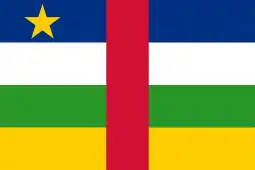 Flag of the Central African Republic | |
|---|---|---|
| Central African Republic (1960–1976) | ||
| Central African Empire (1976–1979) | ||
| Central African Republic (1979–present) | ||
* Acting ‡ Interim | ||
Authority control  | |
|---|---|
| General | |
| National libraries | |
| Other | |