Boomerang (1947 film)
Boomerang! is a 1947 American crime semidocumentary based on the true story of a vagrant who was accused of murder by a highly pressured police force, only to be found not guilty through the efforts of the prosecutor. It stars Dana Andrews, Lee J. Cobb, Karl Malden, Arthur Kennedy and Jane Wyatt, with voiceovers by Reed Hadley.
| Boomerang! | |
|---|---|
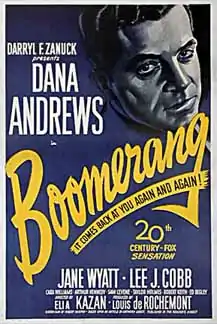 Theatrical release poster | |
| Directed by | Elia Kazan |
| Screenplay by | Richard Murphy |
| Based on | The Perfect Case 1945 article in The Reader's Digest by Anthony Abbot |
| Produced by | Louis de Rochemont Darryl F. Zanuck |
| Starring | Dana Andrews Jane Wyatt Lee J. Cobb |
| Narrated by | Reed Hadley |
| Cinematography | Norbert Brodine |
| Edited by | Harmon Jones |
| Music by | David Buttolph |
| Color process | Black and white |
Production company | 20th Century Fox |
| Distributed by | 20th Century Fox |
Release date |
|
Running time | 88 minutes |
| Country | United States |
| Language | English |
| Budget | $1.14 million[1] |
| Box office | $2.25 million (rentals)[2][3] |
The film was directed by Elia Kazan and adapted, with changes, from a 1945 story written by Fulton Oursler (credited as "Anthony Abbot") based on an actual 1924 crime that was published in Reader's Digest. The film was shot mostly in Stamford, Connecticut after Kazan was denied permission to film in Bridgeport, Connecticut, where the crime and trial occurred.[4]
The film, which some regard as having film noir aspects, was entered into the 1947 Cannes Film Festival.[5]
Plot
Catholic priest Father Lambert is shot dead on a Bridgeport, Connecticut street at night. The police, led by Chief Robinson, fail to immediately find the murderer. It soon becomes a political hot potato, with the police accused of incompetence, and the city's reform-minded administration coming under attack by the political machine it had displaced. Robinson and prosecutor Henry Harvey come under severe pressure by political leaders, the press, and the public, to find the killer or bring in outside help.
Strenuous local efforts yield nothing. However, vagrant military veteran John Waldron is arrested in Ohio, and meets the general description of the alleged criminal in Bridgeport. He is extradited to Connecticut and identified in a lineup. Waldron is interrogated for two days by police until, suffering from severe sleep deprivation, he confesses. A gun that was in his possession is believed to be that which was used in the shooting, and witness and other circumstantial evidence seems solid enough to guarantee conviction.
Harvey then questions Waldron and investigates the evidence and the witnesses. He develops serious doubts as to Waldron's guilt. In court Harris states that it's the prosecutor's job to seek justice, not merely convict. Accordingly, he lays out the flaws in the case before the judge, and indicates that he intends to dismiss the charges. Suspecting Harvey's political motives, the presiding judge calls him into his private chambers and warns Harvey that he will hold his actions to the highest scrutiny. A lynch mob then seeks to seize Waldron when he is escorted from the courtroom at the end of the first day's business, but Chief Robinson not only refuses to yield the prisoner but makes clear to friend and stranger alike in the crowd he will use deadly force to protect his charge.
Harvey is then threatened by reform party kingpin and real estate swindler Paul Harris, who seeks to blackmail him based on his wife's innocent contribution to a community fund for a park land that Harris secretly owns. Harvey threatens to physically throw Harris out of his home.
At a preliminary hearing, Harvey presents detailed evidence that would lead to Waldron's exoneration. Meanwhile, a reporter who had learned Harris had visited Harvey and grew suspicious of a backstory conducted his own investigation of possible wrongdoing. Arriving in court, he secretly threatens to reveal Harris' double dealing. Harris then commits suicide in the courtroom.
Waldron is exonerated. The film ends with a narration explaining that the murder was never solved, and that "Henry Harvey" had actually been Homer Cummings, who rose from state prosecutor to become the United States attorney general.[4]
Cast
- Dana Andrews as State's Attorney Henry L. Harvey
- Jane Wyatt as Madge Harvey
- Lee J. Cobb as Chief Harold F. "Robby" Robinson
- Cara Williams as Irene Nelson (waitress at Coney Island Cafe)
- Arthur Kennedy as John Waldron (murder suspect)
- Sam Levene as Dave Woods (reporter, Morning Record)
- Taylor Holmes as T.M. Wade (Morning Record publisher)
- Robert Keith as "Mac" McCreery
- Ed Begley as Paul Harris
- Karl Malden as Det. Lt. White
- William Challee as Stone, Harvey's assistant
- Lewis Leverett as Whitney, Harvey's assistant
- Arthur Miller as a suspect in the police lineup (uncredited)
- Wyrley Birch as Father Lambert (uncredited)
Background
Factual basis
The film is based on an actual 1924 murder case that occurred in Bridgeport, Connecticut. While walking near the Lyric Theatre in downtown Bridgeport, the Rev. Hubert Dahme (Father George Lambert in the film) was fatally shot behind the left ear by a gun fired at close range. Those in the theater were so shocked that no one thought to call for an ambulance until 10 minutes had passed. Two hours later, the priest was pronounced dead at St. Vincent's Hospital in Bridgeport.[4] A vagrant and discharged soldier, Harold Israel, was indicted for the murder. Israel confessed to the crime, and a .32 revolver was found in his possession that police believed was used in the murder. Fairfield County state's attorney Homer Cummings conducted a thorough investigation and cleared Israel of the crime. Cummings (Henry Harvey in the film) later became United States attorney general under Franklin D. Roosevelt. The Morning Record was the name used in the film for the Bridgeport Post (now the Connecticut Post).[4]
Filming locations
Almost all of the film was shot in Stamford, Connecticut, except for the courtroom scene shot in the Westchester County Superior Court in White Plains, New York.[6]
Stamford locations:[6]
- The South End of Stamford, particularly at Saint Luke's Chapel.
- Old Town Hall, particularly the police-department offices and the stairway leading to the courtroom.
- The Altschul home on Den Road (for a meeting of leading citizens).
- The front and sidewalk of the Plaza Theatre, which stood on Greyrock Place (where a driveway leading into the Stamford Town Center mall now stands).
- The former offices of The Advocate, the Stamford daily newspaper, on Atlantic Street. Some members of the Advocate's editorial staff were used in the scene in which news breaks that the killer has been caught.
The film premiered at the Palace Theatre in Stamford on March 5, 1947, with Kazan and Andrews in attendance. Kazan later filmed Gentleman's Agreement, which takes place in Darien, Connecticut, adjacent to Stamford, and which also starred Jane Wyatt.[4]
Reception
Critical response
In a contemporary review for The New York Times, critic Bosley Crowther discussed the filmmaking, writing the "...style of presentation has resulted in a drama of rare clarity and punch."[7]
Variety published a positive review, writing: "Boomerang! is gripping, real-life melodrama, told in semi-documentary style. Lensing was done on location at Stamford, Conn, the locale adding to realism. Based on a still unsolved murder case in Bridgeport, Conn, plot is backed up with strong cast...All the leads have the stamp of authenticities. The dialog and situations further the factual technique. Lee J. Cobb shows up strongly as chief detective, harassed by press and politicians alike while trying to carry out his duties. Arthur Kennedy is great as the law's suspect."[8]
Awards and honors
Wins
- National Board of Review: NBR Award, Best Director, Elia Kazan; 1947.
- New York Film Critics Circle Awards: NYFCC Award Best Director, Elia Kazan; 1947.
Nominations
- Academy Awards: Oscar, Best Writing, Screenplay, Richard Murphy; 1947.
The film is recognized by American Film Institute in these lists:
- 2001: AFI's 100 Years...100 Thrills – Nominated[9]
Adaptations to other media
Boomerang! was dramatized as a half-hour radio play on the November 10, 1947 broadcast of The Screen Guild Theater with Dana Andrews and Jane Wyatt, on the January 14, 1949 broadcast of the Ford Theatre with Andrews and on Hollywood Sound Stage with Tyrone Power and Wyatt on February 28, 1952.[10]
See also
References
- Solomon, Aubrey (1989). Twentieth Century Fox: A Corporate and Financial History. Lanham, Maryland: Scarecrow Press, p. 244, ISBN 978-0-8108-4244-1.
- Solomon, Aubrey (1989). Twentieth Century Fox: A Corporate and Financial History. Lanham, Maryland: Scarecrow Press, p. 222, ISBN 978-0-8108-4244-1.
- "Top Grossers of 1947", Variety, 7 January 1948 p 63
- "'Boomerang!,' shot in Stamford, to be screened in Bridgeport", The Advocate of Stamford, Connecticut, October 13, 2009
- "Festival de Cannes: Boomerang!". festival-cannes.com. Retrieved February 19, 2011.
- Russell, Don, "'Roles' in movies are nothing new for city: Kazan used Stamford in the '40s", editorial page column in The Advocate, Stamford edition, page A10, April 25, 2007
- Crowther, Bosley. The New York Times, film review, March 6, 1947. Last accessed: Last accessed: February 19, 2011.
- Variety. Film Review, March 5, 1947. Last accessed: November 26, 2009.
- "AFI's 100 Years...100 Thrills Nominees" (PDF). Retrieved August 20, 2016.
- The Screen Guild Programs Archived May 11, 2011, at the Wayback Machine web site. Last accessed: February 19, 2011.
External links
- Boomerang at the American Film Institute Catalog
- Boomerang at IMDb
- Boomerang at AllMovie
- Boomerang at the TCM Movie Database
- Boomerang! at DVD Beaver (includes images)
- Boomerang! film review by John Farr on YouTube