Brahma Chellaney
Brahma Chellaney is a New Delhi-based geostrategist and author who won the Asia Society's 2012 Bernard Schwartz Book Award.[1] He is a columnist for Project Syndicate.[2] He received the $20,000 Bernard Schwartz Award from the New York-based Asia Society for his work, Water: Asia's New Battleground, published by Georgetown University Press.[3]
Brahma Chellaney | |
|---|---|
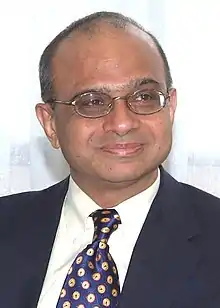 Chellaney in 2009 | |
| Born | 18 January 1962 |
| Nationality | Indian |
| Alma mater | University of Delhi |
| Occupation | Academic and public intellectual |
| Website | chellaney.net |
Education and career
Chellaney was born in New Delhi. After passing the Senior Cambridge examination at Mount St. Mary's School, India, he did a Bachelor of Arts (Honours) from Hindu College, University of Delhi and a Master of Arts from the Delhi School of Economics. He holds a PhD in international arms control.[4]
He is a Professor of Strategic Studies at the New Delhi-based Centre for Policy Research; a Richard von Weizsäcker Fellow with the Robert Bosch Academy in Berlin; and a nonresident affiliate with the International Centre for the Study of Radicalization at King's College London.[5] In the mid-2000s, he was a member of the Indian government's Policy Advisory Group, which was chaired by the External Affairs Minister of India.[6][7] Before that, he was an adviser to India’s National Security Council, serving as convener of the External Security Group of the National Security Advisory Board.[8]
Professor Chellaney was described in The New York Times/International Herald Tribune in 1999 as "one of the independent experts who helped draft India's proposed nuclear doctrine".[9] The country's draft nuclear doctrine was publicly released in August 1999.[10] The thesis he propounded in early 2017 on China's "debt-trap diplomacy,"[11] according to one magazine, "has morphed since into something approaching conventional wisdom, especially in Washington."[12]
Among the institutions where he has held appointments include Harvard University, the Norwegian Nobel Institute, the Brookings Institution, the Paul H. Nitze School of Advanced International Studies at the Johns Hopkins University, and the Australian National University.[13][14]
Chellaney’s work has drawn attention from both academia and mainstream media.[15][16][17][18][19][20][21] Graham Tobin from the University of South Florida has as described Chellaney’s geopolitical analyses as astute and critical.[22]
Debt-Trap Diplomacy
Chellaney coined the concept of debt-trap diplomacy to describe how the Chinese government leverages the debt burden of smaller countries for geopolitical ends.[23]
Chellaney saw 'debt trap diplomacy' in China's handling of Sri Lanka's debt distress by taking over its Hambantota port on a long-term lease in return for cash.[24] Other scholars have disputed the assessment, arguing that Chinese finance was not the source of the country’s financial distress.[25][26][27]
Tibet
After Prime Minister Atal Bihari Vajpayee visit to China in June 2003, a joint declaration was signed in which India recognised that "the Tibet Autonomous Region is part of the territory of the People's Republic of China".[28][29] Chellaney stated that India's recognition of Chinese sovereignty over Tibet constituted its "single biggest security blunder".[30]
Publications
Chellaney is the author of nine books.[31] Two of his most recent books relate to the geopolitics of water resources.[32] Another book, an international best-seller, focuses on how a fast-rising Asia has become the defining fulcrum of global geopolitical change.[33]
His peer-reviewed papers have been published in a number of journals, including International Security (journal), Survival (journal), Nature (journal), Orbis (journal), Asian Survey, Studies in Conflict & Terrorism, Disarmament, The Washington Quarterly, Security Studies (journal) and Politique étrangère.
He is also a prolific newspaper essayist. Besides being a columnist for Project Syndicate, he publishes regularly in The Globe and Mail, The Japan Times, Nikkei Asia, South China Morning Post, Hindustan Times and The Times of India. He has also been a contributor to The Wall Street Journal, The Guardian, The New York Times, and other newspapers and magazines.[34]
Selected books
- Water, Peace, and War: Confronting the Global Water Crisis, Rowman & Littlefield, 2015.[35]
- Water: Asia's New Battleground, Georgetown University Press, 2019.[36]
- Asian Juggernaut: The Rise of China, India and Japan, HarperCollins USA, 2010.[37]
References
- Stanley A. Weiss (21 February 2009), Whom Do Sanctions Hurt?, International Herald Tribune; "Water: Asia's New Battleground |". Georgetown University Press.; "Asian Juggernaut;". HarperCollins Publishers. Retrieved 21 December 2019.
- Columnist Brahma Chellaney. "Project Syndicate".
- "Brahma Chellaney wins Asia Society Bernard Schwartz Book Award;". Business Line. 25 October 2012. Retrieved 17 March 2020.
- "Ph.D. Brahma CHELLANEY;". European Forum Alpbach. Retrieved 17 March 2020.
- "The S.T. Lee Distinguished Annual Lecture by Professor Brahma Chellaney;". S. Rajaratnam School of International Studies. 30 October 2018. Retrieved 17 March 2020.
- "Wilson Center;". Retrieved 21 December 2019.
- "25th Anniversary Debate". United Nations Institute for Disarmament Research. 5 February 2006. Archived from the original on 5 February 2006. Retrieved 9 January 2020.
- "Brahma Chellaney: India's hydro-diplomacy with Pakistan, Bangladesh and China;". Global Water Forum. 30 August 2019. Retrieved 17 March 2020.
- Brahma Chellaney (1 September 1999). "India, Too, Has a Right to Credible Nuclear Deterrence;". International Herald Tribune. Retrieved 27 July 2020.
- "Draft Report of National Security Advisory Board on Indian Nuclear Doctrine;". Federation of American Scientists. 17 August 1999. Retrieved 27 July 2020.
- "Brahma Chellaney: China's Debt-Trap Diplomacy;". Project Syndicate. 23 January 2017. Retrieved 1 October 2020.
- "Inside China's Belt and Road Tangle;". The Diplomat. 1 September 2020. Retrieved 1 October 2020.
- "Robert Bosch Academy |". Retrieved 21 December 2019.
- "25th Anniversary Debate". United Nations Institute for Disarmament Research. 5 February 2006. Archived from the original on 5 February 2006. Retrieved 9 January 2020.
- Stanley A. Weiss (21 February 2009), Whom Do Sanctions Hurt?, International Herald Tribune
- "Delhi Isn't Buying Beijing's Coronavirus Hero Act;". The Wall Street Journal. 2 April 2020. Retrieved 3 April 2020.
- Jason Burke (7 April 2011), "Indian Activist Anna Hazare Refuses to End Hunger Strike", The Guardian
- "'Black Day': China, Pakistan's election to UN rights body draws ire;". The Times of India. 14 October 2020. Retrieved 22 October 2020.
- Shekhar Gupta (3 June 2014), First Person, Second Draft: Once upon a bloody time, Indian Express
- Nathan, Andrew J (November–December 2011). "Water: Asia's New Battleground". Foreign Affairs. 90 (6).
- Patterson, Kendra (May 2013). "Review of Water: Asia's New Battleground". Global Environmental Politics. The MIT Press. 13 (2): 164-165.
- Tobin, Graham (January 2014). "Water, Peace, and War: Confronting the Global Water Crisis by Brahma Chellaney". Journal of Latin American Geography. Johns Hopkins University Press. 13 (3): 257-259.
- Heather Zeiger (13 November 2020), "China and Africa: Debt-Trap Diplomacy?", Mind Matters
- Chellaney, Brahma (21 December 2017), "China's creditor imperialism", The Strategist
- Jones, Lee; Hameiri, Shahar (19 August 2020). "Debunking the myth of 'debt trap'". Chatham House – International Affairs Think Tank. 4. Sri Lanka and the BRI.
- Carrai, Maria Adele (5 June 2021). "Questioning the Debt-Trap Diplomacy Rhetoric surrounding Hambantota Port". Georgetown Journal of International Affairs.
- Rithmire, Meg; Brautigam, Deborah (6 February 2021). "The Chinese 'Debt Trap' Is a Myth". The Atlantic.
- Powers, John; Templeman, David (2012), Historical Dictionary of Tibet, Scarecrow Press, p. 184, ISBN 978-0-8108-7984-3
- "Declaration on Principles for Relations and Comprehensive Cooperation Between the Republic of India and the People's Republic of China". Ministry of External Affairs, Government of India. 23 June 2003. Retrieved 3 March 2021.
- Chellaney, Brahma (2011). Water: Asia's New Battleground. Georgetown University Press. p. 177. ISBN 978-1-58901-798-6.
- "Center for Policy Research |". Retrieved 21 December 2019.; "Nikkei Asian Review;". Retrieved 17 March 2020.
- "The S.T. Lee Distinguished Annual Lecture by Professor Brahma Chellaney;". S. Rajaratnam School of International Studies. 30 October 2018. Retrieved 17 March 2020.
- Chellaney, Brahma (6 April 2010). Asian Juggernaut: The Rise of China, India, and Japan;. ISBN 9780061987625. Retrieved 17 March 2020.; "The S.T. Lee Distinguished Annual Lecture by Professor Brahma Chellaney;". S. Rajaratnam School of International Studies. 30 October 2018. Retrieved 17 March 2020.
- "The S.T. Lee Distinguished Annual Lecture by Professor Brahma Chellaney;". S. Rajaratnam School of International Studies. 30 October 2018. Retrieved 2 November 2021.
- G. John Ikenberry. "Water, Peace, and War: Confronting the Global Water Crisis;". Foreign Affairs. Retrieved 17 March 2020.
- Andrew J. Nathan. "Water: Asia's New Battleground;". Foreign Affairs. Retrieved 17 March 2020.
- Chellaney, Brahma (6 April 2010). Asian Juggernaut: The Rise of China, India, and Japan;. ISBN 9780061987625. Retrieved 17 March 2020.
External links
 |
Wikimedia Commons has media related to Brahma Chellaney. |
- Stagecraft and Statecraft: Brahma Chellaney's website
Authority control  | |
|---|---|
| General | |
| National libraries | |
| Other | |