Brahman dynasty of Sindh
The Brahman dynasty (c. 632 – c. 724 CE[1]) was a Hindu power on the Indian subcontinent which originated in the region of Sindh, present-day Pakistan. Most of the information about its existence comes from the Chach Nama, a historical account of the Chach-Brahman dynasty. The Brahman dynasty were successors of the Rai dynasty.
Brahman dynasty | |||||||||
|---|---|---|---|---|---|---|---|---|---|
| 632 CE–724 CE | |||||||||
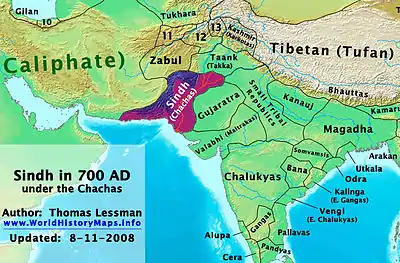 Chacha dynasty in 700 CE | |||||||||
| Government | Monarchy | ||||||||
| History | |||||||||
• Brahman dynasty begins | 632 CE | ||||||||
• Brahman dynasty ends | 724 CE | ||||||||
| |||||||||

History
The dynasty was founded by a Brahman named [[Chach of Alor after he married the widow of Rai Sahasi II, the last ruler of the Rai dynasty. His claim was further secured by the killing of Rai Sahasi II's brother.[1][2]
The rule of Sindh by a Hindu dynasty raised ire in the Umayyad Caliphate. Caliph Abd al-Malik ibn Marwan granted a large army to the governor Al-Hajjaj ibn Yusuf, but no attempt was made to annex Sindh due to the caliph's death. Under his son and successor Al-Walid I, the general Muhammad bin Qasim led Islamic invasion against Sindh in 712 where the last Hindu king of Sindh Raja Dahir died while defending his kingdom.[3]
Rulers
The known rulers of the Brahman dynasty are:[1]
Under the Umayyad Caliphate:
- Dahirsiya (r. c. 679 – c. 709– from Brahmanabad)
- Hullishāh (r. c. 712 – c. 724– )
- Shishah (r. 724– )
References
- Wink, André (1991). Al- Hind: The slave kings and the Islamic conquest. 2. BRILL. pp. 152–153. ISBN 9004095098.
- MacLean, Derryl N. (1989). Religion and Society in Arab Sind. BRILL. ISBN 9004085513.
- Burton, Richard (1851). Sindh and the Races That Inhabit the Valley of the Indus. Asian Educational Services. pp. 14–15. ISBN 9788120607583.