Brian Earp
Brian David Earp is an American bioethicist, philosopher, and interdisciplinary researcher. He is best known for his writings on intersex medical interventions, circumcision, and drug use in the United States.[1][2] He is currently Associate Director of the Yale-Hastings Program in Ethics and Health Policy at Yale University and The Hastings Center, and a Research Fellow at the Oxford Uehiro Centre for Practical Ethics.
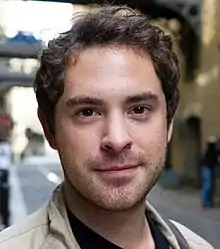
Earp has written on a wide range of topics, including free will,[3] sex and gender[4] and the replication crisis in psychology[5] He currently writes the quarterly "Philosophy in the Real World" column for The Philosopher. In 2019, Earp wrote his first book (co-written with Julian Savulescu), published in the UK as Love Is the Drug: The Chemical Future of Our Relationships [6] and in the United States as Love Drugs: The Chemical Future of Relationships).[7][8][9][10][11]
Personal life
Earp grew up in a conservative evangelical Christian household. His mother was a stay-at-home mother; his father was a X-ray technician.[10]
Work and views
Earp's papers have been characterized as philosophically upholding utilitarianism and liberalism.[12]
Relationships and drugs
He is best known for writing Love Is the Drug: The Chemical Future of Our Relationships with Julian Savulescu.[10][13][14][15] He has argued that certain forms of medications can be ethically consumed as a "helpful complement" in relationships. Both to fall in love, and, to fall out of it.[10][11]
Circumcision and intersex medical interventions
Earp has argued that all forms of involuntary non-therapeutic genital modification and mutilation — in which category he includes routine neonatal circumcision, intersex interventions, and female genital mutilation — are violations of bioethical principles.[1][2][16][17] He has written multiple papers and articles on the history of circumcision: arguing that the desire to control male sexuality is "evident both in Judaism and in the Victorian period."[16] For this work, Earp was nominated for the 2020 John Maddox Prize, and received commendation from the judges, for “taking a multi-disciplined, science-based approach to a deep-rooted cultural practice”.[18]
Criticism
Wesley Smith, an American conservative lawyer and commentator, has harshly criticized Earp's writings on circumcision, saying that they misrepresent the scientific consensus and are intended to:[12]
Ultimately... attack... religious freedom and impos[e] a[n] utilitarian secularist cloak over all of society.
References
- Earp, Brian D.; Steinfeld, Rebecca (May 15, 2017). "How different are female, male and intersex genital cutting?". The Conversation. Retrieved October 29, 2020.
- Earp, Brian (October 2015). "Female genital mutilation and male circumcision: toward an autonomy-based ethical framework". Medicolegal and Bioethics: 89. doi:10.2147/mb.s63709. ISSN 2230-2468.
- psyarxiv.com https://psyarxiv.com/3bxra. Retrieved 2020-12-07. Missing or empty
|title=(help) - "What is Gender For?".
- Earp, Brian D.; Trafimow, David (2015). "Replication, falsification, and the crisis of confidence in social psychology". Frontiers in Psychology. 6: 621. doi:10.3389/fpsyg.2015.00621. ISSN 1664-1078. PMC 4436798. PMID 26042061.
- "Manchester University Press - Love is the Drug". Manchester University Press. Retrieved 2020-12-07.
- Press, Stanford University. "Love Drugs: The Chemical Future of Relationships | Brian D. Earp and Julian Savulescu". www.sup.org. Retrieved 2020-12-07.
- Greenberg, Jon (April 18, 2016). "HIV In Africa: 6 Million Circumcisions And Counting". Politifact. Retrieved 2020-10-25.
- Zublin, Fiona (2020-01-05). "Love in the Roaring '20s". OZY. Retrieved 2020-10-25.
- Shane, Cari (2019-12-12). "Can We Replace Couples Therapy With Real-Life Love Potions?". OZY. Retrieved 2020-10-25.
- Szalavitz, Maia (2014-05-19). "Is It Possible to Create an Anti-Love Drug?". The Cut. Retrieved 2020-10-29.
- Smith, Wesley (October 26, 2021). "Bioethicist Claims Allowing Circumcision Is Sexist". National Review. Retrieved October 31, 2021.
- Fetters, Ashley (2020-01-16). "Your Chemical Romance". The Atlantic. Retrieved 2020-10-25.
- Anekwe, Lilian. "Drugs may be able to fix our romantic lives when things go wrong". New Scientist. Retrieved 2020-10-25.
- Anekwe, Lilian (February 12, 2020). "Drugs may be able to fix our romantic lives when things go wrong". New Scientist. Retrieved 2020-10-29.
- Hacker, Daphna (2017). Legalized Families in the Era of Bordered Globalization. Cambridge University Press. pp. 270–271. ISBN 978-1316508213.
- Shweder, Richard A. (2016). "Equality Now in Genital Reshaping: Brian Earp's Search for Moral Consistency". Kennedy Institute of Ethics Journal. 26 (2): 145–154. doi:10.1353/ken.2016.0016. ISSN 1086-3249. PMID 27477192. S2CID 44291019.
- CAPRISA (Dec 14, 2020). "Anthony Fauci and Salim Abdool Karim jointly awarded John Maddox Prize 2020 for standing up for science during the coronavirus pandemic".
Authority control  | |
|---|---|
| General | |
| National libraries | |