Broderie (garden feature)
Broderie (from the French word French: broderie = "embroidery") is a garden art term associated with Baroque garden design. Broderie emerged in France around 1600 and lasted until 1770, reaching its zenith in the Baroque period.[1] Several phases of development can be distinguished.
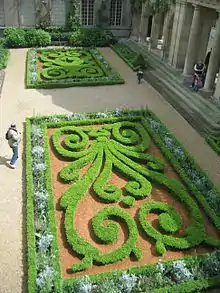

A broderie is an ornamental garden made of sheared box hedges. The main motifs are wreaths and strapwork, more rarely they are in the shape of monograms and figures.
The ornamental shapes were filled in with other materials (gravel, grit, broken brick, glass shards, coal, etc.). This enabled the ornamental garden to be admired from a distance, for example by those in the rooms on the bel étage of a country house, schloss or chateau.
In French garden art the parterre en broderie was the highest form of parterre. Prime examples were the magnificent gardens laid out by André Le Nôtre such as the one in Vaux-le-Vicomte (1656–1661) or the Parterre du Midi in Versailles. Due to the triumph of the landscape garden, no Baroque broderies have been preserved in their entirety in the original. In Germany, for example, the broderies of Schloss Augustusburg in Brühl (around 1730) or Schwetzingen (1753–1758) have been reconstructed.
Many restored broderies are increasingly threatened by fungi and insects, especially the box tree moth.[1]
