Fatherland Front (Bulgaria)
The Fatherland Front (Bulgarian: Отечествен фронт, ОФ, romanized: Otechestven front, OF) began as a Bulgarian communist political resistance movement in 1942 during World War II. The Zveno movement, the communist Bulgarian Workers Party, a wing of the Bulgarian Agrarian National Union and the Bulgarian Social Democratic Workers Party all became part of the OF. The constituent groups of the OF had widely contrasting ideologies and had united only in the face of the pro-German militarist dictatorship in Bulgaria. At the beginning, the members of the OF worked together, without a single dominating group. Professional associations and unions could be members of the front and maintain their organisational independence. However, the Bulgarian Communist Party soon began to dominate. In 1944, after the Soviet Union had declared war on Bulgaria, the OF carried out a coup d'état (9 September 1944) and declared war on Germany and the other Axis powers. The OF government, headed by Kimon Georgiev of Zveno, immediately signed a ceasefire treaty with the Soviet Union (28 October 1944).
Fatherland Front Отечествен фронт | |
|---|---|
.svg.png.webp) | |
| Founded | July 17, 1942 |
| Dissolved | 1989 |
| Succeeded by | Fatherland Union |
| Ideology | Communism Marxism–Leninism |
| Political position | Far-left |
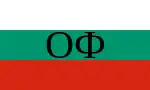
| Party flag | |
 | |
On November 18, 1945, the OF, the only party or alliance listed on the ballot, won a large majority in national elections.[1] In November 1946 Georgiev resigned as Prime Minister; Georgi Dimitrov, leader of the communists succeeded him. Bulgaria became a People's Republic on 15 September 1946. The OF eventually transformed into a wide-ranging popular front under overall Communist control, and all member-parties except the Bulgarian Agrarian People's Union dissolved. With the fall of communism in Bulgaria in 1989 the Fatherland Front was dissolved.
Chairmen of the National Council
- Georgi Dimitrov, 1949
- Encho Stajkov, 1957 – May 1967
- Boyan Bulgaranov, May 1967–April 1972
- Georgi Traikov, 1972–1974
- Pencho Kubadinski, 1974–1989
- Zhivko Zhivkov, 1989 – April 1, 1990
Electoral history
Grand National Assembly elections
| Election | Votes | % | Seats | +/– |
|---|---|---|---|---|
| 1949 | 4,588,996 | 100% | 241 / 241 |
 241 241 |
| 1953 | 4,981,594 | 99.8% | 249 / 249 |
8 |
| 1957 | 5,204,027 | 100% | 247 / 247 |
 2 2 |
| 1962 | 5,461,224 | 100% | 321 / 321 |
74 |
| 1966 | 5,744,072 | 100% | 414 / 414 |
93 |
| 1971 | 6,154,082 | 100% | 400 / 400 |
14 |
| 1976 | 6,369,762 | 100% | 400 / 400 |
 |
| 1981 | 6,519,674 | 100% | 400 / 400 |
|
| 1986 | 6,639,562 | 100% | 400 / 400 |
|
| 1990 | Only constituencies | 2 / 400 |
398 | |
References
- Jessup, John E. (1989). A Chronology of Conflict and Resolution, 1945-1985. New York: Greenwood Press. ISBN 0-313-24308-5.
Authority control  | |
|---|---|
| General | |
| National libraries | |