Bumin Qaghan
Bumin Qaghan (Old Turkic: 𐰉𐰆𐰢𐰣:𐰴𐰍𐰣, romanized: Bumïn qaγan,[2] also known as Illig Qaghan (Chinese: 伊利可汗, Pinyin: Yīlì Kèhán, Wade–Giles: i-li k'o-han) or Yamï Qaghan[lower-alpha 1] (Old Turkic: 𐰖𐰢𐰃:𐰴𐰍𐰣, romanized: Yаmï qaγan, died 552 AD) was the founder of the Turkic Khaganate. He was the eldest son of Ashina Tuwu (吐務 / 吐务).[7] He was the chieftain of the Turks under the sovereignty of Rouran Khaganate.[8][9][10][11] He is also mentioned as "Tumen" (土門, 吐門, commander of ten thousand[12]) of the Rouran Khaganate.[13]
| Bumin Qaghan 𐰉𐰆𐰢𐰣:𐰴𐰍𐰣 | |||||
|---|---|---|---|---|---|
| First Khagan of the Turkic Khaganate | |||||
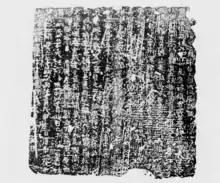
 A line dedicated to Bumin Qaghan in the Ongin inscription. | |||||
| Reign | 551–552 | ||||
| Coronation | 552 in Altai Mountains[1] | ||||
| Successor | Issik Qaghan | ||||
| Died | 552 | ||||
| Spouse | Princess Changle | ||||
| |||||
| House | Ashina Clan | ||||
| Father | Ashina Tuwu | ||||
Early life
According to History of Northern Dynasties and Zizhi Tongjian, in 545 Tumen's tribe started to rise and frequently invaded the western frontier of Wei. The chancellor of Western Wei, Yuwen Tai, sent An Nuopanto (Nanai-Banda, a Sogdian from Bukhara,[14]) as an emissary to the Göktürk chieftain Tumen, in an attempt to establish a commercial relationship.[15][16] In 546, Tumen paid tribute to the Western Wei state.[16] In that same year, Tumen put down a revolt of the Tiele tribes against the Rouran Khaganate, their overlords.[16] Following this, Tumen felt entitled to request of the Rouran a princess as his wife. The Rouran khagan, Anagui, sent a message refusing this request and adding: "You are my blacksmith slave. How dare you utter these words?" Bumin got angry, killed Anagui's emissary, and severed relations with the Rouran Khaganate.[15][17][18][19] Anagui's "blacksmith" (鍛奴 / 锻奴, Pinyin: duàn nú, Wade–Giles: tuan-nu) insult was recorded in Chinese chronicles. Some sources state that members of the Tujue did serve blacksmiths for the Rouran elite,[8][9][10][11] and that "blacksmith slavery" may refer to a kind of vassalage that prevailed in Rouran society.[20] Nevertheless, after this incident Bumin emerged as the leader of the revolt against Rouran.
.PNG.webp)
In 551, Bumin requested a Western Wei princess in marriage. Yuwen Tai permitted it and sent Princess Changle(長樂公主) of Western Wei to Bumin.[15][17][18]In the same year when Emperor Wen of Western Wei died, Bumin sent mission and gave two hundred horses.[15][17]
The beginning of formal diplomatic relations with China propped up Bumin's authority among the Turks. He eventually united the local Turkic tribes and threw off the yoke of the Rouran domination. In 552 Bumin's army defeated Anagui's forces at the north of Huaihuang and then Anagui committed suicide.[17] With their defeat Bumin proclaimed himself "Illig Qaghan" and made his wife qaghatun.[17] "Illig" means Ilkhan (i.e. ruler of people) in Old Turkic.[21] According to the Bilge Qaghan's memorial complex and the Kul Tigin's memorial complex, Bumin and Istemi ruled people by Turkic laws and they developed them.[2][22]
Death and family
Bumin died within several months after proclaiming himself Illig Qaghan. He was married to Princess Changle of Western Wei.
Issue:
- Ashina Keluo (阿史那科罗) - Issig Qaghan
- Ashina Qijin (阿史那俟斤) - Muqan Qaghan
- Taspar Qaghan
- Ashina Kutou (阿史那庫頭) - Ditou Qaghan (appointed by Muqan Qaghan to be lesser khagan of eastern wing of Turkic Empire)[23]
- Mahan Tigin - Lesser khagan appointed by Taspar Qaghan[24]
- Rudan Qaghan (褥但可汗)[25]
- Böri Qaghan (步離可汗) - Lesser khagan of appointed by Taspar Qaghan[25]
Legacy
He was succeeded by his younger brother Istemi[26] in the western part and by his son Issik Qaghan in the eastern part. In less than one century, his khaganate expanded to comprise most of Central Asia.
Notes
- Yamï Qağan on the Ongin inscription is often identified as Qǐmín Kěhàn 啟民可汗 (r. 603–609 or 599-614) of the Eastern Turkic Khaganate[3] W. Radloff identifies Yiamy kagan as Bumyn kagan, basing on similarities of letters "b" and "y" (H.N.Orkhun); Bumyn kagan (S.E Malov),[4] G.Aidarov,[5] Yamï qaγan (T.Tekin),[6] Yamï qaγan (L.Bold), according I. Markwart, Yiamy kagan is Bumyn/Tumen.
References
- Bauer, Susan Wise (2010). The History of the Medieval World: From the Conversion of Constantine to the First Crusade. W. W. Norton & Company. p. 238. ISBN 978-0-393-05975-5.
- Kultegin’s Memorial Complex, TÜRIK BITIG
- Baumer's History of Central Asia (2016), p 324.
- S.E. Malov Onginsky monument; Monuments of ancient Türkic writing of Mongolia, Kyrgyzstan, M., L., 1959, p. 7-11
- G. Aydarov On the language of the Kutlug Kagan monument; News of the Academy of Sciences of the Kazakh SSR, Series of social sciences, 1963, issue-6. p. 81-88
- Orhun H.N. Eski turk yazitlarі. Turk Tarih Kurumu basimevi, Ankara, 1986, p.127-132
- Ouyang Xiu et al., New Book of Tang, Cilt 215-II (in Chinese)
- 馬長壽, 《突厥人和突厥汗國》, 上海人民出版社, 1957, (Ma Zhangshou, Tujue ve Tujue Khaganate), pp. 10-11. (in Chinese)
- 陳豐祥, 余英時, 《中國通史》, 五南圖書出版股份有限公司, 2002, ISBN 978-957-11-2881-8 (Chen Fengxiang, Yu Yingshi, General history of China), p. 155. (in Chinese)
- Gao Yang, "The Origin of the Turks and the Turkish Khanate", X. Türk Tarih Kongresi: Ankara 22 - 26 Eylül 1986, Kongreye Sunulan Bildiriler, V. Cilt, Türk Tarih Kurumu, 1991, s. 731.
- Burhan Oğuz, Türkiye halkının kültür kökenleri: Giriş, beslenme teknikleri, İstanbul Matbaası, 1976, p. 147. «Demirci köle» olmaktan kurtulup reisleri Bumin'e (in Turkish)
- "Tumen" is used for expressing 10,000 and "Bum" is used for expressing 100,000 in Secret History of the Mongols, Larry Moses, "Legend by the numbers: The Symbolism of Numbers in the 'Secret History of the Mongols'", Asian folklore studies, Vol. 55-56, Nanzan University Institute of Anthropology, 1996, p. 95.
- Beckwith, Christopher I. (16 March 2009). Empires of the Silk Road: A History of Central Eurasia from the Bronze Age to the Present. Princeton University Press. pp. 387, 390. ISBN 0691135894. Retrieved 30 May 2015.
- Shing Müller, "Sogdian in China um 600 n. Chr. Archäologische Zeugnisse eines Lebens zwischen Assimilation und Identitätsbewahrung", NOAG, Vol. 183-184, 2008. p. 123. (in German)
- Li Yanshou (李延寿), History of Northern Dynasties, Vol. 99. (in Chinese)
- Sima Guang, Zizhi Tongjian, Vol. 159. (in Chinese)
- Linghu Defen et al., Book of Zhou, Vol. 50. (in Chinese)
- Sima Guang, Zizhi Tongjian, Vol. 164. (in Chinese)
- Christopher I. Beckwith, Empires of the Silk Road: a history of Central Eurasia from the Bronze Age to the present, Princeton University Press, 2009, ISBN 978-0-691-13589-2, p. 9.
- Larry W. Moses, "Relations with the Inner Asian Barbarian", ed. John Curtis Perry, Bardwell L. Smith, Essays on Tʻang society: the interplay of social, political and economic forces, Brill Archive, 1976, ISBN 978-90-04-04761-7, p. 65. Slave' probably meant vassalage to the Juan Juan confederation of Mongolia, whom they served in battle by providing iron weapons, and also marching with qaghan's armies.
- Talat Tekin, (1968), A Grammar of Orkhon Turkic, p. 58
- Bilge kagan’s Memorial Complex, TÜRIK BITIG
- Linghu, Defen. Book of Zhou. p. 33.
- Alyılmaz, Cengiz. "Bugut Yazıtı ve Anıt Mezar Külliyesi Üzerine". Türkiyat Araştırmaları Dergisi.
- 北史/卷099 - 维基文库,自由的图书馆. zh.wikisource.org (in Chinese). Retrieved 2018-07-26.
- Michalis N. Michael; Matthias Kappler; Eftihios Gavriel (2009). Archivum Ottomanicum. Mouton. pp. 68, 69.
The Yujiulü clan of Rouran tribe Khagans of Rouran (includes chieftains, members, noblemen, consorts and descendants) | ||||||||||||
|---|---|---|---|---|---|---|---|---|---|---|---|---|
| Pre-khaganate |
|  | ||||||||||
| Former Khaganate |
| |||||||||||
| Middle Khaganate |
| |||||||||||
| Later Khaganate |
| |||||||||||
| Members, Noblemen, consorts and descendants of the Yujiulü clan | ||||||||||||
| related people |
| |||||||||||
| ||||||||||||

