Burma Road
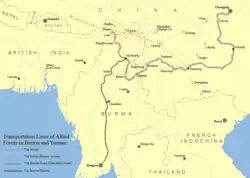
The Burma Road (Chinese: 滇缅公路) was a road linking Burma (now known as Myanmar) with southwest China. Its terminals were Kunming, Yunnan, and Lashio, Burma. It was built while Burma was a British colony to convey supplies to China during the Second Sino-Japanese War. Preventing the flow of supplies on the road helped motivate the occupation of Burma by the Empire of Japan in 1942. Use of the road was restored to the Allies in 1945 after the completion of the Ledo Road. Some parts of the old road are still visible today.[1]
History
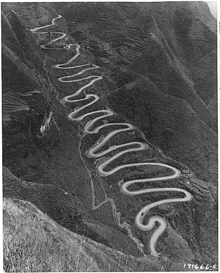
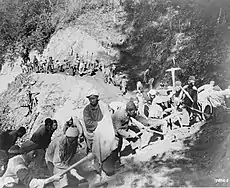
The road is 717 miles (1,154 km) long and runs through rough mountain country.[2] The sections from Kunming to the Burmese border were built by 200,000 Burmese and Chinese laborers during the Second Sino-Japanese War in 1937 and completed by 1938.[3] The construction project was coordinated by Chih-Ping Chen.
During World War II, the Allies used the Burma Road to transport materiel to China, especially after China lost sea-access following the loss of Nanning in the Battle of South Guangxi. Supplies were landed at Rangoon (now Yangon) and moved by rail to Lashio, where the road started in Burma.
In July 1940, Britain yielded to Japanese diplomatic pressure and closed the Burma Road for three months.[4]: 299 The Japanese overran Burma in 1942, closing the Burma Road. The Allies thereafter supplied China by air, flying "over The Hump" from India.
The Allies recaptured northern Burma in late 1944, which allowed the Ledo Road from Ledo, Assam to connect to the old Burma Road at Wandingzhen, Yunnan, China. The first trucks reached the Chinese frontier by this route on January 28, 1945.[5]
Films set on the Burma Road
- Burma Convoy (1941)
- A Yank on the Burma Road (1942)
- Bombs over Burma (1942)
Further reading
- C. T. Chang: Burma Road, Malaysia Publications, Singapore 1964.
- Forbes, Andrew ; Henley, David (2011). China's Ancient Tea Horse Road. Chiang Mai: Cognoscenti Books. ASIN: B005DQV7Q2
- Jon Latimer: Burma:The Forgotten War. John Murray, London 2004, ISBN 0-7195-6576-6.
- Donovan Webster: The Burma Road: The Epic Story of the China-Burma-India Theater in World War II. Farrar Straus & Giroux, New York City, NY 2003, ISBN 0-374-11740-3.
- Smith, Nicol (1940). Burma Road: The Story of the World's Most Romantic Highway. New York: The Bobbs-Merrill Company.
- Tan, Pei-Ying. The Building of the Burma Road. Whittlesey house, 1945. ASIN: B000I1C4XW
See also
 |
Wikivoyage has a travel guide for Burma Road. |
- Ledo Road
- Tea Horse Road, ancient Silk Road segment over the same area
- Hangrui Expressway, the modern road along this route
- Yunnan-Burma Railway
- Burma Road (Israel), wartime makeshift named for the original Burma Road
References
- Voy:Burma Road
- Burma Road - Britannica Online Encyclopedia
- Seagrave, Gordon S., Burma Surgeon, W. W. Norton & Company, New York, 1943
- Lorraine Glennon. Our Times: An Illustrated History of the 20th Century. October 1995. ISBN 9781878685582
- Winston Churchill. The Second World War, v. VI, chap. 11.
External links
 |
Wikimedia Commons has media related to Burma Road. |
- Merrill's Marauders: Protecting The Burma Road
- Burma Road photos
- WW2 - Campaigns in Burma World War II Burma Road video
- WWII - Why We Fight - The Battle of China 1943 video 1
- WWII - Why We Fight - The Battle of China 1943 video 2
- Life-line to China Re-Opened, 1945/02/12 (1945) Universal Newsreel
- The Ghost Road Mark Jenkins, Outside (magazine), October 2003
- Blood, Sweat and Toil along the Burma Road Donovan Webster, National Geographic Magazine, November 2003
- China to Europe via a new Burma road David Fullbrook, Asia Times, September 23, 2004
- On the way to MandalayThe Sydney Morning Herald, August 16, 2008
- Los Angeles Times, "Burma's Stilwell Road: A backbreaking WWII project is revived", December 30, 2008.
- Transcribed copies of Joseph Warren Stilwell's World War II diaries are available on the Hoover Institution Archives website, with the original diaries among the Joseph Warren Stilwell papers at the Hoover Institution Archives.
- Transcribed copies of the World War II diaries of Ernest F. Easterbrook, Stilwell's executive assistant in Burma (as of 1944) and son-in-law, are available on the Hoover Institution Archives website, with the original diaries among the Ernest Fred Easterbrook papers at the Hoover Institution Archives.
- For tours along the Burma Road.
Authority control  | |
|---|---|
| National libraries | |
| Other | |