Buru mountain pigeon
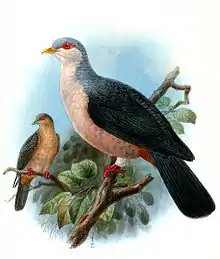
The Buru mountain pigeon (Gymnophaps mada) is a species of bird in the pigeon family Columbidae. It is endemic to Indonesia and inhabits montane forest and disturbed lowland forest on Buru. It was formerly considered to be conspecific with the Seram mountain pigeon. It is a medium-sized pigeon 33–38.5 cm (13.0–15.2 in) long, and has a blue-grey crown and neck, darker slate-grey upperparts, and a white to pale buff-pink throat and breast that becomes buff-pink towards the belly. The species is slightly sexually dimorphic, with females being smaller and having more dark red on the breast.
| Buru mountain pigeon | |
|---|---|
 | |
Scientific classification  | |
| Kingdom: | Animalia |
| Phylum: | Chordata |
| Class: | Aves |
| Order: | Columbiformes |
| Family: | Columbidae |
| Genus: | Gymnophaps |
| Species: | G. mada |
| Binomial name | |
| Gymnophaps mada (Hartert, 1899) | |
| Synonyms[2] | |
| |

The Buru mountain pigeon feeds on fruit. Its breeding season is thought to be from October to December. It is listed as being of least concern by the International Union for Conservation of Nature (IUCN) on the IUCN Red List due to a sufficiently large range and a stable population. The population is estimated to be 20,000–49,999.
Taxonomy and systematics
The Buru mountain pigeon was described as Columba mada by the German ornithologist Ernst Hartert in 1899 on the basis of specimens from Mount Mada on Buru, Indonesia.[3] The generic name Gymnophaps is derived from the Ancient Greek words γυμνος (gumnos), meaning bare, and φαψ (phaps), meaning pigeon. The specific name mada is from Mount Mada, the species' type locality.[4] Buru mountain pigeon is the official common name designated by the International Ornithologists' Union.[5] Other common names for the species include Buru mountain-pigeon and long-tailed mountain-pigeon.[6][7]
The Buru mountain pigeon is one of four species in the genus Gymnophaps, forming a superspecies with the other species in its genus.[8] Within its family, the genus Gymnophaps is sister to Lopholaimus, and these two together form a clade sister to Hemiphaga.[9] The Seram mountain pigeon was previously considered to be a subspecies of the Buru mountain pigeon, but was split on the basis of differences in appearance.[10] The Buru mountain pigeon is now treated as having no subspecies.[5]
Description
The Buru mountain pigeon is a medium-sized pigeon with a slender build, and long wings and tail, measuring 33–38.5 cm (13.0–15.2 in) long. Adult males have blue-grey crowns, napes, and hindnecks, with darker mantles. The rest of the upperparts are slightly glossy dark slate-grey. The flight feathers on the wings and tail are greenish-black, while the primaries and the ends of the flight feathers on the tail have narrow pale fringes. The face, throat, and upper breast are white to pale buff-pink, while the belly is buff-pink. The feathers on the upper leg are pale buff. The iris is grey, pale brown or yellow, with a red or orange outer ring. The beak is ashy-yellow with a red base, and the legs are purplish to brownish-red. The species shows slight sexual dimorphism, with females being smaller on average and having more wine on the breast, along with dark blackish-red bills and ceres. Juveniles have browner upperparts, dusky mottling on the throat and breast, and more ochre on the belly. They also have a white-tipped grey bill, a dull red cere, and dull red legs.[7][10]
Vocalisations
The Buru mountain pigeon's vocalisation's are unknown, but it is likely silent most of the time like other Gymnophaps pigeons.[7]
Distribution and habitat
The Buru mountain pigeon is endemic to Buru in the Maluku Islands. It mainly inhabits hill and montane forests, and occasionally visits lowland disturbed forests to feed. It has been recorded at elevations of 0–2,060 m (0–6,759 ft), but mainly occurs at 650–1,760 m (2,130–5,770 ft).[10][11]
Behaviour and ecology
Buru mountain pigeon usually occurs alone or in pairs, and in small flocks with up to 11 birds from October to December. During other parts of the year, it may also form larger groups.[10] It roosts high in the mountains, and flies to the lowlands in the morning to feed, returning to the roosts in the evening.[7]
Diet
The Buru mountain pigeon is frugivorous and most likely feeds on fruit in the canopy. It has been observed visiting coastal fruiting trees.[10]
Breeding
The Buru mountain pigeon's breeding season may be from October to December.[10]
Status
The Buru mountain pigeon is listed as being of least concern by the International Union for Conservation of Nature (IUCN) on the IUCN Red List due to a sufficiently large range and a stable population. A 1989 estimate placed its population at 43,000 individuals, and the population is currently estimated to number 20,000–49,999 birds. Montane forests throughout its range are relatively undisturbed, and the species does not seem to face any significant threats.[12]
References
- BirdLife International (2016). "Gymnophaps mada". IUCN Red List of Threatened Species. 2016: e.T45448755A95156047. doi:10.2305/IUCN.UK.2016-3.RLTS.T45448755A95156047.en. Retrieved 11 November 2021.
- "Gymnophaps mada (Buru Mountain-Pigeon)". Avibase. Retrieved 2021-11-17.
- British Ornithologists' Club; Club, British Ornithologists' (1899). Bulletin of the British Ornithologists' Club. 8. London: British Ornithologists' Club. p. 33.
- Jobling, James A. (2010). Helm Dictionary of Scientific Bird Names. London: Christopher Helm. pp. 182, 237. ISBN 978-1-4081-2501-4.
- "Pigeons – IOC World Bird List". Retrieved 2021-11-13.
- "Gymnophaps mada (Buru Mountain-Pigeon) - Avibase". avibase.bsc-eoc.org. Retrieved 2021-11-13.
- Gibbs, David; Barnes, Eustace; Cox, John (2001). Pigeons and Doves: A Guide to the Pigeons and Doves of the World. Pica Press. pp. 578–579. ISBN 978-1-8734-0360-0. OCLC 701718514.
- Gibbs, David; Barnes, Eustace; Cox, John (2001). Pigeons and Doves: A Guide to the Pigeons and Doves of the World. Pica Press. p. 577. ISBN 978-1-8734-0360-0. OCLC 701718514.
- Nowak, Jennifer; Sweet, Andrew; Weckstein, Jason; Johnson, Kevin (2019-08-15). "A molecular phylogenetic analysis of the genera of fruit doves and allies using dense taxonomic sampling". Illinois Natural History Survey Bulletin. 42: 2019001. doi:10.21900/j.inhs.v42.93. ISSN 2644-0687.
- Baptista, Luis F.; Trail, Pepper W.; Horblit, H.M.; Kirwan, Guy M.; Garcia, Ernest (2020-03-04), Billerman, Shawn M.; Keeney, Brooke K.; Rodewald, Paul G.; Schulenberg, Thomas S. (eds.), "Buru Mountain-Pigeon (Gymnophaps mada)", Birds of the World, Cornell Lab of Ornithology, doi:10.2173/bow.lotmop1.01, retrieved 2021-11-13
- Reeve, Andrew H.; Haryoko, Tri; Poulsen, Michael; Fabre, Pierre-Henri; Jønssen, Knud A. (2014). "New ornithological records from Buru and Seram, south Maluku, Indonesia, 1995–2012" (PDF). Forktail. 30: 10–22.
- IUCN (2016-10-01). "Gymnophaps mada: BirdLife International: The IUCN Red List of Threatened Species 2016: e.T45448755A95156047". doi:10.2305/iucn.uk.2016-3.rlts.t45448755a95156047.en. Cite journal requires
|journal=(help)