But I'm a Cheerleader
But I'm a Cheerleader is a 1999 American satirical romantic teen comedy film directed by Jamie Babbit and written by Brian Wayne Peterson. Natasha Lyonne stars as Megan Bloomfield, a high school cheerleader whose parents send her to a residential in-patient conversion therapy camp to cure her lesbianism. The film has garnered a cult following.
| But I'm a Cheerleader | |
|---|---|
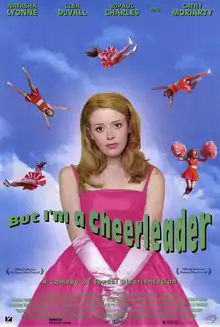 Theatrical release poster | |
| Directed by | Jamie Babbit |
| Screenplay by | Brian Wayne Peterson |
| Story by | Jamie Babbit |
| Produced by | |
| Starring | |
| Cinematography | Jules Labarthe |
| Edited by | Cecily Rhett |
| Music by | Pat Irwin |
Production companies | |
| Distributed by | Lions Gate Films |
Release date |
|
Running time |
|
| Country | United States |
| Language | English |
| Budget | $1 million |
| Box office | $2.6 million[1] |
Plot
Seventeen-year-old Megan Bloomfield is a happy high school senior who loves cheerleading and is dating a football player Jared. She does not enjoy kissing Jared and prefers looking at her fellow cheerleaders. This combined with Megan's interest in vegetarianism and Melissa Etheridge lead her family and friends to suspect that she is in fact a lesbian. With the help of ex-gay Mike, they surprise her with an intervention. Following this confrontation, Megan is sent to True Directions, a reparative therapy camp which uses a five-step program to convert its campers to heterosexuality. Over the course of the program, Megan becomes friends with another girl at the camp, Graham, who though more comfortable being gay than Megan was forced to attend the camp at the risk of otherwise being disowned by her family.
The program involves the campers admitting their homosexuality (step 1), rediscovering their gender identity by performing stereotypical gender-roles (step 2), finding the root of their homosexuality through family therapy (step 3), demystifying the other sex (step 4), and simulating heterosexual intercourse (step 5).
At True Directions, Megan meets the founder, a strict disciplinarian, Mary Brown, Mary's "heterosexual" son Rock,[nb 1] and a group of young people trying to "cure" themselves of their homosexuality. With the prompting of Mary and the others, Megan agrees that she is a lesbian. This fact is at odds with her traditional religious upbringing and distresses her, so she puts every effort into becoming heterosexual. Early on in her stay, Megan discovers two boys, Dolph and Clayton, making out. She panics and screams. On their discovery by Mike, Dolph is made to leave and Clayton is punished with isolation, literally being sent to the dog house.
The camp's kids are encouraged to rebel against Mary by two of her former students, ex-ex-gays Larry and Lloyd, who take the campers to a local gay bar where Graham and Megan's relationship develops into a romance. When Mary discovers the trip, she makes them all picket Larry and Lloyd's house. Megan and Graham sneak away one night and begin to fall in love. When Mary finds out, Megan, now at ease with her sexuality, is unrepentant and made to leave. Disowned by her family and homeless she goes to stay with Larry and Lloyd. Graham, afraid to defy her father, remains at the camp. Megan and Dolph, who is now also living with Larry and Lloyd, plan to win back Graham and Clayton.
Megan and Dolph infiltrate the graduation ceremony where Dolph coaxes Clayton away. Megan entreats Graham to join them as well, but Graham declines. Megan then performs a cheer for Graham, declaring her love and winning her over. They drive off with Dolph and Clayton. The final scene shows Megan's parents attending a PFLAG meeting to come to terms with their daughter's homosexuality.
Cast
- Natasha Lyonne as Megan Bloomfield
- Clea DuVall as Graham Eaton
- Cathy Moriarty as Mary Brown
- RuPaul Charles as Mike
- Mink Stole as Nancy Bloomfield
- Bud Cort as Peter Bloomfield
- Eddie Cibrian as Rock Brown
- Melanie Lynskey as Hilary Vandermueller
- Wesley Mann as Lloyd Morgan-Gordon
- Joel Michaely as Joel Goldberg
- Richard Moll as Larry Morgan-Gordon
- Kip Pardue as Clayton Dunn
- Dante Basco as Dolph
- Douglas Spain as Andre
- Katrina Phillips as Jan
- Katharine Towne as Sinead Lauren
- Brandt Wille as Jared
- Michelle Williams as Kimberly
- Julie Delpy as Lipstick Lesbian
Production
Background
But I'm a Cheerleader was Babbit's first feature film.[3] She had previously directed two short films, Frog Crossing (1996) and Sleeping Beauties (1999), Babbit and producer Andrea Sperling secured financing from Michael Burns, vice president of Prudential Insurance, after showing him the script at Sundance festival.[3][4] Their one-sentence pitch was "Two high-school girls fall in love at a reparative therapy camp."[5] Burns gave an initial budget of US$500,000 which was increased to US$1 million when the film went into production.[4]
Conception
Babbit, whose mother runs a halfway house called New Directions for young people with drug and alcohol problems, had wanted to make a comedy about rehabilitation and the 12-step program.[5] After reading an article about a man who had returned from a reparative therapy camp hating himself, she decided to combine the two ideas.[4][6] With girlfriend Sperling, she came up with the idea for a feature film about a cheerleader who attends reparative therapy.[7] They wanted the main character to be a cheerleader because it is ... "the pinnacle of the American dream, and the American dream of femininity."[8] She wanted the film to represent the lesbian experience from the femme perspective contrasting with several films of the time that represented the butch perspective (Go Fish and The Watermelon Woman).[4] She also wanted to satirize both the religious right and the gay community.[7] Not feeling qualified to write the script herself, Babbit brought in screenwriter and recent graduate of USC School of Cinematic Arts Brian Wayne Peterson.[7][8] Peterson had experience with reparative therapy while working at a prison clinic for sex offenders.[5] He has said that he wanted to make a film that would not only entertain people, but also make people get angry and talk about the issues it raised.[5]
Casting
Babbit recruited Clea DuVall who had starred in her short film Sleeping Beauties, to play the role of Graham Eaton. She was able to meet a lot of the cast through DuVall, including Natasha Lyonne and Melanie Lynskey.[3] Lyonne first saw the script in the back of DuVall's car and contacted her agent about it.[5] She had seen and enjoyed Babbit's short Sleeping Beauties and was eager to work with her.[9] She was not the first choice for the role of Megan. Another actress had wanted to play the part but eventually turned it down due to her religious belief and not wanting her family to see her on the poster.[3] Rosario Dawson was also considered for Megan but her executive producer persuaded her that Dawson, who is Hispanic, would not be right for the All-American character.[7]
A conscious effort was made to cast people of color in supporting roles to combat what she described as "racism at every level of making movies."[7] From the beginning she intended the characters of Mike (played by RuPaul), Dolph (Dante Basco) and Andre (Douglas Spain) to be African American, Asian and Hispanic. She initially considered Arsenio Hall for the character of Mike but Hall was uncomfortable playing a gay role.[8] As Mike, RuPaul made a rare appearance out of drag.[10]
Set and costume design
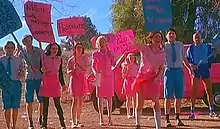
Babbit says that her influences for the look and feel of the film included John Waters, David LaChapelle, Edward Scissorhands and Barbie.[7] She wanted the production and costume design to reflect the themes of the story.
The progression from the ordinary world of Megan's home life where the dominant colors are muted oranges and browns, to the contrived world of True Directions with intense blues and pinks, is intended to represent the artificiality of heteronormativity.[7]
The germaphobic character of Mary Brown represents AIDS paranoia and her clean, ordered world is filled with plastic flowers, fake sky and PVC outfits.[7] The external shots of the colorful house complete with bright pink agricultural fencing were filmed in Palmdale, California.[5]
Themes
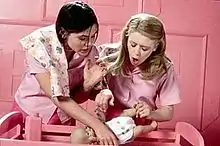
But I'm a Cheerleader is not only about sexuality, but also gender roles and social conformity. Chris Holmlund in Contemporary American Independent Film notes this feature of the film and calls the costumes "gender-tuned."[11] Ted Gideonse in Out magazine wrote "the costumes and colors of the film show how false the goals of True Directions are".[5]
Gender roles are further reinforced by the tasks the campers have to perform in "Step 2: Rediscovering Your Gender Identity." Nikki Sullivan in A Critical Introduction to Queer Theory "this is shown to be difficult and unsuccessful rather than a natural discovery of their latent heterosexuality".[12] The norms and truths of heterosexual society are rendered strange or "queer",[12] the straight characters less normal and likable than the gay ones.[11] This challenge of heteronormativity leaves But I'm a Cheerleader as an archetype to queer theory.[12]
Rating and distribution
When originally submitted to the Motion Picture Association of America rating board, But I'm a Cheerleader received an NC-17 rating.
In order to get a commercially viable R rating, Babbit removed a two-second shot of Graham's hand sweeping Megan's clothed body, a camera pan of Megan's body when she is masturbating, and a comment that Megan "ate Graham out".[13]
Babbit was interviewed by Kirby Dick for his 2006 documentary film This Film Is Not Yet Rated.,[14] it suggests that films with homosexual content are treated more stringently than those with only heterosexual content, and that scenes of female sexuality draw harsher criticism from the board than those of male sexuality.[15] It compares this film to American Pie (also released in 1999), which features a teenage boy masturbating and was given an R rating (though American Pie also originally rated as NC-17 and required cuts of this scene to receive an R rating).
Babbit says that she felt discriminated against for making a gay film.[16] The film was rated as M (for mature audiences 15 and older) in Australia and in New Zealand, 14A in Canada, 12 in Germany and 15 in the United Kingdom.
The film premiered on September 12, 1999, at the Toronto International Film Festival and was screened in January 2000 at the Sundance Film Festival. It was shown at other international film festivals including the Sydney Gay and Lesbian Mardi Gras festival and the London Lesbian and Gay Film Festival.0
It first appeared in US theaters on July 7, 2000, distributed by Lions Gate Entertainment.[17] Fine Line Features intended to distribute the film but dropped it two months before it was due to open following a dispute with the film's production company, Ignite Entertainment.[7][18] It closed after eight weeks, its widest release having been 115 theaters.[17]
The film was released on Region 1 DVD by Lions Gate on July 22, 2002 and by Universal Studios on October 3, 2002.[19] Other than the theatrical trailer, it contained no extras.[20] It was released on Region 2 DVD on June 2, 2003, by Prism Leisure. In addition to the trailer, it features an interview with Jamie Babbit and behind the scenes footage.[21]
In honor of the film's 20th anniversary, the director's cut of But I'm a Cheerleader was released on December 8, 2020, via video on demand[22] and on Blu-Ray on June 1, 2021.
Reception
Box office and audience reaction
But I'm a Cheerleader grossed $2,205,627 in the United States and $389,589 elsewhere, giving a total of $2,595,216 worldwide. In its opening weekend, showing at four theaters, it earned $60,410 which was 2.7% of its total gross.[17]
According to Box Office Mojo, it ranked at 174 for all films released in the US in 2000 and 74 for R-rated films released that year.[17] As of December 2011, its all time box-office ranking for LGBT-related films is 73.[23]
The film was a hit with festival audiences and received standing ovations at the San Francisco International Lesbian and Gay Film Festival.[8][24] It has been described as a favorite with gay audiences and on the art house circuit.[25][26]
Critical response
Initial mainstream critical response to But I'm a Cheerleader was mostly negative.
On Rotten Tomatoes it has an approval rating of 41% based on 87 reviews, with an average rating of 5.2/10. The site reads: "Too broad to make any real statements, But I'm a Cheerleader isn't as sharp as it should be, but a charming cast and surprisingly emotional center may bring enough pep for viewers looking for a light social satire."[27]
On Metacritic it has a weighted average score of 39 out of 100 based on 30 critics, indicating "Generally unfavorable reviews."[28]
Roger Ebert rated it three stars (out of four) and wrote, it "is not a great, breakout comedy, but more the kind of movie that might eventually become a regular on the midnight cult circuit."[29]
Writing for The New York Times, Elvis Mitchell described the character of Megan as a sweet heroine and Lyonne and DuVall were praised for their performances.[30][31]
Several reviewers compared the film to those of director John Waters but felt it fell short of the mark.[31] Stephanie Zacharek called it a "Waters knockoff"[32] while Ebert said that Waters might have been ruder and more polished.[29] Babbit says that although Waters is one of her influences, she did not want her film to have the "bite" of his.[7] Whereas John Waters does not like romantic comedies, she wanted to tell a conventionally romantic story.[7]
On production design, Mick LaSalle described it as clever and eyecatching and James Berardinelli called it a standout feature.[33][34]
Cynthia Fuchs, for NitrateOnline.com, said "no one who is phobic might recognize himself in the film" and that "the audience who might benefit most from watching it either won't see the film or won't see the point."[35] David Edelstein said that the one sidedness of the film creates a lack of dramatic tension and calls it lazy counterpropaganda.[36]
In contrast, LaSalle said that "the picture manages to make a heartfelt statement about the difficulties of growing up gay" and Timothy Shary said that the film openly challenges homophobia and offers support to teenaged gay viewers.[34][37] Chris Holmlund said that the film shows that queer identity is multi-faceted, using as an example the scene where the ex-ex-gays tell Megan that there is no one way to be a lesbian.[11]
Reviews from the gay media were positive, the film has undergone a critical reassessment over time and is understood to have been deliberately satirical and campy. Feminist website Autostraddle declared the film to be number one of 100 best lesbian movies of all time in 2015.[38] AfterEllen.com called it "one of the five best lesbian movies ever made."[39] The site had called the movie's story predictable and characters stereotypical in its initial 2007 review.[40] Curve called the film an "incredible comedy" that had "redefined lesbian film."[41] Jan Stuart, writing for The Advocate, said the film fails to subvert gay stereotypes, calling it "numbingly crude" and that the kitsch portrait of Middle America is out of touch with modern gay teenagers.[42]
The music video for the 2021 song "Silk Chiffon" by musical group Muna with Phoebe Bridgers pays homage to But I'm a Cheerleader and features much of the film's iconography, Guitarist Naomi McPherson said she wanted "a song for kids to have their first gay kiss to."[43]
Awards
The film won the Audience Award and the Graine de Cinéphage Award at the 2000 Créteil International Women's Film Festival.[44]
It was nominated by the Political Film Society of America for the PFS Award in the categories of Human Rights and Exposé the same year.[45]
Music
Pat Irwin composed the score for But I'm a Cheerleader. The soundtrack has never been released on CD.
Artists featured include Saint Etienne, Dressy Bessy and April March.[46] RuPaul contributed one track, "Party Train",
Track listing
- "Chick Habit (Laisse tomber les filles)" (Elinor Blake, Serge Gainsbourg) performed by April March
- "Just Like Henry" (Tammy Ealom, John Hill, Rob Greene, Darren Albert) performed by Dressy Bessy
- "If You Should Try and Kiss Her" (Ealom, Hill, Greene, Albert) performed by Dressy Bessy
- "Trailer Song" (Courtney Holt, Joy Ray) performed by Sissy Bar
- "All or Nothing" (Cris Owen, Miisa) performed by Miisa
- "We're in the City" (Sarah Cracknell, Bob Stanley, Pete Wiggs) performed by Saint Etienne
- "The Swisher" (Dave Moss, Ian Rich) performed by Summer's Eve
- "Funnel of Love" (Kent Westbury, Charlie McCoy) performed by Wanda Jackson
- "Ray of Sunshine" (Go Sailor) performed by Go Sailor
- "Glass Vase Cello Case" (Madigan Shive, Jen Wood) performed by Tattle Tale
- "Party Train" (RuPaul) performed by RuPaul
- "Evening in Paris" (Lois Maffeo) performed by Lois Maffeo
- "Together Forever in Love" (Go Sailor) performed by Go Sailor
Musical
In 2005 the New York Musical Theatre Festival featured a musical stage adaptation of But I'm a Cheerleader written by lyricist Bill Augustin and composer Andrew Abrams. With 18 original songs, it was directed by Daniel Goldstein and starred Chandra Lee Schwartz as Megan. It played during September 2005 at New York's Theatre at St. Clement's.[47] The musical was also performed as part of MT Fest UK from 18 to 20 February 2019 at The Other Palace, London with a cast featuring Bronté Barbé as Megan, Carrie Hope Fletcher as Graham, Jamie Muscato as Jared, Matt Henry as Mike, Ben Forster as Larry, Stephen Hogan as Lloyd and Luke Bayer as Clayton.
The musical will have its world premiere at the Turbine Theatre beginning previews 18 February with an opening night of 23 February running until 16 April 2022. It will be directed by Tania Azevedo, choreographed by Alexzandra Sarmiento with lighting by Martha Godfrey and produced by Paul Taylor-Mills and Bill Kenwright.[48]
TV series
In April 2018, Babbit announced on Twitter that a But I'm a Cheerleader television series was in development with Starz.[49]
See also
- List of LGBT films directed by women
- The Miseducation of Cameron Post
- Boy Erased
- "Cartman Sucks", South Park episode
References
Notes
- In A Critical Introduction to Queer Theory, Nikki Sullivan calls Rock "overtly homosexual" and says that Mary's desire to cure her son of homosexuality is the inspiration for the True Directions program. (According to the film's backstory, she started True Directions after her husband left her for another man.)[2]
Footnotes
- But I'm a Cheerleader at Box Office Mojo
- Sullivan, Nikki p. 55
- Warn, Sarah (June 2004). "Interview with Jamie Babbit". AfterEllen.com. Archived from the original on February 7, 2012. Retrieved April 22, 2007.
- Dixon, Wheeler Winston
- Gideonse, Ted (July 2000). "The New Girls Of Summer". Out. pp. 54–61.
- Stukin, Stacie (July 4, 2000). "But She's Serious". The Advocate.
- Fuchs, Cynthia (July 21, 2000). "So Many Battles to Fight — Interview with Jamie Babbit". Nitrate Online. Nitrate Productions. Retrieved March 25, 2011.
- Grady, Pam. "Rah Rah Rah: Director Jamie Babbit and Company Root for But I'm a Cheerleader". Reel.com. Archived from the original on March 6, 2005. Retrieved March 11, 2010.
- Judd, Daniel (October 4, 2000). "Interviews – Jamie Babbit". Rainbow Network. Archived from the original on September 27, 2007. Retrieved August 13, 2007.
- Fine, Marshall. "Ladies' Man: An Interview with Superdiva RuPaul". DrDrew.com. Archived from the original on October 17, 2007. Retrieved March 7, 2010.
- Holmlund, Chris, pp. 183–187
- Sullivan, Nikki, pp. 52–56
- Taubin, A. (August 3, 1999). "Erasure Police". The Village Voice. p. 57.
- Dick, Kirby (director) (2006). This Film Is Not Yet Rated (Motion picture (DVD)). New York: IFC Films.
- Carlson, Daniel (2006). "Muscles and Boobies and Wieners, Oh No". Pajiba. Retrieved June 2, 2007.
- "'This Film is Not Yet Rated' Explores Anti-Gay Bias of MPAA Ratings System". GayWired.com. September 1, 2006. Archived from the original on October 17, 2007. Retrieved March 7, 2010.
- "But I'm a Cheerleader". Box Office Mojo. Retrieved April 22, 2007.
- Churi, Maya; Hernandez, Eugene (June 3, 2000). "Lion's Gate acquires Jamie Babbit's "But I'm A Cheerleader"". IndieWire. Retrieved July 28, 2010.
- "But I'm a Cheerleader". MovieWeb.com. Archived from the original on September 25, 2012. Retrieved July 28, 2010.
- "DVD Review — Quick Peeks". DVD Review. Archived from the original on August 22, 2014. Retrieved May 13, 2007.
- "But I'm a Cheerleader". Retrieved April 22, 2007.
- Rubin, Rebecca (December 4, 2020). "'But I'm a Cheerleader' Director Jamie Babbit on the Queer Classic 20 Years Later: 'I Wanted to Make a Gay 'Clueless". Variety. Retrieved December 12, 2020.
- "Gay / Lesbian Movies". Box Office Mojo. Internet Movie Database. Retrieved December 11, 2011.
- Mandelberger, Sandy. "New York Lesbian And Gay Film Festival -- 1–11 June". FilmFestivals.com. Archived from the original on March 25, 2012. Retrieved October 13, 2007.
- Tropiano, Stephen. "But I'm a Cheerleader Review". PopMatters. Retrieved October 12, 2007.
- Benshoff & Griffin, p. 333
- "But I'm a Cheerleader (2000)". Rotten Tomatoes. Retrieved June 21, 2021.
- "But I'm a Cheerleader Reviews". Metacritic. Retrieved July 17, 2019.
- Ebert, Roger (July 14, 2000). "But I'm a Cheerleader". Chicago Sun-Times. Retrieved May 3, 2021.
- Mitchell, Elvis (July 7, 2000). "Don't Worry. Pink Outfits Will Straighten Her Out". The New York Times. Retrieved April 29, 2007.
- Noh, David. "But I'm a Cheerleader". Film Journal International. Archived from the original on September 26, 2007. Retrieved April 29, 2007.
- Zacharek, Stephanie (July 7, 2000). "But I'm a Cheerleader". Salon. Retrieved April 29, 2007.
- Berardinelli, James (2000). "But I'm a Cheerleader". ReelViews. Retrieved April 29, 2007.
- LaSalle, Mick; Guthmann, Edward (July 7, 2000). "But I'm a Cheerleader". San Francisco Chronicle. Retrieved April 29, 2007.
- Fuchs, Cynthia (July 28, 2000). "But I'm a Cheerleader". Nitrate Online. Nitrate Productions. Retrieved April 29, 2007.
- Edelstein, David (July 7, 2000). "Overwrought Caricatures Backfire in But I'm a Cheerleader". Slate. The Slate Group. Retrieved November 4, 2007.
- Shary, Timothy, p. 99
- "The 100 Best Lesbian Movies Of All Time". Autostraddle. August 11, 2015. Retrieved June 2, 2017.
- "Sapphic Cinema: "But I'm a Cheerleader" – AfterEllen". AfterEllen. September 25, 2015. Archived from the original on January 11, 2018. Retrieved June 3, 2017.
- Mendenhall, Alexandra (September 1, 2006). "Review of "But I'm a Cheerleader"". AfterEllen.com. Archived from the original on January 18, 2012. Retrieved May 29, 2007.
- "Women to Watch in Film". Curve. November 2003. p. 22.
- Stuart, Jan (July 18, 2000). "But I'm a Cheerleader. - Review". The Advocate.
- "Let's Go, Lesbians! The Muna and Phoebe Bridgers Collab Is Here". Vulture. September 7, 2021. Retrieved October 9, 2021.
- Sullivan, Monica (2007). "But I'm a Cheerleader-- Jamie Babbit Wins Créteil Films de Femmes 'Prix du Public'". Movie Magazine International. Retrieved May 26, 2007.
- "Political Film Society — Previous Award Winners". Political Film Society. Archived from the original on December 10, 2007. Retrieved May 13, 2007.
- "Soundtrack Details: But I'm a Cheerleader". SoundtrackCollector. Retrieved May 28, 2007.
- "But I'm a Cheerleader to Debut at NYMF With Chandra Lee Schwartz, Kelly Karbacz, Natalie Joy Johnson, John Hill and More". BroadwayWorld.com. August 25, 2005. Retrieved October 14, 2007.
- Meyer, Dan (November 30, 2021). "But I'm A Cheerleader: The Musical Will Get London Premiere in 2022". Playbill. Retrieved December 13, 2021.
- Babbit, Jamie [@BabbitJamie] (April 18, 2018). "I'm developing BUT IM A CHEERLEADER the tv series with Starz now so fingers crossed. #askherfilm" (Tweet). Retrieved October 21, 2019 – via Twitter.
Bibliography
- Benshoff, Harry M.; Griffin, Sean (2004). America on Film: Representing Race, Class, Gender, and Sexuality at the Movies. Blackwell Publishing. ISBN 0-631-22583-8.
- Dixon, Wheeler Winston (2004). "Jamie Babbit". In Duchovnay, Gerald (ed.). Film Voices: Interviews from Post Script. SUNY Press. pp. 153–165. ISBN 0-7914-6156-4.
- Holmlund, Chris (2004). "Generation Q's ABCs: Queer Kids and 1990s' Independent Films". In Holmlund, Chris; Wyatt, Justin (eds.). Contemporary American Independent Film: From The Margins To The Mainstream. Routledge. ISBN 0-415-25486-8.
- Shary, Timothy (2005). Teen Movies: American Youth on Screen. Wallflower Press. ISBN 1-904764-49-5.
- Sullivan, Nikki (2003). A Critical Introduction to Queer Theory. Edinburgh University Press. ISBN 0-7486-1597-0.
External links
 |
Wikiquote has quotations related to: But I'm a Cheerleader |