C1D
Nuclear nucleic acid-binding protein C1D is a protein that in humans is encoded by the C1D gene.[5][6][7][8][9][10]
| C1D | |||||||||||||||||||||||||
|---|---|---|---|---|---|---|---|---|---|---|---|---|---|---|---|---|---|---|---|---|---|---|---|---|---|
| Identifiers | |||||||||||||||||||||||||
| Aliases | C1D, LRP1, SUN-CoR, SUNCOR, hRrp47, C1D nuclear receptor corepressor | ||||||||||||||||||||||||
| External IDs | OMIM: 606997 MGI: 1927354 HomoloGene: 4619 GeneCards: C1D | ||||||||||||||||||||||||
| |||||||||||||||||||||||||
| |||||||||||||||||||||||||
| |||||||||||||||||||||||||
| |||||||||||||||||||||||||
| Orthologs | |||||||||||||||||||||||||
| Species | Human | Mouse | |||||||||||||||||||||||
| Entrez | |||||||||||||||||||||||||
| Ensembl | |||||||||||||||||||||||||
| UniProt | |||||||||||||||||||||||||
| RefSeq (mRNA) | |||||||||||||||||||||||||
| RefSeq (protein) | |||||||||||||||||||||||||
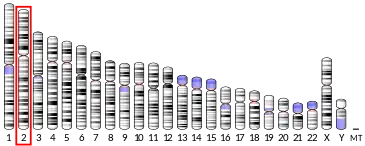
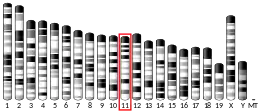
| Location (UCSC) | Chr 2: 68.04 – 68.11 Mb | Chr 11: 17.26 – 17.27 Mb | |||||||||||||||||||||||
| PubMed search | [3] | [4] | |||||||||||||||||||||||
| Wikidata | |||||||||||||||||||||||||
| |||||||||||||||||||||||||




Function
The protein encoded by this gene is a DNA binding and apoptosis-inducing protein and is localized in the nucleus. It is also a Rac3-interacting protein which acts as a corepressor for the thyroid hormone receptor. This protein is thought to regulate TRAX/Translin complex formation. Several alternatively spliced transcript variants of this gene have been described, but the full length nature of some of these variants has not been determined.[10]
References
- GRCh38: Ensembl release 89: ENSG00000197223 - Ensembl, May 2017
- GRCm38: Ensembl release 89: ENSMUSG00000000581 - Ensembl, May 2017
- "Human PubMed Reference:". National Center for Biotechnology Information, U.S. National Library of Medicine.
- "Mouse PubMed Reference:". National Center for Biotechnology Information, U.S. National Library of Medicine.
- Nehls P, Keck T, Greferath R, Spiess E, Glaser T, Rothbarth K, Stammer H, Werner D (Apr 1998). "cDNA cloning, recombinant expression and characterization of polypetides with exceptional DNA affinity". Nucleic Acids Res. 26 (5): 1160–6. doi:10.1093/nar/26.5.1160. PMC 147382. PMID 9469821.
- Schilders G, Egberts WV, Raijmakers R, Pruijn GJ (Jul 2007). "C1D is a major autoantibody target in patients with the polymyositis-scleroderma overlap syndrome". Arthritis Rheum. 56 (7): 2449–54. doi:10.1002/art.22710. PMID 17599775.
- Schilders G, van Dijk E, Pruijn GJ (May 2007). "C1D and hMtr4p associate with the human exosome subunit PM/Scl-100 and are involved in pre-rRNA processing". Nucleic Acids Res. 35 (8): 2564–72. doi:10.1093/nar/gkm082. PMC 1885644. PMID 17412707.
- Erdemir T, Bilican B, Oncel D, Goding CR, Yavuzer U (Jan 2002). "DNA damage-dependent interaction of the nuclear matrix protein C1D with Translin-associated factor X (TRAX)". J. Cell Sci. 115 (Pt 1): 207–16. doi:10.1242/jcs.115.1.207. hdl:11693/24740. PMID 11801738.
- Zamir I, Dawson J, Lavinsky RM, Glass CK, Rosenfeld MG, Lazar MA (December 1997). "Cloning and characterization of a corepressor and potential component of the nuclear hormone receptor repression complex". Proceedings of the National Academy of Sciences of the United States of America. 94 (26): 14400–5. doi:10.1073/pnas.94.26.14400. PMC 24996. PMID 9405624.
- "Entrez Gene: C1D nuclear DNA-binding protein".
- Yavuzer U, Smith GC, Bliss T, Werner D, Jackson SP (Jul 1998). "DNA end-independent activation of DNA-PK mediated via association with the DNA-binding protein C1D". Genes Dev. 12 (14): 2188–99. doi:10.1101/gad.12.14.2188. PMC 317006. PMID 9679063.
External links
- Human C1D genome location and C1D gene details page in the UCSC Genome Browser.
- Human LRP1 genome location and LRP1 gene details page in the UCSC Genome Browser.
Further reading
- Rual JF, Venkatesan K, Hao T, Hirozane-Kishikawa T, Dricot A, Li N, Berriz GF, Gibbons FD, Dreze M, Ayivi-Guedehoussou N, Klitgord N, Simon C, Boxem M, Milstein S, Rosenberg J, Goldberg DS, Zhang LV, Wong SL, Franklin G, Li S, Albala JS, Lim J, Fraughton C, Llamosas E, Cevik S, Bex C, Lamesch P, Sikorski RS, Vandenhaute J, Zoghbi HY, Smolyar A, Bosak S, Sequerra R, Doucette-Stamm L, Cusick ME, Hill DE, Roth FP, Vidal M (2005). "Towards a proteome-scale map of the human protein-protein interaction network". Nature. 437 (7062): 1173–8. doi:10.1038/nature04209. PMID 16189514. S2CID 4427026.
- Rothbarth K, Stammer H, Werner D (2002). "Proteasome-mediated degradation antagonizes critical levels of the apoptosis-inducing C1D protein". Cancer Cell Int. 2 (1): 12. doi:10.1186/1475-2867-2-12. PMC 140130. PMID 12379155.
- Rothbarth K, Hunziker A, Stammer H, Werner D (2001). "Promoter of the gene encoding the 16 kDa DNA-binding and apoptosis-inducing C1D protein". Biochim. Biophys. Acta. 1518 (3): 271–5. doi:10.1016/S0167-4781(01)00198-1. PMID 11311939.
- Rothbarth K, Spiess E, Juodka B, Yavuzer U, Nehls P, Stammer H, Werner D (1999). "Induction of apoptosis by overexpression of the DNA-binding and DNA-PK-activating protein C1D". J. Cell Sci. 112 (13): 2223–32. doi:10.1242/jcs.112.13.2223. hdl:11693/25220. PMID 10362552.
- Haataja L, Groffen J, Heisterkamp N (1998). "Identification of a novel Rac3-interacting protein C1D". Int. J. Mol. Med. 1 (4): 665–70. doi:10.3892/ijmm.1.4.665. PMID 9852280.
This article is issued from Wikipedia. The text is licensed under Creative Commons - Attribution - Sharealike. Additional terms may apply for the media files.