COASST
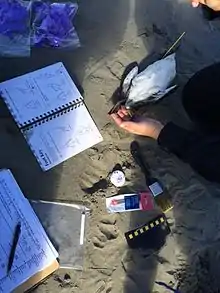
COASST (Coastal Observation and Seabird Survey Team) is a citizen science project of the University of Washington, Seattle, WA, USA, with a vision of monitoring marine ecosystem health with the support of citizens within coastal communities.[1] With the help of hundreds of volunteers from different locations spanning the entire U.S. west coast from Washington to California and into the northern state of Alaska, COASST assesses beach conditions and identifies and tracks any carcasses of dead seabirds found. Data on the carcass of a seabird contributes to creation of a baseline record for the death rates of various species of seabirds including which beaches birds are found at and in what density. Any irregularities can be identified and evaluated so the cause of any increased mortality can be identified. COASST believes citizen scientists partnered with trained scientists create an invaluable relationship that benefits our ability to track and understand marine ecosystems. COASST works closely with state, tribal and federal agencies, environmental organizations and community groups to help this vision of monitoring, and successfully establish marine conservation solutions.
History
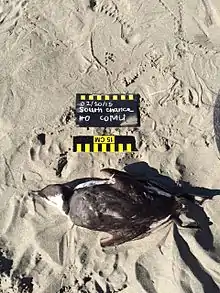
COASST was founded in 1998 by Julia Parrish with the goal expanding long-term data collection on seabirds, including baseline data for discovering patterns of seabird mortality, natural or human-induced, through the program. Due to the increasing human use of coastal waters, Parish envisioned a program that could provide data on both resident and migrant species of birds; mortality rates after oil spills; levels of chronic oiling, information regarding incidents of entanglement with fishing gear; and causes of death for seabird populations. Since a live bird monitoring program would be difficult, Parish opted to monitor carcasses from beached birds which could be tracked and identified by anyone.[1]
In July 1998, Parrish obtained a grant from the David and Lucile Packard Foundation to fund her vision of creating a seabird monitoring program that would generate baseline data to help assess patterns of seabird mortality due to natural and human-induced events. The first director of the program Todd Hass co-developed COASST with Parrish. Ten years later, COASST has expanded from monitoring five beaches along the outer coast of Washington state, to almost 300 beaches spread across northern California, Oregon, Washington, and Alaska. As of 2018, COASST has more than 1000 participants,[2] which makes COASST the largest beached bird monitoring network in the world today.
Project recognition
The observations of COASST volunteers on jellyfish have been published in both the scientific literature[3] and the popular press.[4] Stories about COASST observations have presented the stories of citizen scientists,[5] common murre die-offs,[6] Cassin's auklets,[7] and puffins[8] In 2013, the White House honored Parrish for her work in establishing and leading the COASST program.[9]
References
- "What's COASST?". COASST.
- Read "Learning Through Citizen Science: Enhancing Opportunities by Design" at NAP.edu. 2018. doi:10.17226/25183. ISBN 978-0-309-47916-5.
- Jones, T; Parrish, Jk; Burgess, Hk (2021-03-18). "Long-term patterns of mass stranding of the colonial cnidarian Velella velella: influence of environmental forcing". Marine Ecology Progress Series. 662: 69–83. doi:10.3354/meps13644. ISSN 0171-8630.
- Banse, Tom (2021-03-24). "'Blue tides' of sailor jellies on Northwest coast correlate with warmer seas in winter". www.kuow.org. Retrieved 2021-10-06.
- May 10, Larry Pynn/Hakai Magazine Image credit: Shanna Baker; 2017 (2017-05-10). "What citizen science can say about seabird deaths". www.hcn.org. Retrieved 2021-10-06.CS1 maint: numeric names: authors list (link)
- Correspondent, Michelle Blackwell | (2019-05-24). "Major die-off of Common Murres under way along the Mendocino Coast". Fort Bragg Advocate-News. Retrieved 2021-10-06.
- Mapes, Lynda (2018-06-02). "'The Blob,' a marine heat wave, caused massive die-off of West Coast birds". The Seattle Times. Retrieved 2021-10-06.
- McRae, Mike (May 30, 2019). "Thousands of Puffins Perished in Alaska in a Massive Mortality Event". ScienceAlert. Retrieved 2021-10-06.
- "White House Honors Four Leaders of NSF-Funded Citizen Science Groups Studying Ecology". www.nsf.gov. June 25, 2013. Retrieved 2021-10-06.