Battle of Cable Street
The Battle of Cable Street was a series of clashes that took place at several locations In the inner East End, notably Cable Street on Sunday 4 October 1936. It was a clash between the Metropolitan Police, sent to protect a march by members of the British Union of Fascists[1] led by Oswald Mosley, and various anti-fascist demonstrators, including local trade unionists, communists, anarchists, British Jews, gangsters led by Jack "Spot" Comer and socialist groups.[2][3][4] The majority of both marchers and counter-protesters travelled into the area for this purpose.
| Battle of Cable Street | ||||
|---|---|---|---|---|
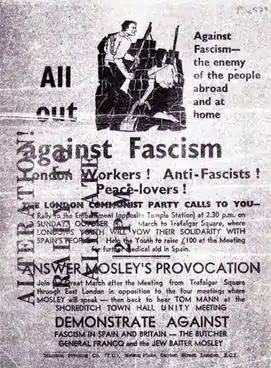 Flyer distributed by the London Communist Party | ||||
| Date | 4 October 1936 | |||
| Location | 51.5109°N 0.0521°W | |||
| Caused by | Opposition to a fascist march through East London | |||
| Methods | Protest | |||
| Resulted in | Fascist march called off | |||
| Parties to the civil conflict | ||||
| Lead figures | ||||
| ||||
| Number | ||||
| ||||
| Casualties | ||||
| Injuries | ~175 | |||
| Arrested | ~150 | |||


Background
It had become known that the British Union of Fascists (BUF) were organising a march to take place on Sunday 4 October 1936, sending thousands of marchers dressed in their Blackshirt uniform through the heart of the East End (an area which then had a large Jewish population).[5] The route would take the Blackshirts from Tower Hill through Limehouse, Bow, Mile End, Bethnal Green and Shoreditch, with open air meetings of local BUF supporters along the way.[6]
Events
The fascists began to gather at Tower Hill from around 2pm, and there were a number of clashes around Tower Hill, Minories, Mansell Street and the vicinity.[7]
Estimates of the number of anti-fascist demonstrators vary greatly, but a figure of 100,000 is often used.[8][9] They were met by 6,000–7,000 policemen (including mounted police), who attempted to clear the road to permit the march of 2,000–3,000 fascists to proceed.[10] The anti-fascist groups built roadblocks in an attempt to prevent the march from taking place. The barricades were constructed near the junction with Christian Street in Stepney, towards the west end of this long street. The main confrontation took place around Gardiner's department store in Whitechapel. Police attempted to clear a route, but the demonstrators fought back with sticks, rocks, chair legs and other improvised weapons. Rubbish, rotten vegetables and the contents of chamber pots were thrown at the police by women in houses along the street. The BUF marchers were dispersed towards Hyde Park instead while the anti-fascists fought with police. About 150 demonstrators were arrested, although some escaped with the help of other demonstrators. Around 175 people were injured including police, women and children.[11] In the end, Mosley ordered the Blackshirts to retreat. Police escorted them back to central London.[3]
Aftermath
Following the battle, the Public Order Act 1936 outlawed the wearing of political uniforms and forced organisers of large meetings and demonstrations to obtain police permission. Many of the arrested demonstrators reported harsh treatment at the hands of the police.[12] The event is frequently cited by modern Antifa movements as "...the moment at which British fascism was decisively defeated"[13][3] although the BUF actually experienced an increase in membership after the event.[14]
Many leading British communists were present at the Battle of Cable Street. Some examples include, Bill Alexander the commander of the International Brigade's British Battalion, Charlie Hutchison one of the liberators of Belsen concentration camp and the only black British volunteer to join the International Brigades, and pioneering journalist and war correspondent Alan Winnington, were all present and partially credit the battle for shaping their political beliefs. Communist activist Gladys Keable the future children's editor of the Morning Star, and her husband and fellow communist Bill Keable who would become the Morning Star's director, were both present at the Battle of Cable Street.[15] The Morning Star described the Jewish Communist activist Max Levitas as the "last survivor of the Battle of Cable Street".[16]
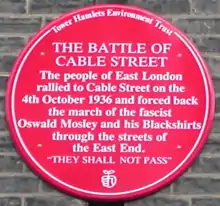
Between 1979 and 1983, a large mural depicting the battle was painted on the side of Stepney Town Hall. It stands in Cable Street, about 150 yards (140 m) west of Shadwell overground station. A red plaque in Dock Street commemorates the incident.[17]
Numerous events were planned in East London for the battle's 75th anniversary in October 2011, including music[18] and a march,[19] and the mural was once again restored. In 2016, to mark the battle's 80th anniversary, a march took place from Altab Ali Park to Cable Street.[20] The march was attended by some of those who were originally involved.[21]
In popular culture
- The Arnold Wesker play Chicken Soup with Barley depicts an East End Jewish family on the day of the Battle of Cable Street.[22]
- British folk punk band The Men They Couldn't Hang relate the battle in their 1986 song "Ghosts of Cable Street".[23]
- The 2010 BBC revival of the Upstairs Downstairs series devotes an episode to the Battle of Cable Street.[24]
- The incident is depicted in the 2012 novel Winter of the World by Welsh-born author Ken Follett.[25]
- The song "Cable Street" by English folk trio The Young'uns tells the story of the confrontation from the perspective of a young anti-fascist fighter.[26]
- The book 'Night Watch' by Terry Pratchett features a Battle of Cable Street.[27]
See also
- Battle of George Square – a riot in Glasgow in 1919 in which William Gallacher (a colleague of Phil Piratin) was involved
- Battle of Stockton – an earlier incident between BUF members and anti-fascists in Stockton-on-Tees on 10 September 1933
- Battle of South Street – an incident between BUF members and anti-fascists in Worthing on 9 October 1934
- Battle of De Winton Field – a clash between BUF members and anti-fascists in the Rhondda on 11 June 1936
- Battle of Holbeck Moor – a clash between BUF members and anti-fascists in Leeds on 27 September 1936
- Battle of Stepney – a gunfight that took place in 1911, a few streets away
- Christie Pits riot – a similar incident that took place in Toronto on 16 August 1933
- 6 February 1934 crisis – a similar event that took place in Paris
- Battle of Praça da Sé – a similar event that took place in São Paulo in 1934
References
- "Cable Street: 'Solidarity stopped Mosley's fascists'". BBC News. Retrieved 13 October 2015.
- Barling, Kurt (4 October 2011). "Why remember Battle of Cable Street?". Retrieved 16 May 2018 – via www.bbc.co.uk.
- Philpot, Robert. "The true history behind London's much-lauded anti-fascist Battle of Cable Street". www.timesofisrael.com. Retrieved 4 February 2021.
- "The Battle of Cable Street". www.bbc.co.uk. Retrieved 4 February 2021.
- hate, HOPE not. "The Battle of Cable Street". www.cablestreet.uk. Retrieved 16 May 2018.
- Content taken from Lewis, Jon E. (2008). London, The Autobiography. Constable. p. 401. ISBN 978-1845298753., it comes from the East London Advertiser primary source, and also the books editorial commentary
- East London Advertiser – reproduced in Lewis, Jon E. (2008). London, The Autobiography. Constable. ISBN 978-1845298753.
- Marr, Andrew (2009). The Making of Modern Britain. Macmillan. pp. 317–318. ISBN 978-0230709423.
- Lewis, Jon E. (2008). London, The Autobiography. Constable. p. 401. ISBN 978-1845298753.
- Jones, Nigel, Mosley, Haus, 2004, p. 114
- Brooke, Mike (30 December 2014). "Historian Bill Fishman, witness to 1936 Battle of Cable Street, dies at 93". News. London. Hackney Gazette. Archived from the original on 17 September 2016. Retrieved 28 April 2016.
- Kushner, Anthony and Valman, Nadia (2000) Remembering Cable Street: fascism and anti-fascism in British society. Vallentine Mitchell, p. 182. ISBN 0-85303-361-7
- Penny, Daniel (22 August 2017). "An Intimate History of Antifa". The New Yorker. Retrieved 26 August 2017.
- Webber, G.C. "Patterns of Membership and Support for the British Union of Fascists". Jstor. Sage Publications Inc. Retrieved 2 December 2021.
- Meddick, Simon; Payne, Simon; Katz, Phil (2020). Red Lives: Communists and the Struggle for Socialism. UK: Manifesto Press Cooperative Limited. p. 119. ISBN 978-1-907464-45-4.
- Davis, Mary (16 November 2018). "Remembering Max Levitas – Jewish Communist and last survivor of the Battle of Cable Street". The Morning Star. Retrieved 17 April 2021.
- "Battle of Cable Street - Dock Street". London Remembers. Retrieved 16 May 2018.
- Phil Katz. "Communist Party – Communist Party". Retrieved 13 October 2015.
- Cable Street 75. "Cable Street 75". Retrieved 13 October 2015.
- Brooke, Mike. "'They Shall Not Pass' message from the past for Battle of Cable Street 80th anniversary". East London Advertiser. Retrieved 3 April 2017.
- Rod McPhee (1 October 2016). "'We still haven't learned the lesson of the Battle of Cable Street 80 years on'". Daily Mirror. Retrieved 8 September 2017.
- "Chicken Soup with Barley, Royal Court, London". The Independent. 9 June 2011. Retrieved 5 May 2017.
- "Ghosts of Cable Street". Song Lyrics. Retrieved 23 May 2021.
- "Upstairs Downstairs – episode synopses". BBC. Retrieved 23 May 2021.
- Follett, Ken (2012). Winter of the World. Penguin Books. ISBN 9781509848522.
- You tube
- "Mark Reads 'Night Watch': Part 15". Mark Reads. Retrieved 23 May 2021.
External links
 |
Wikimedia Commons has media related to Battle of Cable Street. |
- The Battle of Cable Street 80th anniversary
- News footage from the day News reel from youtube.com
- Video for the Ghosts of Cable Street by 'They Men They Couldn't Hang' set to images of the battle
- Historical article by David Rosenberg linked to the 'battle's 75th anniversary
- The Battle of Cable Street as told by the Communist Party of Britain.
- "Fascists and Police Routed at Cable Street" a personal account of the battle by a participant.
- Cable Street and the Battle of Cable Street.
- Google Earth view of the junction of Cable Street and Christian Street as it is now
- The Myth of Cable Street on the History Today website
- A police constable's account – Tom Wilson was on duty at Cable Street

