Café-chantant
Café chantant (French: lit. "singing café"), café-concert or caf’conc, is a type of musical establishment associated with the Belle Époque in France.[1] The music was generally lighthearted, sometimes risqué, even bawdy[2] but, as opposed to the cabaret tradition, not particularly political or confrontational.
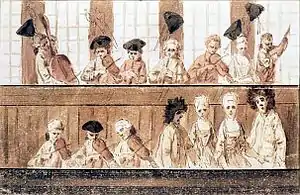
Although there is much overlap of definition with cabaret, music hall, vaudeville, etc. the café chantant was originally an outdoor café where small groups of performers performed popular music for the public.[3]
National variations
The tradition of such premises as a venue for music has its origins in Paris[4][5] and London of the 18th century, but gained its widest popularity in the late 19th and early 20th centuries with the growth of various other national "schools" of cafè chantant (besides French).[6] Thus, one spoke of an Italian,[7][8] German,[9] or Austrian café chantant, and at least one Victorian era premises in England,[10] for example. One of the most famous performers in this medium was violinist Georges Boulanger who performed in this style from 1910 till 1958, and singer Gorella Gori or Zaira Erba who died in 1963. [11]
In Spain it was known as a café cantante and became the centre for professional flamenco performances from the mid 19th century to the 1920s.
Cafés chantants were known as kafeşantan in Turkish,[12] and many were opened in the Beyoğlu/Péra district of Istanbul in the early years of the twentieth century. They are described in great detail in the memoirs of such authors as Ahmed Rasim and Sermet Muhtar Alus. Earlier versions of the kafeşantan, known as kahvehane in Turkish, appeared in Istanbul during the Ottoman Era as early as 1554. Hundreds of them were opened continually, most of them with a social club status.[13]
In the Russian Empire, the term was taken wholesale into the Russian language as "kafe-shantan" (кафе-шантан); Odessa was the city best known for its numerous kafe-shantany.
Fundraising for women's suffrage and other causes
Cafe Chantant events were held across the UK to bring together supporters, and raise funds for the women's suffrage movement; the organisation and musical and other performances were intended to be of a high standard (and unlikely to be risqué although unconventional), so that fundraising this way was successful; starting in one branch[14] then rolling out across Scotland; this was led in 1908 by Jessie M.Soga, contralto.[15] A programme for a London Cafe Chantant shows the variety of performances from music, talks, to clairvoyance and jujitsu.[16] A Thé and Café Chantant event had previously been organised (in Edinburgh, in 1900) by Alice Low (suffragist) and an actor to raise money for a patriotic fund for Scottish soldiers.[17] A similar event for prisoners of war comforts fund, was organised by a 'tea committee' in Leamington Spa, during World War One in 1916.[18]
Literary uses
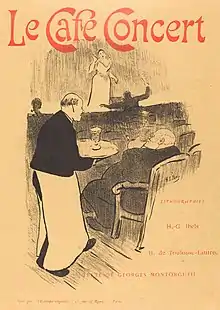
Le Café Concert, was a book published by L’Estampe originale in 1893, with a text by Georges Montorgueil and illustrated with numerous lithographs by Toulouse-Lautrec and Henri-Gabriel Ibels, mostly showing famous performers, or customers, from the contemporary Paris scene.
The name Cafe Chantant appears in
- Araby, a short story by James Joyce (written c. 1904-1905; published 1914 in Dubliners).[19]
- The Man Who Was Thursday: A Nightmare, by G. K. Chesterton (published 1908).[20]
- Buddenbrooks, by Thomas Mann (published 1901).[21] in German
- The Sundays of Jean Dézert, by Jean de La Ville de Mirmont (published 1914).[22]
References
 |
Wikimedia Commons has media related to Café-concerts. |
- Sorokoff, Stephen. "Photos: Yanna Avis Brings Paris To The Grand Salon at La Goulue". BroadwayWorld.com. Retrieved 2021-12-15.
- Rousse_Redacxelle, Axelle (2020-12-21). "Une sortie au caf'conc". Culture générale (in French). Retrieved 2021-12-15.
- Lametino7. "Lamezia, Gran Café Chantant con Tato Russo al Teatro Grandinetti il 12 gennaio". il Lametino.it - il giornale di Lamezia Terme e del lametino (in Italian). Retrieved 2021-12-15.
- Nast, Condé (2015-01-31). "An Henri de Toulouse-Lautrec Divan Japonais Print Is on the Block". Architectural Digest. Retrieved 2021-12-15.
- "Venerdì 1 novembre, il Vanilla Wine&Restaurant presenta "Café Chantant" - Napolitan.it" (in Italian). 2019-10-29. Retrieved 2021-12-15.
- Bove, Angelo (2021-08-30). "La nascita del café chantant e del mitico Salone Margherita di Napoli |". Caserta Web (in Italian). Retrieved 2021-12-15.
- Squillace, Germana (2015-05-13). "Il Salone Margherita, primo cafè-chantant italiano". Vesuvio Live (in Italian). Retrieved 2021-12-15.
- ""CAFÈ CHANTANT: 1915-1918 La musica, le poesie, la satira"". VeneziaToday (in Italian). Retrieved 2021-12-15.
- "Travis Jeppesen on "1913: The Brücke and Berlin"". www.artforum.com. Retrieved 2021-12-15.
- Massey, Lizzie (2016-10-09). "Bear pit 'under threat' from the garden city bulldozers". Kent Online. Retrieved 2021-12-15.
- Lucini, Gianni (2019-11-25). "Gorella Gori, una delle protagoniste del café chantant". Dailygreen (in Italian). Retrieved 2021-12-15.
- "Janet and Jak Esim - Turkish Sephardic roots revived". www.rootsworld.com. Retrieved 2021-12-15.
- seyhan.library.boun.edu.tr
- "Branch Notes - Hillhead branch". Women's Freedom League. 24 December 1908. p. 313.
- "Scottish Notes". Women's Freedom League. 31 December 1908. p. 324.
- "London Society for Women's Suffrage". Woman and her Sphere. Retrieved 2021-09-04.
- "Society in Scotland: Thé and Café Chantant in Edinburgh". The Gentlewoman. 17 March 1900. p. 331.
- "Royal Leamington Spa Courier and Warwickshire Standard - Warwick and Country Edition page 1". WW1 Database. 17 January 1916. Archived from the original on 17 January 1916. Retrieved 2021-09-04.
- "The Project Gutenberg eBook of Dubliners, by James Joyce". www.gutenberg.org. Retrieved 2021-12-15.
- The Man Who Was Thursday: A Nightmare by G. K. Chesterton.
- Buddenbrooks: Verfall einer Familie by Thomas Mann.
- La Ville de Mirmont, Jean de (2019). The Sundays of Jean Dézert. André Naffis-Sahely. Cambridge, Massachusetts. ISBN 978-1-939663-40-5. OCLC 1057768586.