Californian turkey
The Californian turkey (Meleagris californica) is an extinct species of turkey indigenous to the Pleistocene and early Holocene of California. It has been estimated that the Californian turkey went extinct about 10,000 years ago.[1]
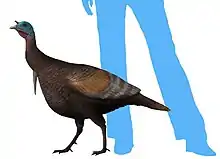
| California turkey Temporal range: Pleistocene - Early Holocene | |
|---|---|
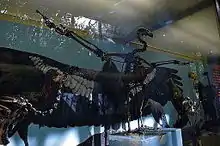 | |
| Californian turkey (lower left) and other extinct birds from the La Brea Tar Pits | |
Scientific classification  | |
| Kingdom: | Animalia |
| Phylum: | Chordata |
| Class: | Aves |
| Order: | Galliformes |
| Family: | Phasianidae |
| Genus: | Meleagris |
| Species: | M. californica |
| Binomial name | |
| Meleagris californica (Miller, 1909) | |
Fossil evidence indicates that the Californian turkey was stockier than the wild turkey of the eastern United States, with a shorter, wider beak, but was largely similar otherwise. It is a very common fossil in the La Brea tar pits.[2]: 5 Size-wise, though, the California turkey might've been intermediate in size between the smaller southwestern turkey (Meleagris crassipes) and the larger North American wild turkey (Meleagris gallopavo).[3]
Human hunting has been suggested as contributing to the extinction of this species, based on evidence of turkey hunting elsewhere in North America.[2]: 52
This species was originally described as a type of peacock, by Miller in 1909, and placed in the genus Pavo with that bird.[2]: 3 Years later he reclassified it as an intermediate between the peacock and the ocellated turkey. But it eventually was seen as a close relative of modern extant turkeys.
Distribution and origin
"The unquestionable geographic range of M. californica extended from Orange County in the south (Imperial Highway), through Los Angeles County (Rancho La Brea and probable also Workman and Alhambra Streets), to Santa Barbara County in the north (Carpinteria)."[2]: 44
During the Miocene, Californian turkeys probably originated from other turkey populations that have become restricted to southern California. However, the similarities between the Californian and wild turkey suggest the former, following isolation of their ancestors, may have faced similar evolutionary pressures when compared to their mainland relatives.[4]
The xeric desert topography that prevails now in southeastern California and western Arizona may have prevented its neighbor, the wild turkey, from exchanging genes with one another. This would therefore indicate the California turkey has been an isolated species separated from the more abundant wild turkey for some time before their extinction.[5]
References
- California Department of Fish and Game. Wild Turkey Guide 2005.
- Bocheński, Zbigniew M.; Campbell, Kenneth E. Jr. (2006-11-10). "The Extinct California Turkey, Meleagris californica, from Rancho La Brea: Comparative Osteology and Systematics". Natural History Museum of Los Angeles County. 509 (509): 1–92. doi:10.5962/p.214385. eISSN 0459-8113. S2CID 33771032.
- "Wild Turkey a Calif native". creagrus.home.montereybay.com. Retrieved 2021-02-26.
- "Wild Turkey a Calif native". creagrus.home.montereybay.com. Retrieved 2021-02-26.
- "Wild Turkey a Calif native". creagrus.home.montereybay.com. Retrieved 2021-02-26.
- Physical Geography of North America, by Antony Orme
- https://blogs.scientificamerican.com/guest-blog/california-s-wild-turkey-troubles/


