Hardwicke's bloodsucker
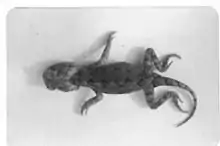
Hardwicke's bloodsucker (Calotes minor) is an agamid lizard and found in South Asia.
| Hardwicke's bloodsucker | |
|---|---|
 | |
Scientific classification  | |
| Kingdom: | Animalia |
| Phylum: | Chordata |
| Class: | Reptilia |
| Order: | Squamata |
| Suborder: | Iguania |
| Family: | Agamidae |
| Genus: | Calotes |
| Species: | C. minor |
| Binomial name | |
| Calotes minor | |
 | |
| Synonyms | |
|
Agama minor Hardwicke & Gray 1827: 218 | |

Morphology
Physical structure: This is a small stocky and pot-belly lizard with a short tail. Its head large and elongated, flat above, sloping towards snout.[2] Its dorsal scales larger, strongly imbricate and keeled, pointing backward and upward, ventral scales smaller than dorsal; upper head scales larger, unequal, strongly keeled or tubercular.[3] Females are larger than the males.[1]
Color pattern: Dorsal color is olive-brown with 3 rows of dark-brown light edged spots on the back and base of the tail; spots of middle row are most prominent and rhomboidal; a white streak on each side of the neck is bifurcating behind and an oblique one from the eye to the angle of mouth; limbs are with dark-brown cross bars; throat is profusely spotted with dark-brown and orange; belly is yellowish-white with numerous orange dots.[3] Color inside the mouth is ink-blue.[4] Females are more brilliantly colored during breeding season.[1]
Length: Maximum:18 cm,[2] Common:10 cm. (Snout to vent 6 cm.)[2]
Maximum published weight: ? g.
Distribution
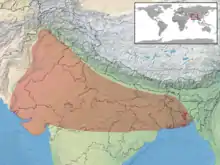
Found in Bangladesh (southeast part of the country), India (Madhya Pradesh, Uttar Pradesh, Rajasthan, Gujarat, Odissa) and Pakistan (Sindh).
Vernacular names
Bengali: আগামা গিরিগিটি, পাতি রক্তচোষা, পাতিয়াল গিরিগিটি (Patial girigiti), হার্ডউইকের গিরিগিটি।
English: Dwarf rock agama, Hardwicke's bloodsucker, Hardwicke's short-tail agama and lesser agama.
Hindi & other Indian languages: ?
Urdu & Sindhi: ?
Habitat
This lizard is Terrestrial & sometimes arboreal; inhabits in frequently fragmented dry forest, arid environments, barren desert and desolate areas across the Indo-Gangetic plains.[1]
Habit
This lizard is diurnal & crepuscular. It shelters in burrows close to the roots of thorny bushes.[1] Generally it is found sitting on stones, but it can climb up shrubby vegetation. It is sluggish in movements, often not attempting to escape when approached.[3] It is a docile species.[5]
Diet
This lizard is mainly insectivorous; feeds on grasshoppers and their nymphs, earwigs, beetles, bugs, arthropods and spiders.[3] Sometimes it also eats flowers.[1]
Reproduction
This lizard is oviparous; breeding season extends from April to June; lays 4-6 hard shelled white eggs in burrows under the roots of vegetation.[1]
Importance & Uses
There is no known practical uses of this species but plays roles in Eco-system by eating various types of insects and otherwise.
Etymology
The species-name minor, a Latin word, meaning ‘less’ or ‘smaller’, also referring to the smaller size of this agamid.[7]
Extra Notes
This lizard has a bad reputation for being particularly harmful, which is totally baseless and unfortunately contributed much to its depletion.[1]
References
- Khan, M.S.; Papenfuss, T. (2016). "Calotes minor". IUCN Red List of Threatened Species. 2016: e.T170377A104646004. doi:10.2305/IUCN.UK.2016-3.RLTS.T170377A104646004.en. Retrieved 20 November 2021.
- http://www.pakwildlife.org/wp-content/uploads/Artical-6.pdf
- "Archived copy". Archived from the original on 2017-10-24. Retrieved 2015-08-07.CS1 maint: archived copy as title (link)
- http://www.landofthewild.com/showPic.php?&albumId=276&albumTitle=Reptiles&picId=1173&picTitle=Lesser%20Agama
- http://faunaofindia.nic.in/PDFVolumes/hpg/007/index.pdf
- http://faunaofindia.nic.in/PDFVolumes/sfs/007/index.pdf
- https://www.google.com/search?q=Etymology+of+minor+&ie=utf-8&oe=utf-8
- Blyth, E. 1856, Proceedings of the Society. Report of the Curator. J. Asiat. Soc. Bengal 25:448-449
- Boulenger, G.A. 1885 Catalogue of the Lizards in the British Museum (Nat. Hist.) I. Geckonidae, Eublepharidae, Uroplatidae, Pygopodidae, Agamidae. London: 450 pp.
- Boulenger, George A. 1890 The Fauna of British India, Including Ceylon and Burma. Reptilia and Batrachia. Taylor & Francis, London, xviii, 541 pp.
- Günther, A. 1864 The Reptiles of British India. London (Taylor & Francis), xxvii + 452 pp.
- Hardwicke, F.R. & Gray, J.E. 1827 A synopsis of the species of saurian reptiles, collected in India by Major-General Hardwicke. Zool. J. London 3: 214-229
- Manthey, U. & SCHUSTER, N. 1999 Agamen, 2. Aufl. Natur und Tier Verlag (Münster), 120 pp.
- Smith, M.A. 1935 Reptiles and Amphibia, Vol. II. in: The fauna of British India, including Ceylon and Burma. Taylor and Francis, London, 440 pp.
- https://web.archive.org/web/20100506062300/http://www.jcvi.org/reptiles/species.php?genus=Brachysaura&species=minor Downloaded Feb. 17, 2010.