Royal Cambodian Army
The Royal Cambodian Army (Khmer: កងទ័ពជើងគោក, Kângtoăp Cheung Koŭk) is a part of the Royal Cambodian Armed Forces. It has ground forces which numbered 85,000 divided into eleven divisions of infantry, with integrated armour and artillery support. The Royal Army is under the jurisdiction of the Ministry of National Defence.
| Royal Cambodian Army | |
|---|---|
| កងទ័ពជើងគោក | |
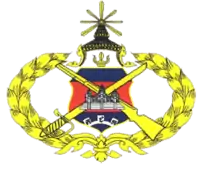 Emblem of the Royal Cambodian Army | |
| Founded | 9 November 1953 |
| Country |  Cambodia Cambodia |
| Allegiance | HM The King |
| Type | Army |
| Size | 85,000[1] |
| Part of | Royal Cambodian Armed Forces |
| Garrison/HQ | Phnom Penh, Cambodia |
| Motto(s) | Defending the Kingdom of Cambodia |
| Colours | Red, Blue |
| Anniversaries | 9 November 1953 |
| Engagements | First Indochina War Cambodian Civil War Cambodian–Vietnamese War 1997 clashes in Cambodia Cambodian–Thai border dispute |
| Commanders | |
| Current commander | General Hun Manet |
| Notable commanders | General Meas Sophea General Tea Banh General Srey Doek General Hun Manet General Hing Bun Hieng |
| Insignia | |
| Unit colour | |
Military organisation
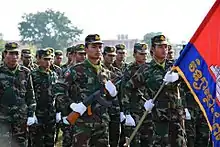
Under the current military plan and divisions, every military region has a full division size. Each division will be supplemented by a mobile reinforcement division in Phnom Penh. The country is divided into six, until recently five, military regions, each comprising three or four provinces. There are garrisons in major cities and major army bases.
General Hun Manet is the commander of the Royal Cambodian Army. He is also the Deputy Commander in Chief of the Royal Cambodian Armed Forces.
The forces are deployed as required across the country and in operations, with bases as follows:
- Region One: Headquarters are in Stung Treng and the region covers the provinces of Stung Treng, Kratié, Ratanakiri and Mondulkiri.
- Region Two: Headquarters are in Kampong Cham and the region covers the provinces of Kampong Cham, Prey Veng, and Svay Rieng.
- Region Three: Headquarters are in Kampong Speu and the region covers the provinces of Kampong Speu, Takéo, Kampot, Sihanoukville, Koh Kong and Kep.
- Region Four: Headquarters are in Siem Reap and the region covers the provinces of Siem Reap, Oddar Meanchey, Preah Vihear, and Kampong Thom.
- Region Five: Headquarters are in Battambang and the region covers the provinces of Battambang, Pursat, Banteay Meanchey and Pailin.
- Special Region: Headquarters are in the capital, Phnom Penh and the region covers the provinces of Kampong Chhnang, Kandal and the greater municipality of Phnom Penh.
Every Military Region is under the command of a Major General, assisted by a Chief of staff with a rank of a Brigadier General. In every province, there is a military base called Military Operation Zone under the command of a Colonel.
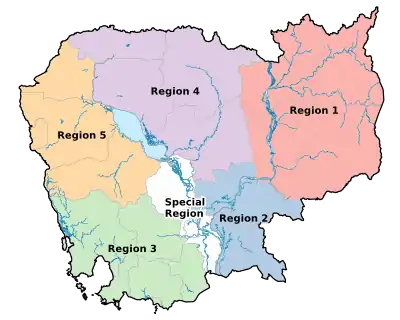
Airborne special forces
Equipment
As of June 2018, it is assessed that 800 of the tanks are to be fully operational.
- 800+ tanks and an unknown number of light tanks.
- 800+ APC
- 1200+ artillery
- 40 helicopters
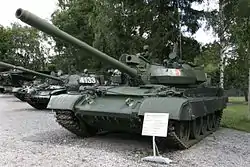
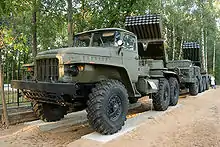
Operational art and tactical doctrine is still being defined as the process of reform continues. Ostensibly, the continuing military reorganisation will provide integrated armoured support for each of the regional infantry divisions. However, much of Cambodia's terrain does not lend itself to armoured operations and tanks are rendered unusable during the rainy season. All the OT-64 APCs have apparently gone to the Phnom Penh reserve force.
In the 1990s, to make the army more mobile and mechanised, there was a steady influx of new tanks, self-propelled artillery, armoured personnel carriers (APCs), and trucks. The ground forces seldom retire old models of weapons and tend to maintain a large equipment stock, keeping old models along with upgraded ones in the active force or in reserve. The army remains largely an infantry force, although a decade-long modernisation program has significantly improved the mobility and firepower of its active forces.
Equipment for the main force units was furnished by Vietnam, China, and by the Soviet Union. Armaments consisted of small arms of Soviet origin, including the AKM (updated version of the AK-47) assault rifle, RPD light machine gun, PKM general-purpose machine gun, RPG-2 82mm rocket-propelled grenade, RPG-7 85mm rocket-propelled grenade, Chinese Type 56 assault rifle, and various crew-served weapons, including towed medium howitzers, and air-defense weapons in several calibres. Tanks in the RCAF armoured battalions included the T-54/55, an old, but capable, main battle tank of Soviet origin; the obsolete PT-76/Type 63 light amphibious tank; and the Type-59, an older Chinese main battle tank, probably handed down from Vietnamese stocks. Multiple rocket launcher in main force included BM-14 and BM-21. Armored fighting vehicles in the main force inventory consisted of the Soviet BTR series of wheeled vehicles, and some ageing American equipment, such as: M106 armoured carriers and M113 armoured personnel carriers, either bequeathed by Vietnam or left behind from the days of the Khmer Republic.
Peacekeeping operations
The RCAF has sent RCAF personnel to various hotspots as part of the Kingdom of Cambodia's role as a member of the United Nations. Mostly engineers and logistical units, a total of 6,822 soldiers, of them 369 are women, have been so far sent to 10 peacekeeping missions in nine countries such as:[2]
Army ranks and insignia
| Rank group | General/flag officers | Field/senior officers | Junior officers | Officer cadet | ||||||||||||||||||||||||||||||||
|---|---|---|---|---|---|---|---|---|---|---|---|---|---|---|---|---|---|---|---|---|---|---|---|---|---|---|---|---|---|---|---|---|---|---|---|---|
| Royal Cambodian Army |
 General of the Army |
 General |
 Lieutenant General |
 Major General |
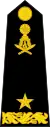 Brigadier General |
 Colonel |
 Lieutenant Colonel |
 Major |
 Captain |
 1st Lieutenant |
 2nd Lieutenant |
 | ||||||||||||||||||||||||
| នាយឧត្តមសេនីយ៍ផុតលេខ Néay Ŭtdâmséniy Phŏt Lék |
នាយឧត្តមសេនីយ៍ Néay Ŭtdâmséniy |
ឧត្តមសេនីយ៍ឯក Ŭtdâmséniy Êk |
ឧត្តមសេនីយ៍ទោ Ŭtdâmséniy Toŭ |
ឧត្តមសេនីយ៍ត្រី Ŭtdâmséniy Trei |
វរសេនីយ៍ឯក Vôrséniy Êk |
វរសេនីយ៍ទោ Vôrséniy Toŭ |
វរសេនីយ៍ត្រី Vôrséniy Trei |
អនុសេនីយ៍ឯក Ânŭséniy Êk |
អនុសេនីយ៍ទោ Ânŭséniy Toŭ |
អនុសេនីយ៍ត្រី Ânŭséniy Trei |
នាយចំណង់ Néay Châmnáng | |||||||||||||||||||||||||
| General of the army | General | Lieutenant general | Major general | Brigadier general | Colonel | Lieutenant colonel | Major | Captain | 1st lieutenant | 2nd lieutenant | Officer cadet | |||||||||||||||||||||||||
| Rank group | Senior NCOs | Junior NCOs | Enlisted | |||||||||||||||||||||||||||||||||
|---|---|---|---|---|---|---|---|---|---|---|---|---|---|---|---|---|---|---|---|---|---|---|---|---|---|---|---|---|---|---|---|---|---|---|---|---|
| Royal Cambodian Army |
 |
 |
 |
 |
 |
 |
 |
 |
 | |||||||||||||||||||||||||||
| ព្រឹន្ទបាលឯក Pruntobealek |
ព្រឹន្ទបាលទោ Pruntobealto |
ពលបាលឯក Polbalek |
ពលបាលទោ Polbalto |
ពលបាលត្រី Polbalotrei |
នាយឯក Néay ek |
នាយទោ Néay to |
ពលឯក Plek |
ពលទោ Polto | ||||||||||||||||||||||||||||
| Warrant Officer | Command Sergeant Major | Master Sergeant | Staff Sergeant | Sergeant | Corporal | Lance corporal | Private 1st Class | Private | ||||||||||||||||||||||||||||
See also
References
- Anthony H. Cordesman; Robert Hammond (16 May 2011), THE MILITARY BALANCE IN ASIA: 1990–2011 (PDF), Center for Strategic and International Studies, p. 70, retrieved 27 June 2011
- "Hun Sen says Cambodia proud of participating in UN peacekeeping missions". Khmer Times. 20 September 2020. Retrieved 28 December 2020.
External links
 |
Wikimedia Commons has media related to Army of Cambodia. |
.svg.png.webp)