Cannock Chase murders
The Cannock Chase murders (also known as the A34 murders and the Babes in the Ditch murders[3]) were the murders of three girls aged between 5 and 7 that occurred in Staffordshire, England, between 1965 and 1967.[4] The bodies of all three children were discovered on Cannock Chase; a vast area of countryside in the county of Staffordshire.[5]
Raymond Leslie Morris | |
|---|---|
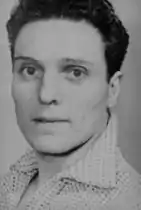 Morris, circa 1966 | |
| Born | Raymond Leslie Morris 13 August 1929 Walsall, Staffordshire, England |
| Died | 11 March 2014 (aged 84) HM Prison Preston, Lancashire, England |
| Other names | The A34 Killer The Monster of Cannock Chase |
| Motive | Child sexual abuse Rape[1] |
| Conviction(s) | Murder (x1) Indecent assault (x2) Attempted abduction (x1) |
| Criminal penalty | Life imprisonment |
| Details | |
| Victims | 1–3+ |
Span of crimes | 8 September 1965 – 19 August 1967 |
| Country | England |
Date apprehended | 15 November 1968[2] |
The perpetrator of all three murders, Raymond Leslie Morris, was arrested in 1968 for the attempted abduction of an intended fourth victim. He was convicted in February 1969 of the 1967 murder of seven-year-old Christine Ann Darby at Stafford Assizes. Morris is also believed to be responsible for the abduction, sexual assault, and attempted murder of a fifth girl in 1964.[6]
Although never charged with the murders of the first two victims discovered on Cannock Chase, following Morris's conviction, a police spokesman informed the media all investigators involved in his apprehension remained convinced that all three children had been murdered by Morris.[7][5][8]
The manhunt to identify and apprehend Morris is reported to be one of the largest initiated to apprehend a child killer in British history.[7][9][3][10] He died of natural causes at HMP Preston on 11 March 2014.[10][11][12]
Abductions
Julia Taylor
At 9 p.m. on 2 December 1964, a nine-year-old named Julia Taylor was lured into a blue Vauxhall Velox in Bloxwich by a man claiming to be a friend of her mother and referring to himself as "Uncle Len". The child was informed her mother had asked this individual to transport her to her aunt's home to "fetch Christmas presents".[13] She was driven to a pile of slag heaps near the mining village of Bentley where she was sexually assaulted, manually strangled and thrown half-naked from the car into a ditch, having endured grievous internal injuries. Taylor was found alive by a passing cyclist approximately fifty minutes later. This individual would later state he had overheard "weak, sobbing" noises as he cycled in the pouring rain and darkness and had stopped his bicycle to investigate the sounds. The cyclist immediately flagged down a passing van, which drove the sobbing and bleeding child to a hospital.[14]
Had the cyclist not overheard, then observed the child in this ditch, she likely would have died from exposure[13] within twenty minutes.[15]
Taylor could remember little about her ordeal, her abductor or his vehicle beyond sobbing and begging her abductor to drive her home when she noticed he had driven past her aunt's home and his conversation suddenly became more lurid in nature.[14] However, one eyewitnesses to Taylor's abduction was certain the abductor's vehicle was a large car with two-tone paint, small fins at the rear and a hand spot-lamp mounted close to one wing "at the end of the windscreen, near the driver's door". Despite intense efforts to locate this car, the vehicle was not traced.[16]
Margaret Reynolds
On the afternoon of Wednesday 8 September 1965, a six-year-old girl, Margaret Reynolds, disappeared from a location close to her home on Clifton Road, Aston as she walked the short distance from her home to the Prince Albert Primary School. She was last seen alive by her older sister, Susan, when the two parted company to walk in separate directions to their respective schools, having returned to their home for lunch. When the child failed to return home from school, her parents quickly learned she had not returned to school that afternoon, and immediately reported her missing.[17]
In the weeks following Reynolds' disappearance, 160 police officers questioned over 25,000 individuals in and around Aston. Two hundred posters featuring a composite photograph of the child in the clothes she was last seen, with an accompanying appeal for witnesses to contact police were printed by the Birmingham Evening Mail. These posters were distributed in and around Aston, Lozells and Handsworth.[18] With assistance from members of the public,[19] investigators extensively searched all houses and landmarks within an eight-mile radius of where Reynolds was last seen alive. Despite these efforts, no trace of the child was discovered.[20]
In the months prior to Reynolds' abduction, investigators in and around the vicinity of her disappearance had received numerous reports of a lone white male in a car who had attempted to entice prepubescent girls into his vehicle and who, if successful, had sexually assaulted the children, with his assaults often including digital penetration.[20]
Diana Tift
Three months later, on 30 December, a five-year-old girl named Diana Joy Tift disappeared from a street close to her Walsall home. The child was last seen at 2 p.m. outside her grandmother's home in Chapel Street, walking to her own home in nearby Hollemeadow Avenue. She was carrying a pink plastic handbag with a white plastic strap she had received as a Christmas present. The last potential sighting of Tift was made by a family member, who believed she had subsequently seen her walking past a nearby launderette en route to the family home.[21]
Tift was reported missing by her parents at 7 p.m.[22] As had earlier been the case with Margaret Reynolds, despite extensive searches, no trace of the child was discovered. Tift's disappearance saw approximately 2,000 people search for her. A local councillor also offered a reward for the child's safe return.[5]
By 2 January 1966, more than 500 officers from across the West Midlands region had been assigned to the manhunt to locate Tift. Several senior officers had also tentatively linked her disappearance to that of Margaret Reynolds.[23] Over 6,000 homes, gardens and outhouses in and around Bloxwich were searched by 5 January. Ponds and reservoirs were also searched by underwater units. Other officers searched derelict factories and warehouses, to no avail.[24]

Initial discoveries
On the afternoon of 12 January 1966, the body of Diana Tift was found by a man hunting rabbits. She lay half-concealed in undergrowth aside a water-logged ditch at Mansty Gulley on Cannock Chase in Staffordshire, between the villages of Penkridge and Littleton.[25] This location was a seldom-used farm track just half a mile from the A34.[26][11][n 1] An autopsy later revealed the child had been raped, then suffocated with the pixie hood of her anorak as her murderer had pressed upon her nose and mouth.[28]
The naked body of Margaret Reynolds lay just inches away. Her body was largely skeletonized, and none of her clothing was ever recovered save for one shoe. As such, pathologists were unable to determine her cause of death.[29] Aside from traces of semen found upon and within Tift's body, no forensic evidence was recovered from the crime scene.[30]
Prior to the discovery of the children's bodies, police had concluded their abductions were linked. The modus operandi of Taylor's 1964 abduction and body disposal also led investigators to strongly link her abduction and attempted murder to the same perpetrator.[28] At a press conference held on 14 January, the Assistant Chief Constable of Staffordshire Police, Thomas Lockley, informed the media: "We are hunting a dangerous child killer who may strike again."[31]
Investigation
Following the discovery of the children's bodies, investigators contacted Scotland Yard, seeking the assistance of experienced investigators. Two individuals from the Yard's Murder Squad were dispatched to Staffordshire to assist in the investigation, which saw a task force dedicated to the apprehension of the suspect work fourteen hours a day, seven days a week. An index card filing system expanded to number in the tens of thousands. Numerous vehicles sighted on Mansty Gulley between 30 December and 12 January were traced, their owners interviewed, and subsequently eliminated from the enquiry following the verification of their whereabouts on crucial dates. The individual who had discovered the children's bodies—a poacher with a known history of violence—was also eliminated as a suspect.[32]
Despite painstaking groundwork efforts over the following months—including extensive house-to-house enquiries—police failed to identify the perpetrator, although several unrelated offences involving the abduction, attempted abduction or sexual assault of young girls were solved as a result of the investigation.[33] By the summer of 1967, no further clues of any substance existed for police to pursue, and the investigation into the children's murders had largely become cold.[34] The August 1966 abduction of a 10-year-old girl named Jane Taylor, who disappeared from the Cheshire village of Mobberley while riding her bicycle, was also tentatively linked to the same perpetrator, as investigators could not discount the possibility her disappearance was linked to what were colloquially known as the "A34 murders".[8][n 2]
Strategy
Although unable to identify the children's murderer, investigators felt certain the perpetrator would strike again. In preparation, the head of Staffordshire CID, Detective Chief Superintendent Harry Bailey, devised plans to seal the immediate locality of any future child abduction occurred in and around the vicinity of Walsall, and to further cordon all minor and major exits further afield from the radius of the abduction by setting up roadblocks. These plans were to be initiated within twenty minutes of any reported child abduction, with other officers to be deployed upon all major approaches to the perimeter of Cannock Chase.[36] Three neighbouring police forces were also notified of this plan, with officers from their forces instructed of their required duties upon receipt of notification of a simple code word: Stop Plan.[37]
Christine Darby
At 2:30 p.m. on 19 August 1967, a seven-year-old named Christine Darby was lured into a grey car as she played with friends near her home in Camden Street, Caldmore, Walsall.[38] The individual had asked Darby and her two friends if they knew the directions to Caldmore Green. When the children pointed the direction to this individual, adding his intended destination was just a short distance up the road, he had feigned confusion and asked Christine to enter the car and show him the way, promising to drive her back to her friends immediately afterwards. The child—whose parents did not own a car—had entered the vehicle excitedly.[39] Her friends then observed the vehicle reverse, then drive at speed in the opposite direction to Caldmore Green—the direction of Cannock Chase.[19]
The witnesses to Darby's abduction immediately ran to Darby's home to report the incident to her mother; she in turn almost immediately ran to a payphone and notified police.[n 3] With assistance from neighbouring police forces, the devised plan to install roadblocks at all minor and major roads exiting Walsall and further afield was immediately implemented.[40]
Questioned by police, the two witnesses to Darby's abduction explained the man had been in his mid-thirties, clean-shaven and with dark brown hair. He wore a white shirt and drove a grey car—possibly an A55 or A60 "Farina" model Austin Cambridge or a Morris Oxford—and spoke in a notable local accent. One of the children in particular, seven-year-old Nicholas Baldry, remained adamant the man had pronounced Caldmore Green as "Carmer Green" and not "Cold-moor Green", as only a local individual would.[n 4] This information further reaffirmed the police view they were hunting a local man. Furthermore, all three children had lived within a seventeen-mile radius of each other and near the arterial A34 road which passes through Cannock Chase.[42] As such, police concentrated their manhunt for the perpetrator in and around Walsall.[43] A team of 80 detectives began house-to-house enquiries in a renewed effort to apprehend the murderer.[44]
Second manhunt
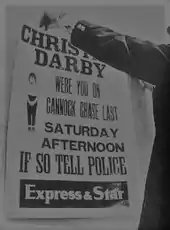
Over the following days, 24,000 flyers bearing Darby's photograph were distributed to the public and displayed in prominent locations such as shop windows, bus stops and telephone poles in and around the West Midlands. Each circular bore the inscription Christine Darby. Were you in Cannock Chase last Saturday afternoon? If so, tell police.[45] One eyewitness reported to police he had seen a grey car travelling in the direction of Cannock Chase shortly after 2:30 p.m. on 19 August. According to this witness, a dark-haired girl had been sitting in the passenger seat.[19]
By the early hours of 20 August, police had initiated a thorough search of Cannock Chase for the body of Christine Darby. As approximately thirty per cent of the eighty-five square mile surface of Cannock Chase was covered by fir trees, dense foliage, mine shafts, clay pits and fox holes, any aerial search of the terrain would be ineffective. As such, over three hundred police began searching Cannock Chase on foot, with the operation beginning at a pool close to Mansty Gulley. These officers were soon assisted by over two hundred officers from two neighbouring forces and two-hundred-and-fifty soldiers of the nearby Staffordshire Regiment.[46] Within hours, a pair of soiled child's knickers were discovered snagged against the branch of a fallen tree. A child's plimsoll was discovered among fern leaves three miles north of this location in the early hours of the following day.[47]
Third discovery
On the afternoon of 22 August, a soldier named Michael Blundred, searching a cluster of trees within an area of Cannock Chase known to the Forestry Commission as Plantation 110 discovered the child's sprawled, naked body partially concealed by fern branches.[48] This individual immediately raised his right hand and called for his colleagues to halt the search.[47]
Darby lay on her back on a small ridge between two rows of trees. She was naked from the waist down, with her arms outstretched, her legs parted and her knees raised. Blood had stained the grass and needles beneath her body, indicating the child had been sexually assaulted where she lay. Signs of petechial haemorrhage about Darby's face and neck and the fact her tongue protruded beyond the tooth margin indicated she had died of suffocation.[49] The location of her discovery was only a mile from where the bodies of Reynolds and Tift had been discovered the previous year.[10]
A detailed examination of the crime scene on the morning of 23 August revealed fragmented tyre tracks close to where Darby's body had been discovered.[n 5] These tyre impressions extended 140 yards from the open heath into the plantation where the child's body was discovered, and clearly indicated Darby's murderer had driven into the plantation, then later reversed some distance from the location prior to performing a U-turn.[50]

Second murder investigation
The manhunt for the Cannock Chase murderer was now led by Sir Stanley Bailey, Staffordshire's Assistant Chief Constable at the time.[51][52] Via a process of elimination, investigators began the task of identifying and eliminating all vehicles upon Cannock Chase on the afternoon in question from the enquiry. Over the following months, the owners of over 600 vehicles known to be upon Cannock Chase were traced and eliminated from the enquiry.[53][n 6]
Two individuals who had been on Cannock Chase on the afternoon of 19 August reported to investigators they remembered seeing a grey vehicle parked close to the location where the child's body was discovered. The vehicle in question had been driven by a white male with dark hair.[26] One of these witnesses, Victor Whitehouse, gave a detailed description of the man, whom he had observed leaning on the door of a vehicle he believed to be a Cambridge or Oxford saloon parked where police had found the vehicle's tyre tracks. Whitehouse was certain he would recognise the man should he see him again. The other witness, Jeanne Rawlings, was certain the vehicle was an Austin Cambridge A60.[54]
In response to this information, police began the mammoth task of tracing every grey Austin A55 and A60 in the Midlands.[4] Over the following months, investigators checked 1,375,000 files from eleven local taxation offices, identifying 23,097 vehicles which needed to be traced, their owners interviewed, and their alibi on the date of Darby's abduction verified. As each successive vehicle was eliminated from the enquiry, investigators expanded their search radius—gradually interviewing the owners of over 44,000 Austin A55 and A60 vehicles in and around the Midlands.[55][n 7] In what would prove to be the first instance in British criminal history in which police created and distributed a colour facial composite of a suspect in a manhunt, over 2,000 copies of a facial composite of the individual seen close to Plantation 110 were distributed throughout the country on 5 September.[56] This Identikit produced several thousands of further leads for police to investigate—ultimately to no avail.[55]
Attempted abduction
On 4 November 1968, a 10-year-old girl named Margaret Aulton narrowly escaped an attempted abduction when a man engaged her in conversation by asking if she would like to take some "rockets and Catherine wheels" from the front passenger seat of his car, which had been parked at the junction between Bridgeman Street and Queen Street, Walsall.[57] When the girl approached the vehicle, she noted the passenger seat was covered in newspaper and that no fireworks could be seen, causing her to hesitate; in response, the individual attempted to drag her into his vehicle. The child managed to break free and run away when her would-be abductor observed an 18-year-old woman exit a fish and chip shop across the road, causing him to speed away from the scene with his head lowered.[4]
The 18-year-old woman had witnessed this incident; she made a mental note of the make of the vehicle (a green Ford Corsair with a cream roof) and the registration plate, which she recounted to police as being 429 LOP.[58] Armed with this information, police contacted the local vehicle registrations officer for Walsall. No such vehicle registration existed but detectives examined a number of permutations, discovering that a local record existed for a green and white Ford Corsair with a registration of 492 LOP. This vehicle was registered to a 39-year-old local named Raymond Leslie Morris, who resided in a block of flats located directly opposite the police station.[19][n 8]
Arrest
Morris was arrested in connection with Aulton's attempted abduction. He denied any knowledge of the incident, but did confirm to detectives—who were aware Morris had been questioned four times in recent years in relation to the abductions and murders[n 9]—that he had only purchased the Corsair within the previous year, having previously owned a grey Austin A55. Investigators were also struck by his uncanny resemblance to the 1967 composite drawing.[13]
By 12 November, an examination of Morris's insurance records revealed that at the time of the abduction of Julia Taylor and the murder of Margaret Reynolds, he had owned a two-tone Vauxhall Velox, which he had sold in November 1965. Furthermore, petrol receipts obtained from his employer placed him in specific areas at the time of abductions. For example, he had been driving a green company-issued Hillman Super Minx on the date of Reynolds' abduction, being tasked with visiting a particular Aston firm on this date.[61] However, the young woman who had observed Aulton's attempted abduction failed to identify Morris from an identity parade, resulting in his being released. Shortly thereafter, investigators from Scotland Yard were again called to assist in the investigation.[58]
Formal charges
On 15 November, Morris was rearrested as he drove to work. On this occasion, he was informed his arrest was in relation to the murder of Christine Darby.[9] A police search of Morris's flat uncovered a small cache of homemade child pornography. Many of these images depicted the same young girl, who was later determined to be Carol Morris's five-year-old niece, and the background in several images revealed the photographs had been taken inside the flat itself. Although Morris's face was not depicted in any of the images, a distinctive wristwatch visible in several images was later found strapped to his ankle in an effort to conceal the item from investigators.[4] The Austin A55 was quickly traced and recovered from the individual to whom Morris had sold the vehicle; the car was impounded pending a forensic examination.[4]
Within hours of Morris's arrest, his wife was also detained for questioning. She was questioned at Hednesford police station by detectives, who were certain she had provided a false alibi for her husband. Initially, Carol Morris remained emphatic her statement had been authentic, but within hours, she confessed to having given her husband a false alibi; confirming that on the date of Darby's murder, Morris had not returned to their home until almost 5 p.m.[60]
Confronted with this revelation, Morris still refused to confess and refused to participate in a further identity parade lineup. In response, police brought eyewitness Victor Whitehouse to the station; Whitehouse positively identified Morris as the man he had seen parked near Plantation 110 on the date of Christine Darby's murder.[60]
On 17 November, Morris was formally charged with Darby's murder. He was remanded in custody at Winson Green Prison to await his first scheduled court appearance.[62] Two charges of indecent assault pertaining to his niece and a further charge in relation to the attempted abduction of Margaret Aulton would also later be filed against Morris.[4]
Prior to Morris's arrest, police had conducted house-to-house enquiries at over 39,000 homes; interviewed approximately 80,000 people; and checked over a million car forms in their efforts to identify and apprehend the murderer.[10][26] Morris had been interviewed by police shortly after Darby's murder, and had been considered a strong suspect;[19] however, his wife had provided him with a false alibi by claiming the couple were shopping together the day of the child's abduction and murder, resulting in his initially being eliminated from the enquiry.[4]
Perpetrator
Raymond Leslie Morris was born on 13 August 1929 in Walsall, Staffordshire (now part of the county of West Midlands).[4] Morris lived in Walsall his entire life and was reported to have an IQ of 120.[8][4] In 1951, he married the daughter of a neighbour who was two years younger than he; the couple fathered two boys.[8] Their marriage lasted less than ten years before his first wife left the marital home, in part due his violent behaviour. The coupe officially divorced on the grounds of adultery when she later gave birth to another man's child.[8]
An engineer by trade, by 1967, Morris had risen to the rank of foreman at a precision instruments factory in the town of Oldbury. Both personally and professionally, he was considered polite and helpful, but unfriendly.[7][4][58]
Morris's first wife would later describe her first husband as a highly-sexed individual with a need to express sexual dominance and whose "cheeks would go pale" if she did not disrobe immediately upon his ordering her to do so.[8] At the age of 35, Morris married again, this time to a 21-year-old woman named Carol Horsley.[4] The year prior to Darby's murder, in October 1966, he had been suspected of taking indecent photographs of two schoolgirls, aged 10 and 11, whom he had encountered truanting and who he had lured into his flat. He was not charged in relation to this incident as although police had searched Morris's flat, they had failed to find any evidence to corroborate the children's claims.[13] At the time of the A34 murders, Morris and his wife lived at Flat 20, Regent House, Green Lane, Walsall.[4][58]
Trial
Morris was brought to trial at Stafford Assizes on 10 February 1969, charged with the murder of Christine Darby, two counts of sexual assault against his niece, and the attempted abduction of Margaret Aulton. He was tried before Mr Justice Ashworth.[7]
On the second day of the trial, two of the most crucial prosecution witnesses—Victor Whitehouse and Jeanne Rawlings—testified as to their eyewitness statements regarding the man they had seen on Cannock Chase on 19 August 1967 and the Identikits they had subsequently helped investigators to produce. Although on both occasions Morris's defense counsel asked his client to stand before handing the witnesses copies of the colour and black-and-white composites, asking both to compare these composites to Morris as he physically appeared in the courtroom and stating "Neither Identikit picture bears very much resemblance to [Morris], does it?", both witnesses disagreed, with Whitehouse concluding his testimony by stating: "I think if I had happened to see Mr. Morris walking down a street on the other side, any time after August 1967, I would have been able to pick him out."[63]
Carol Morris would eventually become the chief witness for the prosecution and retract what she had initially told investigators about shopping on the day of Darby's murder.[4] Detective Inspector Pat Molloy reported that when informed he was to be arrested for the murder of Christine Darby, Morris had exclaimed "Oh God. Is it my wife?";[64] Morris denied making such a statement, and alleged that he had been beaten in police interrogations.[13]
"Mr Forbes, I am addressing you but in addressing you, I am really addressing you and the many colleagues who have helped bring this dreadful case to its conclusion. There must be many mothers in and around Walsall and the area whose hearts will beat more lightly as a result of this verdict ... it must have been a nightmare for mothers and fathers in Walsall over the last months when [they heard of] a child missing."
Judge Ashworth, addressing Detective Superintendent Ian Forbes following Morris's conviction for the murder of Christine Darby. 18 February 1969.[65]
Conviction
On 18 February 1969, Morris was found guilty of the rape and murder of seven-year-old Christine Darby, the attempted abduction of Margaret Aulton, and two counts of sexual assault against his wife's niece.[66] The jury had deliberated for less than two hours before reaching their verdict. He was sentenced to life imprisonment, with the judge simply informing him: "I do not intend to keep you long or make any comment about this terrible murder. There is only one sentence, as you know: Life imprisonment."[5]
Upon receipt of this sentence, Morris turned to the public gallery; he briefly stared coldly in the direction of his second wife. He was then led from the court to begin his life sentence as several members of the public repeatedly shouted "Hang him!"[67]
Shortly before Morris's conviction, he had taken the stand in his own defence. As Morris began to testify under oath, Julia Taylor—then aged in her early teens—rose from the public gallery, hysterically pointing at Morris and crying out: "That's him! That's the man that did it to me." She was gently ushered, weeping, from the public gallery.[13]
Judicial review
In November 2010, Morris was granted a judicial review of the refusal of the Criminal Cases Review Commission to refer his case to the Court of Appeal, in a bid to overturn his conviction.[68] A statement from Morris's defence team said:
The application for a judicial review is the first stage in his attempts to have the matter referred back to the Court of Appeal after 42 years in prison. If Morris's conviction was overturned it would be the longest running miscarriage of justice in British history. It might also potentially mean that a child murderer had remained at large for more than 40 years during Morris's incarceration.[69][70]
However, Mr Justice Simon rejected the judicial review.[71] Shortly thereafter, Morris indicated his potential intention to transfer his case to the European Court of Human Rights. He later abandoned this plan, adding his belief he would die in prison.[72]
Aftermath
The four-year enquiry into the Cannock Chase murders is reported to be one of the most exhaustive British child murder investigations of the 20th century. By the time investigators had apprehended Morris, they had amassed millions of index cards, making the volume of information so enormous and cumbersome that by the autumn of 1967 the task of cross-checking information had become difficult and laborious.[60]
Although convicted only of murdering Christine Darby, Morris is considered the chief suspect in the deaths of both Reynolds and Tift in addition to the abduction and attempted murder of Julia Taylor,[73] despite a lack of sufficient evidence for him to be charged with either murder or Taylor's attempted murder.[7] All three cases were officially closed in 1969.[5][8] Relatives of all three children share investigators' conviction Morris had killed both children and attempted to murder Taylor in addition to having killed Christine Darby.[5]
Shortly after the conclusion of Morris's trial, it was discovered that in early 1966, his own brother had entered Cannock police station, stating he and his mother had long known of his predilection for prepubescent girls and that they believed Morris to be capable of abducting and murdering Reynolds and Tift, whose bodies had at the time yet to be found. However, as Morris's brother had no evidence to substantiate his statement, his report had simply been marked 'No Further Action' . Due to a filing error, this incident was not discovered until after the trial.[13]
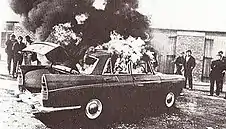
Five weeks after the conclusion of Morris's trial, on 28 March 1969, the Austin A55 car in which he had abducted and murdered Christine Darby was bought by a Worcestershire-based car dealer, who immediately drove the car onto the forecourt of his garage and publicly burned the vehicle.[74]
Raymond Morris died at the HMP Preston health facility of natural causes on 11 March 2014 at the age of 84,[75] having spent the final 45 years of his life in prison. He never admitted his guilt in any of the Cannock Chase murders, or any semblance of remorse.[61]
Morris was reportedly issued with a whole life tariff by a Home Secretary or High Court judge at some stage, although this was never confirmed by the Home Office.[76] By the time of Morris's death, he had become one of the oldest and longest-serving prisoners in England and Wales.[77]
Nine months after Morris's death, the Ministry of Justice publicly released the details of the cost of Morris's taxpayer-funded cremation. In response, a retired policewoman named Maureen Freeman, who had participated in the manhunt to identify and apprehend Morris, stated: "I'm sure the families of his victims would be disgusted. Cannock Chase will never forget what he did."[78]
Media
Literature
Television
- Regional current affairs programme ATV Today broadcast a 20-minute episode pertaining to the abduction and murder of Christine Darby in November 1969. Morris's wife is among those interviewed for this programme.[79]
- The Crime & Investigation Network have broadcast an episode focusing on the murders committed by Harold Jones as part of their Murder Casebook series. Presented by Fred Dinenage, this 45-minute episode was first broadcast in November 2012. Criminologist David Wilson is among those interviewed.[80]
See also
Notes
- In the 1960s, the A34 was a major trunk road two hundred miles in length extending from Southampton, via locations such as Berkshire, Cannock Chase, Walsall and Cheshire, to Manchester.[27]
- Taylor's murder was subsequently proven to have been committed by a criminal named William Copeland. Her body was found buried in a field in Llanfairfechan in February 1972.[35]
- According to police records, Darby's mother notified police of her daughter's abduction twenty-two minutes after the incident.[36]
- In Walsall, the phonetic pronunciation of the district of Caldmore Green is "Carmer Green";[41] the vernacular the abductor had used. Individuals from towns less than twenty miles away did not pronounce this location in a local dialect.
- The afternoon of 19 August had seen intermittent showers in and around Walsall.
- Only one vehicle known to have been on Cannock Chase on 19 August was never traced. This vehicle was not the one driven by Darby's abductor.[53]
- The Austin A55 and A60 models were among the most popular British family vehicles of the 1960s.[55]
- This vehicle was the only green and cream Corsair in the United Kingdom to contain the letters LOP in its registration.[59]
- Investigators would later discover that on each of these four occasions, his wife had knowingly provided a false alibi to authorities, resulting in no further action being taken.[60]
References
- Not the Moors Murders ISBN 978-0-863-83473-8 p. 79
- Not the Moors Murders ISBN 978-0-863-83473-8 p. 171
- "Child Killer to Appeal After 32 Years". BBC News. 16 August 2001. Retrieved 9 September 2009.
- Murder Cases of the Twentieth Century: Biographies and Bibliographies of 280 Convicted or Accused Killers ISBN 978-0-786-40184-0 pp. 325–329
- Cartledge, James (8 September 2005). "Child Killer 'Should Rot in Prison'". Birmingham Mail. Retrieved 9 September 2009.
- "Cannock Chase Child Murderer Raymond Morris is Dead". Express & Star. 13 March 2014. Retrieved 30 November 2021.
- "Our Century 1950-1975: Chase Killer Jailed for Life". Express & Star. Wolverhampton. Archived from the original on 23 June 2002. Retrieved 3 September 2009.
- The Mammoth Book of the History of Murder ISBN 978-0-786-70714-0 pp. ix; 129–132
- "Yard Nabs Suspect in Child's Murder". The Hartford Courant (1923–1984) – Hartford, Connecticut. 17 November 1968. pp. 19A. Retrieved 9 September 2009.
- "Murders Left Area Asking: Whose Child Will be Next?". Express & Star. Retrieved 8 September 2009.
- "Those Were The Days: All Over – and We've Won!". Express & Star. Wolverhampton. Archived from the original on 28 June 2002. Retrieved 4 September 2009.
- "Taking Ten With...Bob Warman". Staffordshire County Council. Archived from the original on 23 February 2012. Retrieved 4 September 2009.
- Staffordshire Murders ISBN 978-0-750-94706-0 pp. 134–149
- "I was Abducted, Strangled and Sexually Assaulted by Cannock Chase Killer: Midland Housewife Demands DNA Test on Child Murderer Morris". freelibrary.com. 14 January 2001. Retrieved 10 December 2021.
- Not the Moors Murders ISBN 978-0-863-83473-8 pp. 20-21
- Not the Moors Murders ISBN 978-0-863-83473-8 p. 20
- Not the Moors Murders ISBN 978-0-863-83473-8 p. 27
- "From the Archives: Alarm Bells Start Ringing over Girls' Disappearance". Birmingham Evening Mail. 24 October 2012. Retrieved 13 December 2021.
- "Crime - Plimmer's Casebook: How Police Finally Caught Cannock Chase Child Killer after Biggest Manhunt in the Midlands". thefreelibrary.com. 19 May 2002. Retrieved 23 November 2021.
- Real-life Crimes ISBN 978-1-856-29978-7 p. 957
- Not the Moors Murders ISBN 978-0-863-83473-8 p. 29
- Murderers' England ISBN 978-0-7091-4054-2 p. 72
- Not the Moors Murders ISBN 978-0-863-83473-8 pp. 23-25; 30
- Real-life Crimes ISBN 978-1-856-29978-7 p. 955
- "Photos: Raymond Morris". The Birmingham Mail. 13 March 2014. Retrieved 11 December 2021.
- Crime in Britain Today ISBN 978-0-710-08232-9 pp. 50–52
- Not the Moors Murders ISBN 978-0-863-83473-8 p. 34
- Real-life Crimes ISBN 978-1-856-29978-7 p. 956
- "Unsolved Murders: Margaret Reynolds". unsolved-murders.co.uk. 1 January 2008. Retrieved 21 November 2021.
- Not the Moors Murders ISBN 978-0-863-83473-8 p. 44
- "Half-day Killer:: Two Children Found Dead". The Canberra Times. 15 January 1966. Retrieved 17 December 2021.
- Not the Moors Murders ISBN 978-0-863-83473-8 p. 45
- Not the Moors Murders ISBN 978-0-863-83473-8 p. 64
- Staffordshire Murders ISBN 978-0-750-94706-0 ch. 12
- Oruye, Rebekah (13 May 2010). "From the Archives: Was Little Christine Just One of Raymond Morris's Victims?". Birmingham Mail. Birmingham, England. Retrieved 23 July 2012.
- Not the Moors Murders ISBN 978-0-863-83473-8 p. 70
- Real-life Crimes ISBN 978-1-856-29978-7 pp. 956-957
- The New Murderers' Who's Who ISBN 978-0-245-54639-6 pp. 219-220
- "From the Archives: Was Little Christine Just One of Raymond Morris's Victims?". The Birmingham Mail. 13 May 2010. Retrieved 22 November 2021.
- Not the Moors Murders ISBN 978-0-863-83473-8 pp. 66-69
- Not the Moors Murders ISBN 978-0-863-83473-8 p. 69
- The Provincial Press and the Community ISBN 978-0-719-00460-5 p. 66
- "Morris, Raymond Leslie". real-crime.co.uk. Archived from the original on 18 February 2009. Retrieved 9 September 2009.
- "Manhunt for Killer of Child". The Canberra Times. 9 January 1968. Retrieved 30 November 2021.
- Not the Moors Murders ISBN 978-0-863-83473-8 p. 100
- "Massive Hunt". The Canberra Times. 23 August 1967. Retrieved 11 December 2021.
- Real-life Crimes ISBN 978-1-856-29978-7 p. 958
- "Sex-murder Trial Begins in UK". The Canberra Times. 12 February 1969. Retrieved 12 December 2021.
- Not the Moors Murders ISBN 978-0-863-83473-8 p. 89
- Not the Moors Murders ISBN 978-0-863-83473-8 pp. 93-94
- "Black Panther Police Chief Dies at 81". Express & Star. Wolverhampton. Archived from the original on 11 October 2008. Retrieved 9 September 2009.
- "Obituaries: Sir Stanley Bailey". The Daily Telegraph. 27 August 2008. Retrieved 9 September 2009.
- Real-life Crimes ISBN 978-1-856-29978-7 pp. 956-959
- Real-life Crimes ISBN 978-1-856-29978-7 p. 959
- Real-life Crimes ISBN 978-1-856-29978-7 p. 960
- "Identikit Picture". The Canberra Times. 6 September 1967. Retrieved 12 December 2021.
- Not the Moors Murders ISBN 978-0-863-83473-8 p. 159
- Murderers' England ISBN 978-0-7091-4054-2 pp. 71-72
- Real-life Crimes ISBN 978-1-856-29978-7 p. 962
- Real-life Crimes ISBN 978-1-856-29978-7 p. 963
- "How the Net was Closed on Cannock Chase Child Killer Raymond Morris". The Birmingham Mail. 14 October 2012. Retrieved 13 December 2021.
- "Murder Charge". The Canberra Times. 18 November 1968. Retrieved 11 December 2021.
- Not the Moors Murders ISBN 978-0-863-83473-8 p. 222
- Not the Moors Murders ISBN 978-0-863-83473-8 p. 173
- Not the Moors Murders ISBN 978-0-863-83473-8 p. 255
- "Morris Found Guilty". The Canberra Times. 20 February 1969. Retrieved 12 December 2021.
- Not the Moors Murders ISBN 978-0-863-83473-8 p. 256
- "Cannock Chase Murderer Raymond Morris in New Bid to Overturn Conviction". Birmingham Post. Trinity Mirror Midlands Limited. 1 November 2010. Retrieved 1 November 2010.
- "Cannock Chase Child Killer Raymond Morris Granted Legal Review". Express & Star. Wolverhampton. 1 November 2010. Retrieved 1 November 2010.
- "Cannock Chase Murders Appeal for Raymond Morris". norriewaite.co.uk. 9 December 2010. Retrieved 8 January 2017.
- "England and Wales High Court (Administrative Court) Decisions: Mr Justice Simon v. Raymond Morris & the Criminal Cases Review Commission". bailii.org. 7 February 2011. Retrieved 17 November 2021.
- "Child Killer Raymond Morris in EU Court Freedom Bid". Express & Star. 12 February 2011. Retrieved 8 January 2017.
- "Wales's Cannock Chase Hero Dies". The Western Mail. 19 June 2003. Retrieved 13 December 2021.
- Not the Moors Murderers ISBN 978-0-863-83473-8 p. 259
- McCarthy, Nick (13 March 2014). "Cannock Chase Killer Raymond Morris Dead: Timeline of Events". Birmingham Mail. Retrieved 18 August 2017.
- "Funeral for Child Killer and Rapist Raymond Morris Cost Taxpayer £2,686". The Belfast Telegraph. 25 January 2015. Retrieved 8 December 2021.
- "Life Meant Life for Wicked Killer Raymond Morris". Express & Star. Wolverhampton. 13 March 2014. Retrieved 9 April 2014.
- "Taxpayers Money Used to Fund Funeral of Cannock Chase Child Killer Raymond Morris". ITV News. 25 January 2015. Retrieved 23 November 2021.
- "ATV Today: 11.11.1969: Cannock Chase Murders". Retrieved 19 November 2021.
- "Fred Dinenage Murder Casebook: The Cannock Chase Murders". Retrieved 19 November 2021.
Cited works and further reading
- Berry-Dee, Christopher (2021). A Special Place in Hell: The World's Most Depraved Serial Killers. Ad Lib Publishers Ltd. ISBN 978-1-913-54375-4.
- Borrell, Clive; Cashinella, Brian (1975). Crime in Britain Today. Routledge & Kegan Paul Ltd. pp. 50–52. ISBN 978-0-710-08232-9.
- Butler, Ivan (1973). Murderers' England. Hale. pp. 71–72. ISBN 978-0-7091-4054-2. Retrieved 9 September 2009.
- Duffy, Wendy (2003). Children and Bereavement. Church House Publishing. ISBN 0-715-14998-9.
- Frasier, David K. (1996). Murder Cases of the Twentieth Century: Biographies and Bibliographies of 280 Convicted or Accused Killers. McFarland & Co. pp. 325–329. ISBN 978-0-786-40184-0.
- Gaute, J. H. H.; Odell, Robin (1991) [1989]. The New Murderers' Who's Who. Dorset Press. ISBN 978-0-245-54639-6.
- Hawkes, Harry (1971). Murder on the A34. John Long Publishing. ISBN 0-09102-960-0
- Hayhurst, Alan (2012) [2008]. Staffordshire Murders. History Press. pp. 134–49 ISBN 978-0-750-94706-0
- Jackson, Ian (1971). The Provincial Press and the Community. Manchester University Press. pp. 61–73. ISBN 978-0-719-00460-5.
- Lane, Brian (1991). The Murder Guide to Great Britain. Robinson Publishing Ltd. ISBN 1-854-87083-1.
- Lane, Bran (1993). "Real-Life Crimes" (44). Eaglemoss Publications Ltd. ISBN 978-1-856-29978-7. Cite journal requires
|journal=(help) - Molloy, Pat (1990) [1988]. Not the Moors Murders: A Detective's Story of the Biggest Child-killer Hunt in History. Gomer Press. ISBN 978-0-863-83473-8
- Morris, Jim (2015). The Who's Who of British Crime in the Twentieth Century. Amberley Publishing. ISBN 978-1-445-63924-6
- Ramsland, Katherine; McGrain, Patrick N. (2010). Inside the Minds of Sexual Predators. Praeger Publishing. ISBN 978-0-313-37960-4.
- Richards, Cara (2000). The Loss of Innocents: Child Killers and Their Victims. Scholarly Resources. ISBN 978-0-520-28287-2
- Sanders, John (2008). Inside the Mind of the Sex Killer. Forum Press. ISBN 978-1-874-35840-4
- Wilson, Colin (2000). The Mammoth Book of the History of Murder. Carroll & Graf Publishers. ISBN 978-0-786-70714-0.
External links
- Contemporary news article detailing the discovery of the bodies of the first two victims of the Cannock Chase Murders
- 17 February 1969 Canberra Times news article detailing the trial of Raymond Morris
- 2011 Birmingham Mail article pertaining to the Cannock Chase murders
- 2014 BBC news article focusing upon Morris's death
- Sickening Cases of the Cannock Chase Murders at thefreelibrary.com
- The Cannock Chase Murders at crimeandinvestigation.co.uk