Capitol Studios
Capitol Studios is a recording studio located at the landmark Capitol Records Tower in Hollywood, California. Established in 1956, the studios were initially the primary recording studios for American record label Capitol Records. While they are still regularly used by Capitol recording artists, the studios began making the facility available to artists outside the label during the late 1960s to early 1970s. The studios are owned by Universal Music Group, the parent company of Capitol Music Group.
 | |
| Type | Recording studio |
|---|---|
| Industry | Music |
| Founded | 1956 |
Area served | Los Angeles, California, United States |
| Parent | Capitol Music Group |
| Website | www |
For over 60 years, Capitol Studios has hosted some of the most celebrated artists, from Frank Sinatra, Nat King Cole, Michael Jackson, and Dean Martin to Barbra Streisand, Paul McCartney, and the Beach Boys. Along with traditional recording sessions, the studios have been the location for numerous iTunes, Sirius/XM sessions, CMG Productions, such as the Top of the Tower concerts and the 1 Mic 1 Take Series. The Studios have also hosted music video shoots (Justin Timberlake's "Suit & Tie"), TV/Documentaries Behind the Music, Classic Albums, PBS Specials, Showtime Original Lost Songs: The Basement Tapes Continued and HBO feature If You're Not In The Obit, Eat Breakfast as well as feature shoots (Ray, Sandy Wexler). The studio has hosted "The Oscars" for the past two decades for the orchestra pre-records and hosts dozens of branded experiential and playback events each year.
Facilities
Overview
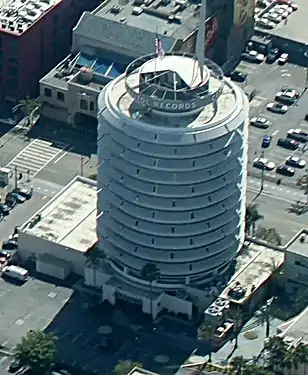
Capitol Studios are located in the rectangular ground floor base of the 13-story circular Capitol Records Tower located just north of the intersection of Hollywood and Vine. the Capitol Studios facility has business offices, five mastering rooms, and four studios, three of which were constructed within a layer of asphalt-impregnated cork to insulate them from outside vibration.[1] Originally designed by acoustics expert Michael Rettinger and Capitol's chief electronics engineer, Edward Uecke with objectives to accommodate developing musical and recording trends like high-fidelity and stereo recording,[2] the studios have been remodeled and updated to meet evolving demands.
In 2006, EMI Music North America sold the Capitol Records Tower to New York real estate firm Argent Ventures, but agreed to keep Capitol Studios in the Capitol Tower under long-term lease.[3]
The Studios
Studio A is the largest single recording space, with 1,500 square feet of floor space capable of accommodating up to 50 musicians at one time. The studio features adjustable wooden wall panels for adjusting the room's reverberation delay time, as well as two isolation booths, and has been utilized by artists ranging from Frank Sinatra and Nat King Cole to Imagine Dragons and Michael Buble. A large private artist lounge is located above the control room.[4]
Originally built in 1956, Studio A was remodeled by Jeff Cooper in 1989. In 1990, a retractable soundproof wall was installed between Studio A and Studio B enabling them to be joined together to create an over-2700 square foot space large enough to accommodate up to 75 musicians for the recording of orchestral and soundtrack music. In 2012, Studio A's control room was updated with a Neve 88RS recording console. Clients have access to instruments that have been played on numerous Capitol Studios sessions, including Yamaha C9 and New York Steinway Model B grand pianos, vintage Rhodes and Wurlitzer keyboards, and a Hammond B-3 Organ. The studio's outboard equipment includes a selection of vintage and modern equipment, including Fairchild 670 and UREI 1176 vintage compressors.[4]
Studio B contains 1023 square feet of floor space and a 150 square foot drum booth. While this makes Studio B ideal as a rock studio, it is also sonically responsive enough to handle orchestral sessions. The studio has the original 1956 adjustable swing-out acoustical panels with varnished hard wood surface on one side and absorptive fiberglass on the other side, as well as separate moveable soundproof partitions along the back wall for sound separation when recording live ensembles. The control room is outfitted with a vintage Neve 8068 56-input recording console that has been autographed by famous engineers and producers, including Rupert Neve, George Martin, Eddie Kramer, Geoff Emerick, Phil Ramone, Al Schmitt, and Andy Johns. Designed by Jack Edwards, Studio B has been the location of sessions for Green Day and Bob Dylan to Neil Young and John Mayer. Like Studio A, Studio B has a large private artist lounge that overlooks the studio.[4]
Studio C is a mixing suite with overdub capabilities and its own isolation booth. Later remodeled by Vincent Van Haaff, Studio C was Al Schmitt's favorite mixing room, and has been the site of multiple Grammy-winning mixes over the years. Studio C's Neve 88R 72-input console is customized for Dolby Atmos, Auro 3-D, 7.1 and 5.1 surround mixing, making it ideal for TV and film projects.[4] Across The Universe, True Lies, The Revenant, Independence Day: Resurgence and Chips were mixed in Capitol Studio C.
Studio D is a 259 square foot mixing and editing suite with adjacent isolation booth for the recording of vocals and overdubs. Studio D is outfitted with a vintage Neve 8058 console.[4]
All of Capitol's studios have full access to Capitol's echo chambers.[4]
Echo chambers
One of Capitol Studios' assets are its eight subterranean echo chambers. Located 30 feet below Capitol Tower's parking lot, each of the trapezoidal-shaped echo chambers, constructed with thick concrete walls and ceilings finished with a highly reflective hard lacquer, was designed to have a different sound. The echo chambers are capable of producing a maximum reverb time of 5 seconds.[4] Sound from any of Capitol's studios or mastering rooms can be sent to speakers in the echo chambers, with microphones capturing the combination of the sound, along with the rich reverberation of the chamber, and returning it to the studio. Chambers 1-4, designed by Les Paul, were completed as part of the building's original construction in 1956, with chambers 5-8 added in 1969. Capitol previously leased their echo chambers to studios like United Western Recorders and The Village, who recorded using the chambers remotely via telephone lines. In 2019, Universal Audio released officially licensed software emulations of Capitol Studios' four most popular echo chambers.[5]
Mastering
Capitol Studios also features an on-site mastering department with five dedicated mastering rooms. Capitol's mastering team also has access to Capitol Studio's echo chambers, analog tape machines and digital technology, as well as proprietary custom-built gear, made in-house by Capitol's technical and engineering staff. Artists like the Beach Boys, R.E.M., Deep Purple, Glass Animals, N.W.A., Red Hot Chili Peppers, Miley Cyrus, and Selena Gomez have all had projects mastered at Capitol Studios.
Capitol Studios has two vintage Neumann recording lathes used to cut lacquer for vinyl in all formats including 7", 10" and 12". These vintage lathes have been used to cut such notable albums as Pink Floyd's The Dark Side of the Moon, the Bee Gees' Saturday Night Fever (soundtrack), Paul McCartney's Band on the Run, George Harrison's All Things Must Pass, John Lennon's Plastic Ono Band, Ringo Starr's album Ringo 2012, and Boston's debut studio album Boston.
Historical Timeline
1950s
- 1956- Capitol Studios opened (Note: 2016 marked the 60th anniversary of this legendary studio.)
- 1956- First artist to record at Capitol Studios was Frank Sinatra Frank Sinatra Conducts Tone Poems of Color
1960s
- 1963- The Beach Boys record portions of their Surfin’ U.S.A. album
- 1967 Bobbie Gentry recorded "Ode To Billie Joe"
- 1968- from ’56-’68 Capitol Studios was reserved strictly for Capitol Records artists, but in 1968 they opened their doors to non-Capitol artists.
- Key artists who recorded at the studios in the 60’s: Nat King Cole, Frank Sinatra, The Beach Boys, Bobby Darin, Nancy Wilson (rock musician), Wayne Newton, Lou Rawls, The Seekers, The Stone Poneys, Glen Campbell, Peggy Lee, and The Kingston Trio
1970s
- 1977- Carole King records "God Only Knows" and "In the Name of Love"
- Key artists who recorded at the studios in the 70’s: Natalie Cole, Steve Miller, Carole King, Bob Seger, Rosemary Clooney, Grand Funk Railroad, George Benson’s Breezin' album and Merle Haggard
1980s
- 1985-1986 Bob Seger & Silver Bullet Band record Like a Rock
- Key artists who recorded at the studios in the 1980s: Duran Duran, Tina Turner, Heart, Iron Maiden, The Smithereens, Poison, Little River Band, Missing Persons, Anne Murray, Juice Newton, Dwight Yoakam and Prince
1990s
- 1990- Studio A control room updated with a Neve VR-60
- 1990- Retractable walls were installed between Studios A & B to accommodate up to 75 musicians
- 1991- Natalie Cole recorded Unforgettable
- 1992- Dwight Yoakam recorded This Time (Dwight Yoakam album).
- 1994- Studio C was renovated and equipped with 5.1 surround sound
- 1995: Toto record Tambu
- 1999- Elliott Smith records his final album, Figure Eight
- Key artists who recorded at the studios in the 90’s: Bonnie Raitt, Dwight Yoakam, Garth Brooks, Tony Bennett, Frank Sinatra, Harry Connick Jr., Celine Dion, Natalie Cole, Tanya Tucker, Richard Marx, and Dave Koz
2000s
- 2004- Ray Charles records Genius Loves Company & Green Day records American Idiot
- Key artists who recorded at the studios in the 2000s: Sting, Ringo Starr, Oasis, Green Day, Coldplay, Train, Britney Spears, Faith Hill, Mariah Carey, The Wallflowers, and Weezer
2010s
- 2011-2012- Muse record The 2nd Law
- 2012- Studio A control room updated to a Neve 88RS console. The first artist to record in the revamped studio was Paul McCartney‘s Kisses on the Bottom Live from Capitol Studios.
- 2012- Capitol Music Group launches 1Mic 1Take a series of stripped down performances filmed exclusively at Capitol Studios
- 2013-2014: Toto record Toto XIV
- 2014 - Bob Dylan records Shadows In The Night
- 2014-2017- John Mayer records The Search For Everything
- 2016- Capitol Studios celebrates 60th anniversary
- 2016- Studio C console was updated to a Neve 88R
- 2017- Studio C is in the process of being expanded to accommodate Auro-3D and Dolby Atmos multi-channel sound for audio and video production
- Key artists who recorded at the studios in the 2010s: Paul McCartney, Bob Dylan, Imagine Dragons, Tori Kelly, Sam Smith (singer), Muse, Mary J. Blige, Beck, Ryan Adams, Michael Buble, Seth MacFarlane, Queen Latifah, and Emeli Sande
Other Capitol Studios locations
5515 Melrose Avenue, Hollywood
Prior to establishing its own recording studio in 1948, Capitol Records booked recording sessions for their artists at Radio Recorders or C.P. MacGregor Studios. In Fall 1948, Capitol purchased the former home of radio station KHJ at 5515 Melrose Avenue to establish Capitol Studios. Capitol Studios operated in the Melrose Avenue location from 1948 until 1956, and was one of the first recording studios to offer multitrack recording to tape via Ampex Model 200 tape decks.[6] Notable Capitol Records classics, including Nat King Cole's "Mona Lisa" and "Unforgettable," Frank Sinatra's "I've Got the World on a String" and "I've Got You Under My Skin" were recorded at Capitol Studios on Melrose Avenue.[1]
151 West 46th Street, New York
From 1949 to 1961, Capitol also operated studios in Midtown Manhattan at 151 West 46th Street in New York City, on the first floor of the Eaves Building (above the Eaves Costume Company). Capitol artists who recorded at the New York studio included Nat King Cole, Duke Ellington, and Ray Charles.
See also
References
- Cogan, Jim; Clark, William (2003). Temples of Sound: Inside the Great Recording Studios. San Francisco, California, USA: Chronicle Books. pp. 14–29. ISBN 0-8118-3394-1.
- Bush, William (2013). Greenback Dollar: The Incredible Rise of the Kingston Trio. Plymouth, UK: The Scarecrow Press. pp. 187–8. ISBN 978-0-8108-8192-1.
- Morris, Chris. "EMI selling landmark Capitol Records Tower". PS Audio. PS Audio. Retrieved 7 October 2021.
- Seetoo, John. "A Visit to Capitol Studios". PS Audio. PS Audio. Retrieved 7 October 2021.
- Rudolph, Barry (13 August 2019). "UAD Capitol Chambers Plug-In". Mix Online. Future Plc. Retrieved 11 October 2021.
- Buskin, Richard (December 2012). "Classic Tracks: Frank Sinatra "I've Got You Under My Skin"". Sound On Sound. Future Plc. Retrieved 28 October 2021.
Further reading
- Schoenherr, Steven E. Recording Technology History. Department of History at the University of San Diego, [July 6, 2005]. Includes Pictures of Studio A
External links
- Capitol Studios official website
- The Capitol Film Collection - The Capitol Tower (1958)
- Want to buy a record? - Capitol Studios Melrose Avenue video tour
- Capitol Studios: Past, Present & Future video feature at Sound On Sound
Authority control  | |
|---|---|
| General | |
| Other | |